Synopsys and TSMC are deepening a partnership that could help determine how fast the next wave of AI chips reaches the market, with new design flows, IP and packaging tools aimed at TSMC’s A14 process, 2nm silicon and co-packaged optics.
Synopsys and TSMC Expand AI Chip Design Deal

That matters because the bottleneck in AI is no longer just building bigger models — it is getting increasingly complex chips, chiplets and interconnects designed, verified and manufactured fast enough to keep up with demand. For investors, the announcement reinforces a simple but powerful theme: the AI buildout is still broadening down the stack, and the companies that sell the tools, IP and manufacturing know-how needed to make those systems work can compound for years.
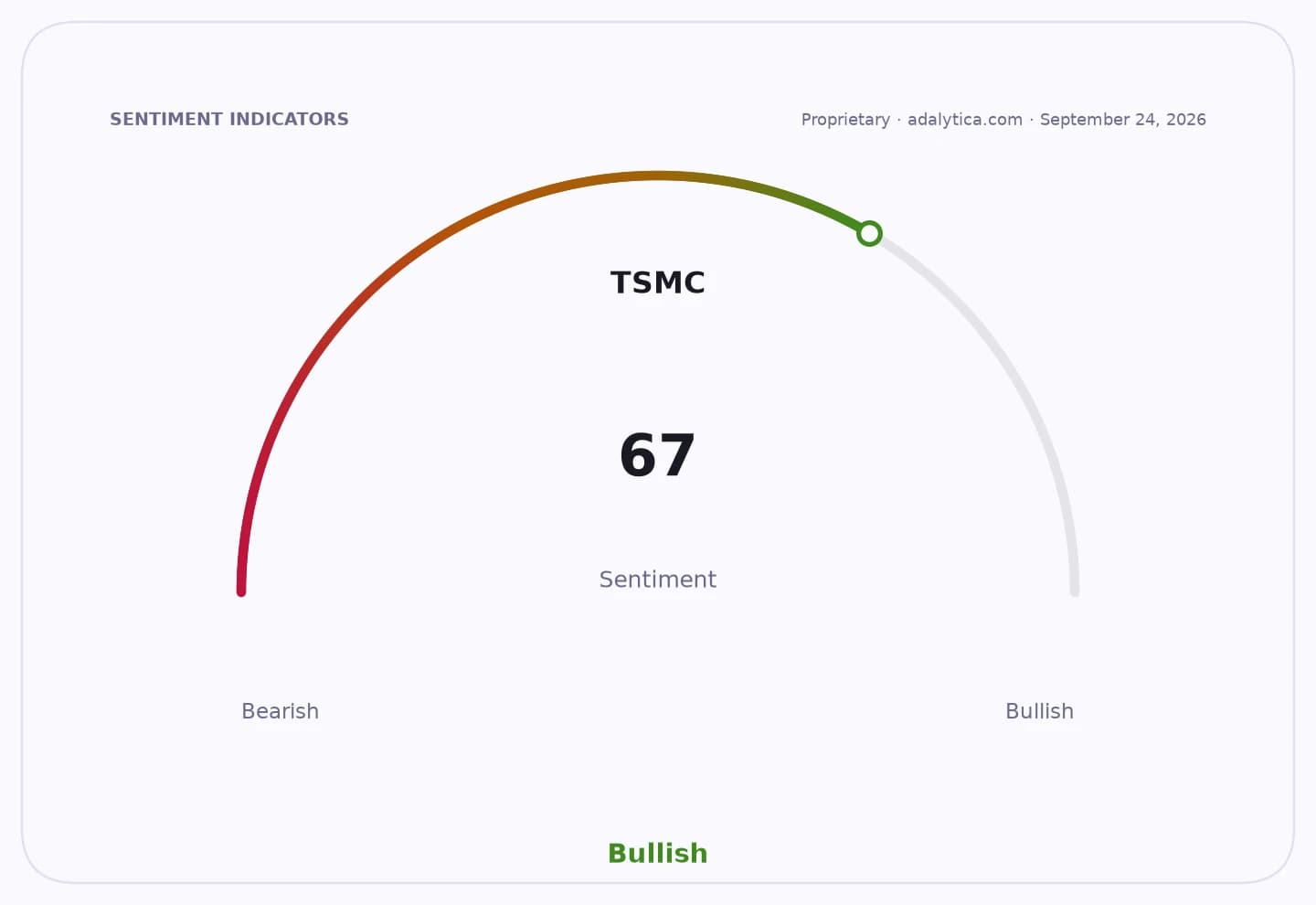
Sentiment IndicatorsⓘProprietary · adalytica.com · September 28, 2026
This is a snapshot — live sentiment, awareness and momentum for 130+ markets update continuously in the dashboard.Open AlphaPulse
Synopsys said the collaboration spans certified EDA flows on A14, agentic AI engineering workflows, multi-die design support, co-packaged optics and expanded 2nm IP. In plain English, the companies are trying to make it easier for customers to design chips that are more powerful, more energy efficient and more tightly integrated — exactly what hyperscalers, data center builders and AI hardware companies need as power and bandwidth demands climb.
The A14 certification is important because it gives customers a clearer path to use Synopsys tools on one of TSMC’s latest process technologies. Synopsys also said it is applying agentic AI to automate analog, digital and multi-die workflows, which could cut design cycle time and reduce the cost of bringing advanced chips to tape-out. For chip designers, that is not a nice-to-have. At the cutting edge, time-to-market is often the difference between owning a generation and missing it.
The partnership also reaches into the packaging technologies that have become central to AI computing. Synopsys said its 3DIC Compiler now supports co-design and simulation of integrated voltage regulators on TSMC’s CoWoS technology, while the two companies are extending co-packaged optics work on TSMC-COUPE. Those efforts matter because the biggest AI systems are increasingly constrained by power delivery, heat and interconnect bandwidth, not just raw transistor performance.
That is why the emphasis on 2nm IP, PCIe 7.0, HBM4, LPDDR6 and 224G Ethernet PHYs matters. These are the building blocks that let chips move data faster and manage energy more efficiently. The company also said it demonstrated UCIe-A silicon on a TSMC N3P test chip and has completed 64G UCIe IP tape-outs on 2nm and 3nm nodes, which speaks to how quickly chiplet-based architectures are moving from concept to commercial reality.
For Synopsys, the strategic appeal is clear: as semiconductor designs become more complex, its software and IP become harder to replace. That creates a durable moat if customers keep relying on its tools across the full design flow, from implementation to signoff and advanced packaging. For TSMC, the relationship strengthens its role as the manufacturing platform around which the AI industry organizes itself.
The stock market already understands part of that story. Synopsys shares have been volatile, but the company’s latest technical readings show the stock near the 50-day moving average and well below the 200-day moving average, suggesting investors are still waiting for proof that growth in advanced design wins can translate into more consistent earnings momentum. TSMC’s shares, by contrast, remain above both of those levels, reflecting continued confidence in its central role in AI infrastructure. Nvidia, meanwhile, remains the demand bellwether for the whole ecosystem, and its business still depends on a supply chain that can deliver faster interconnects, advanced packaging and enough power efficiency to scale.
The bigger takeaway for long-term investors is that AI infrastructure is entering a more sophisticated phase. The easy gains from simply adding more accelerators are giving way to a systems race involving chiplets, optics, memory bandwidth and power management. That tends to benefit the companies with the deepest engineering relationships and the most embedded tools.
If you own Synopsys or TSMC, this is the kind of collaboration that can compound over multiple product cycles rather than one quarter. If you are building a long-term AI basket, both names remain worth watching closely.
| Entity | Gains | Losses |
|---|---|---|
| Synopsys | ▲deeper IP demand | ▼slower design cycles |
| TSMC | ▲broader ecosystem lock-in | ▼rivals chasing advanced nodes |
| AI chip customers | ▲faster tape-outs | ▼higher design complexity |
| Legacy tool vendors | ▲fewer competitive openings | ▼share in cutting-edge flows |