Taiwan’s central bank kept its benchmark rate unchanged for a tenth straight quarter, choosing stability even as it lifted its growth and inflation outlooks on the back of a stronger economy and a still-powerful technology cycle.
Taiwan Central Bank Holds Rate for Tenth Quarter

The decision matters because Taiwan is sitting at the center of the global AI supply chain, and policymakers are signaling that the island can absorb higher prices without slamming the brakes on expansion. That balance is important for markets because it keeps financing conditions steady for exporters and chipmakers while also suggesting the central bank sees enough demand strength to tolerate firmer inflation.
Sentiment IndicatorsⓘProprietary · adalytica.com · September 19, 2026
This is a snapshot — live sentiment, awareness and momentum for 130+ markets update continuously in the dashboard.Open AlphaPulse

A freeze in electricity rates is helping ease the near-term price pressure. Taiwan’s Ministry of Economic Affairs approved a hold on power tariffs, deferring a technically warranted 12.83% increase until December, which should keep a lid on household and business costs even as the economy benefits from semiconductor demand.
The policy stance also reflects a more confident view of Taiwan’s macro backdrop. The central bank’s upgraded forecasts come as the island’s currency has strengthened alongside South Korea’s won, driven by surging demand for AI-related chips and the region’s deep exposure to the electronics cycle.
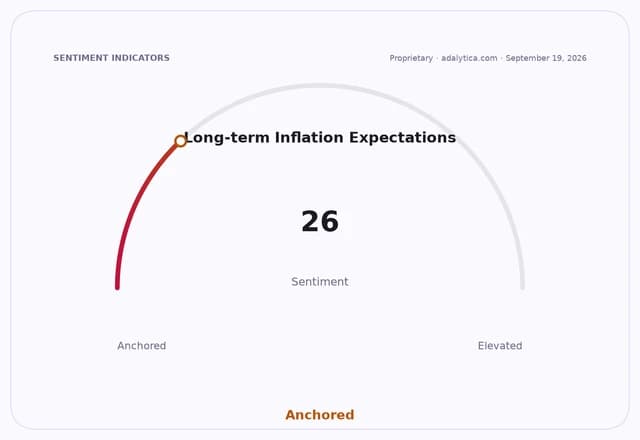
For investors, the message is that Taiwan is not yet in a hurry to tighten policy further, even as inflation risks are being watched closely. That is supportive for local equities and for the semiconductor complex, particularly names tied to advanced chip production and export volumes, while the steady rate backdrop limits immediate pressure on borrowing costs.
The move also feeds into a broader cross-asset trade in which stronger Asian technology currencies and resilient chip demand support risk appetite. U.S. Treasury markets, meanwhile, continue to reflect a market still digesting inflation and growth expectations, with the 10-year yield around 4.94% and the 2-year near 4.67%.
The next catalysts are Taiwan inflation readings, further updates from chip exporters and any shift in global central bank guidance that could alter the path for the New Taiwan dollar.
| Entity | Gains | Losses |
|---|---|---|
| Taiwan exporters | ▲Stable borrowing costs | ▼Higher currency pressure |
| Semiconductor makers | ▲Strong AI demand | ▼Input-cost inflation |
| Consumers/businesses | ▲Frozen electricity rates | ▼Delayed tariff repricing |
| Bond investors | ▲Policy stability | ▼Less chance of near-term cuts |