A sharp reversal in AI-linked technology shares is rippling through global markets, pulling down major indexes and hitting havens and commodities at the same time as investors reassess how much growth, cash flow and central-bank support are really in the price.
Tech Selloff Hits Nasdaq, Gold, and Oil
S&P 500
That combination matters because it is not just a sector rotation. It is a risk-off move broadening beyond the high-multiple names that led this year’s rally and into assets that usually behave differently, suggesting investors are cutting exposure to growth, inflation and geopolitical hedges all at once.
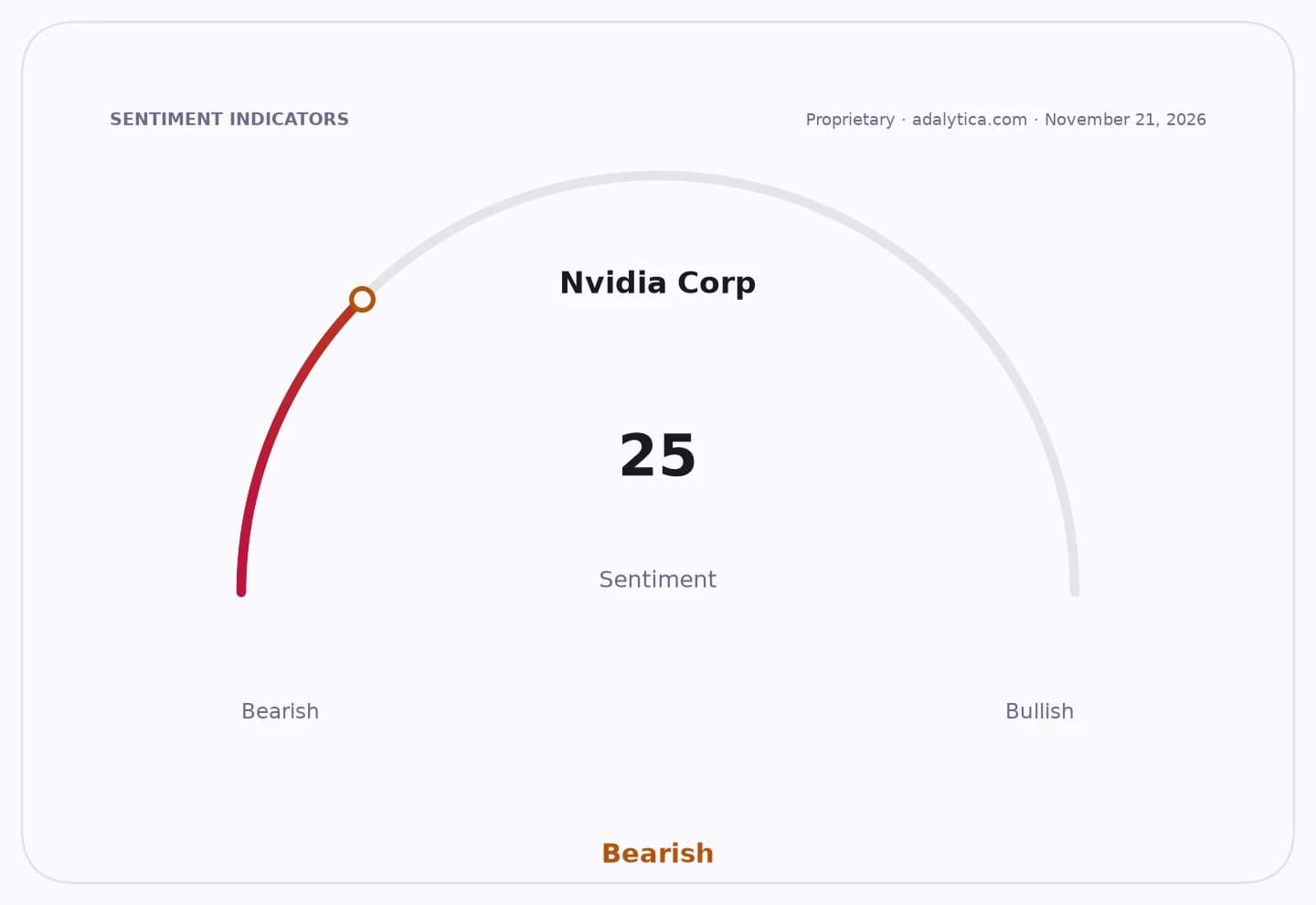
Sentiment Indicators
The Nasdaq and other Wall Street benchmarks were under pressure, while European markets also traded lower. The heaviest selling again centered on technology stocks tied to artificial intelligence, the trade that has dominated equity leadership and become the market’s most crowded bet. QQQ, the Nasdaq 100 ETF, fell to $608.45 on Nov. 20 from $645.04 the day before, with its relative strength index sliding to 31.4, a level that signals the fund has moved deep into oversold territory. Its 50-day moving average sits at $710.88, underscoring how far the sector has already retreated from peak optimism.
The damage was not confined to tech. Gold, often a refuge in turbulent markets, dropped to $322.87 in GLD on Nov. 20 from $335.18 a day earlier and is trading below its 200-day average of $405.83. Oil and wheat also weakened, with Brent crude around $91 a barrel. That matters because it points to a market repricing of both growth expectations and the inflation outlook, not just a narrow unwind in speculative tech names.
The catalyst is a toxic mix of hawkish Federal Reserve expectations and waning confidence in the AI earnings story. U.S. Treasury yields remain elevated, with the 10-year around 5.01%, keeping pressure on duration-sensitive assets such as megacap technology. At the same time, investors are questioning whether the enormous capital spending tied to AI can keep delivering the revenue growth needed to justify stretched valuations.
That is why the selloff is so important for positioning. The market is no longer rewarding simply owning the AI theme; it is starting to demand proof of monetization. That shift can punish the most expensive software, semiconductor and infrastructure names first, but it also creates opportunity in the businesses that sit behind the buildout — power, data centers, networking, utilities, and industrial suppliers that benefit from AI capex without carrying the same valuation risk.
Energy is also entering the frame. XLE, the energy ETF, dropped to $60.51 on Nov. 20 from $60.89 the prior day, but it remains above its 200-day average and far better positioned than the tech complex. That resilience supports the view that investors are moving toward cash-generating, lower-duration assets even as the broader market de-risks. If crude stabilizes after this pullback, integrated producers and select service names could regain favor as portfolios rotate away from high-multiple growth.
Gold’s slide is more telling than many traders may realize. When bullion falls even as stocks wobble, it often means the market is not pricing acute crisis, but rather a forced reduction in crowded macro hedges. That can create a tradable reset, especially if real rates stop climbing. But for now, the message is clear: the easy part of the AI rally is over, and the market is starting to discriminate.
For investors, that creates a two-track opportunity. The first is to avoid or underweight the most crowded AI winners until valuations reset and earnings catch up. The second is to look for the pick-and-shovel beneficiaries of the same spending boom — electrical equipment, grid infrastructure, data-center power, and select semiconductor suppliers with cleaner balance sheets and less narrative risk. If this selloff deepens, those are the names that can outperform when capital eventually comes back to the AI trade.
The bigger takeaway is that markets are moving from enthusiasm to verification. That transition usually hurts the leaders first, but it also sets up the next durable winners for those willing to buy the infrastructure behind the story rather than the story itself.
| Entity | Gains | Losses |
|---|---|---|
| AI infrastructure suppliers | ▲Capex demand | ▼Richly valued AI stocks |
| Energy producers | ▲Relative rotation inflows | ▼Growth-heavy portfolios |
| Cash and short-duration assets | ▲Lower equity risk | ▼Long-duration tech bets |
| Gold holders | ▲Potential rebound later | ▼Near-term haven demand |