Elon Musk’s claim that Russia would have won the war in Ukraine without Starlink is putting the strategic leverage of private space infrastructure back at the center of geopolitics, even as Tesla shares slide sharply on the day.
Tesla Shares Fall as Musk Talks Starlink in Ukraine

The comments matter because they underline how a single commercial network now sits inside the mechanics of modern warfare, from battlefield communications to drone operations, and how much influence one company can wield when governments depend on its system. Musk’s argument also reinforces the degree to which SpaceX, through Starlink, has become embedded in Ukraine’s defense architecture while remaining outside formal military command.
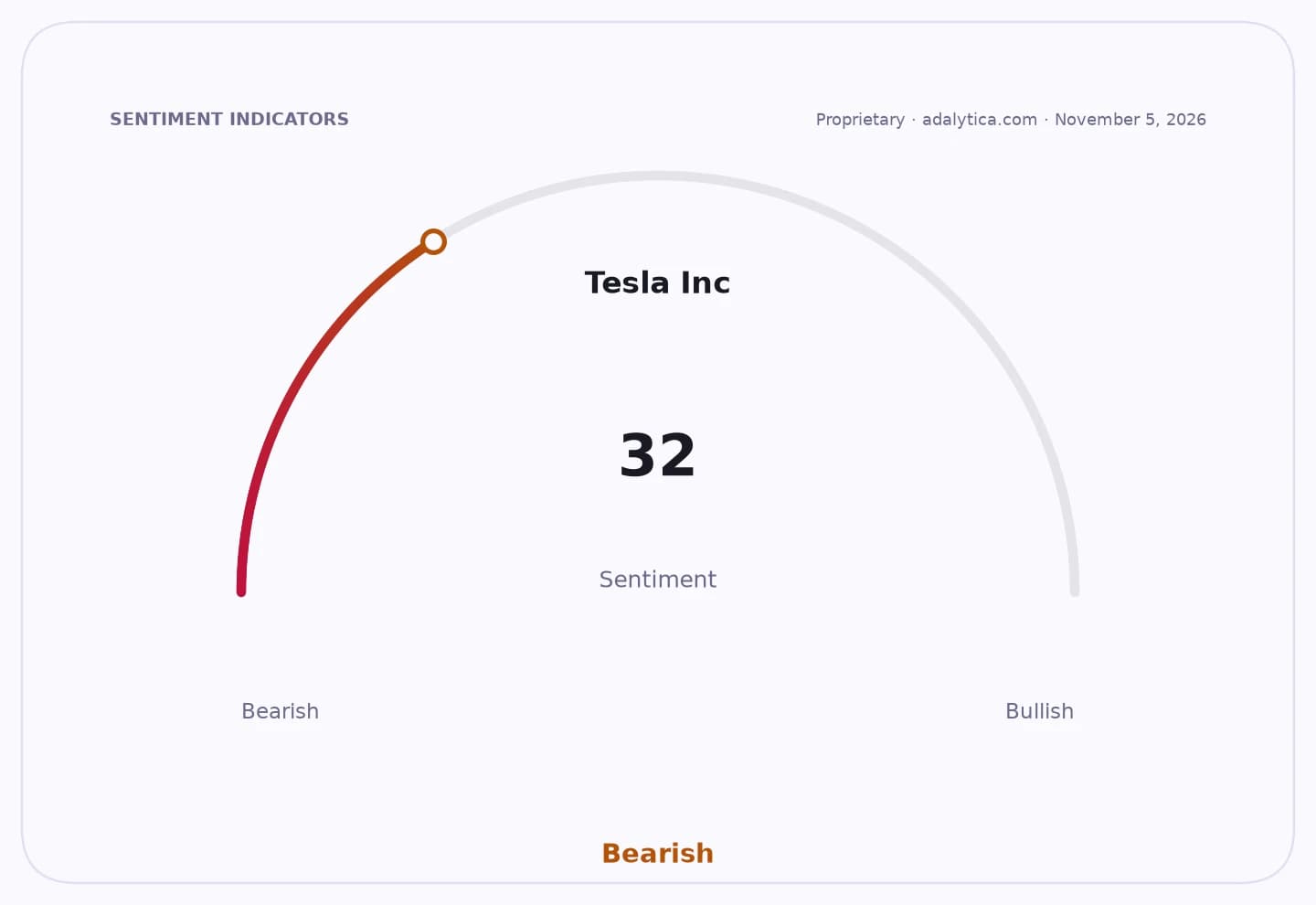
Sentiment Indicators
Musk told CNBC that no private individual had helped Ukraine more than him and said Starlink was the only communications system Russia could not disable after its invasion. He also said shutting it off would “immediately” collapse Ukraine’s front line. That is a dramatic claim, but the bigger market implication is that control over satellite connectivity has become a national-security asset, not just a telecom service.
The remarks arrive amid continuing friction over how Starlink is used on the battlefield. Ukrainian officials have complained about problems using the system for fast-moving drones, and Musk said SpaceX had intervened to stop Ukraine using the civil network for strikes inside Russia. He argued any offensive use should go through Starshield, the government-controlled version of the system. That sharpens the debate over where commercial defense support ends and state oversight begins.
Geopolitical Risk vs TSLAadalytica.com
Explore this data interactively — full history, time series and cross-market comparisons.
For investors, the issue cuts in two directions. On one hand, the comments highlight the strategic value of SpaceX’s satellite business and the moat around low-Earth-orbit communications. On the other, they keep alive the governance and political risk tied to Musk’s companies, particularly when his own public statements can affect perceptions of reliability, neutrality and regulatory scrutiny. Tesla shares fell to $345.82 in the latest session, well below the 50-day moving average of $375.64 and the 200-day average of $381.66, while RSI readings at 33.3 suggest the stock has moved into technically oversold territory.
The broader industry backdrop is one of rising demand for resilient communications as militaries and governments rethink their dependence on vulnerable terrestrial systems. Iridium, another satellite communications operator, has traded around $42.08, above its 200-day average of $41.44 but below its 50-day average of $46.06, while AST SpaceMobile has fallen to $23.27 from much higher levels earlier in the year. The selloff in those names reflects how volatile the market remains around the satellite communications buildout, even as the strategic case strengthens.
The geopolitical framing is just as important. In a world where leaders are increasingly warning about escalation and nuclear risk, Musk’s comments show how private infrastructure can become part of deterrence, coercion and battlefield endurance. That makes Starlink less a consumer broadband story than a geopolitical utility with direct implications for warfighting, diplomacy and corporate accountability.
For investors, the near-term question is whether Starlink’s wartime role becomes a lasting valuation support for SpaceX-related assets or a liability that draws tighter government control. For Tesla shareholders, the immediate issue is more straightforward: Musk’s geopolitical interventions continue to dominate the narrative around the stock, adding headline risk at a time when the technical picture is already fragile.
| Entity | Gains | Losses |
|---|---|---|
| SpaceX / Starlink | ▲Strategic relevance | ▼Political scrutiny |
| Ukraine | ▲Battlefield communications | ▼Dependence on Musk |
| Russia | ▲None | ▼Opponent resilience |
| Tesla shareholders | ▲None | ▼Headline risk |