Thailand’s push to open a regulated route for Bitcoin and Ether exchange-traded funds may not translate into a rush of money, with CoinShares saying the first products are more likely to attract tens of millions of dollars than the billions seen in larger markets.
Thailand Bitcoin Ether ETFs May See Modest Inflows
That matters because Bangkok is trying to channel crypto demand into a supervised local market, but the economics of the launch suggest the addressable pool may be narrower than policymakers hope. If early inflows are modest, Thailand’s ETF market could become another example of how regulatory approval is only the first step in building a meaningful crypto investment industry.
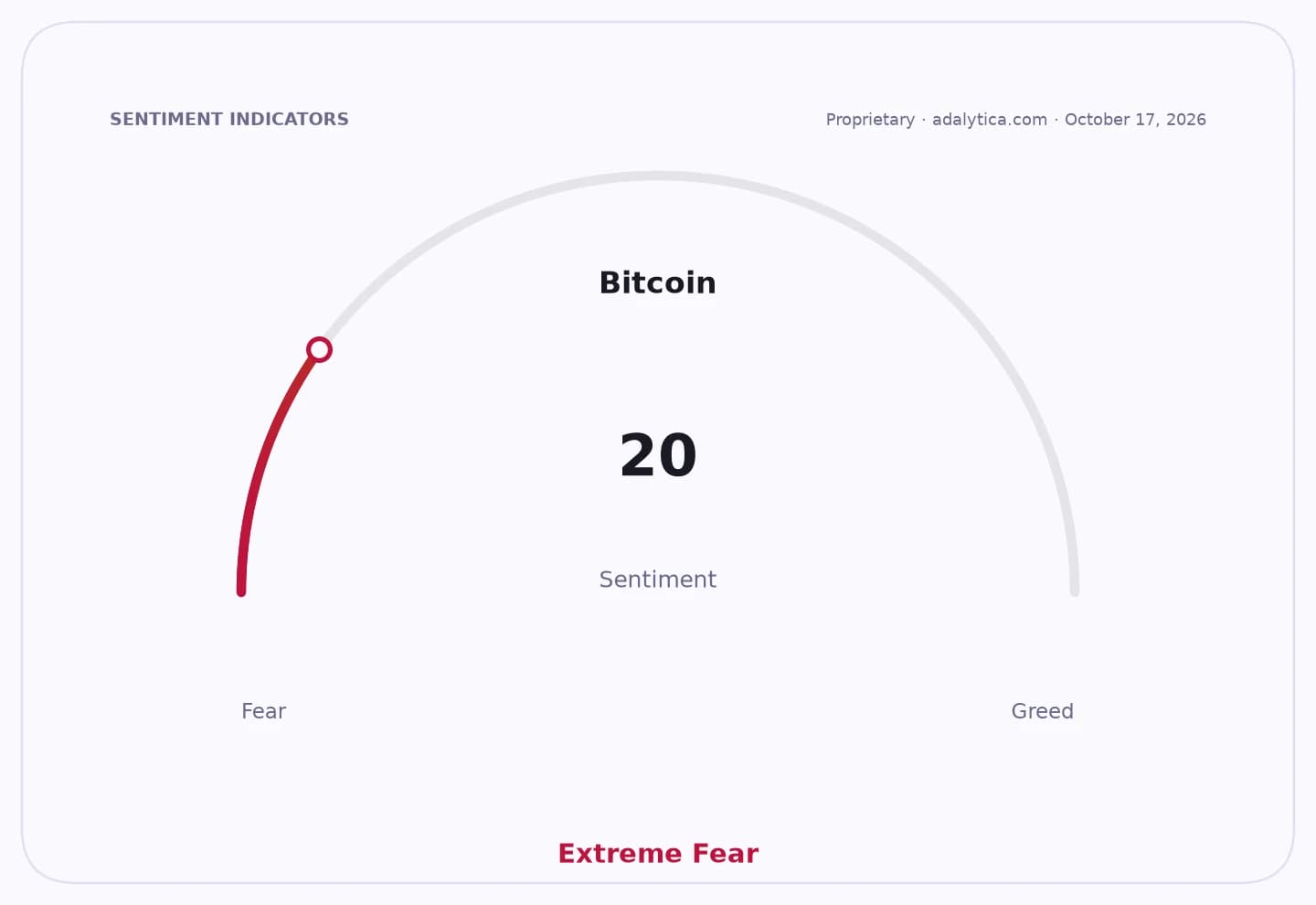
Sentiment IndicatorsⓘProprietary · adalytica.com · October 17, 2026
This is a snapshot — live sentiment, awareness and momentum for 130+ markets update continuously in the dashboard.Open AlphaPulse
James Butterfill, head of research at CoinShares, said he would expect “modest inflows initially,” adding that “tens of millions of US dollars across the first products” was a more realistic starting point than billions. Thailand’s rules allowing Bitcoin and Ether ETFs to list on the Stock Exchange of Thailand take effect on Friday, opening a new domestic channel for retail investors while keeping overseas crypto ETF access through local brokers limited to institutions and ultra-high-net-worth clients.
The structure gives Thai asset managers a potential new product line, but it also highlights the constraints. Some investors already buy Bitcoin through foreign funds or direct trading, which reduces the need for a locally listed wrapper. That is important for issuers because a new ETF has to persuade investors either to switch or to bring fresh money into the market.
CoinShares pointed to Hong Kong as a cautionary comparison. Despite its role as an international financial hub, Hong Kong accounts for just 0.42% of assets in global crypto exchange-traded products, or $733 million out of $172.9 billion in late September, according to CoinShares data. The message for Thailand is clear: market maturity, brand recognition and regulatory access do not automatically produce large ETF flows.
For investors, the near-term significance is less about Thailand becoming a major source of global crypto demand and more about whether local issuers can prove there is enough retail appetite to justify product launches. MFC Asset Management already offers a Bitcoin ETF Tracker Fund that invests in BlackRock’s iShares Bitcoin Trust, while ONE Asset Management has approval for a Bitcoin ETF-linked fund. But the first locally listed crypto ETFs still need regulatory approval, custody and distribution arrangements before trading can begin.
That leaves the launch timeline and take-up uncertain. CoinShares has not confirmed whether MFC or ONE plans to bring products to market, and Thailand’s securities regulator has yet to clarify the pace of approvals. For now, the country’s new rules expand access in principle, but the early economics suggest the first wave of money may be limited.
| Entity | Gains | Losses |
|---|---|---|
| Thai asset managers | ▲New product revenue | ▼Limited early flows |
| Retail Thai investors | ▲Local regulated access | ▼Fewer product choices |
| Global crypto ETF issuers | ▲Potential regional model | ▼Slower expansion story |
| Existing offshore/spot crypto channels | ▲Retain demand | ▼Face competition from ETFs |