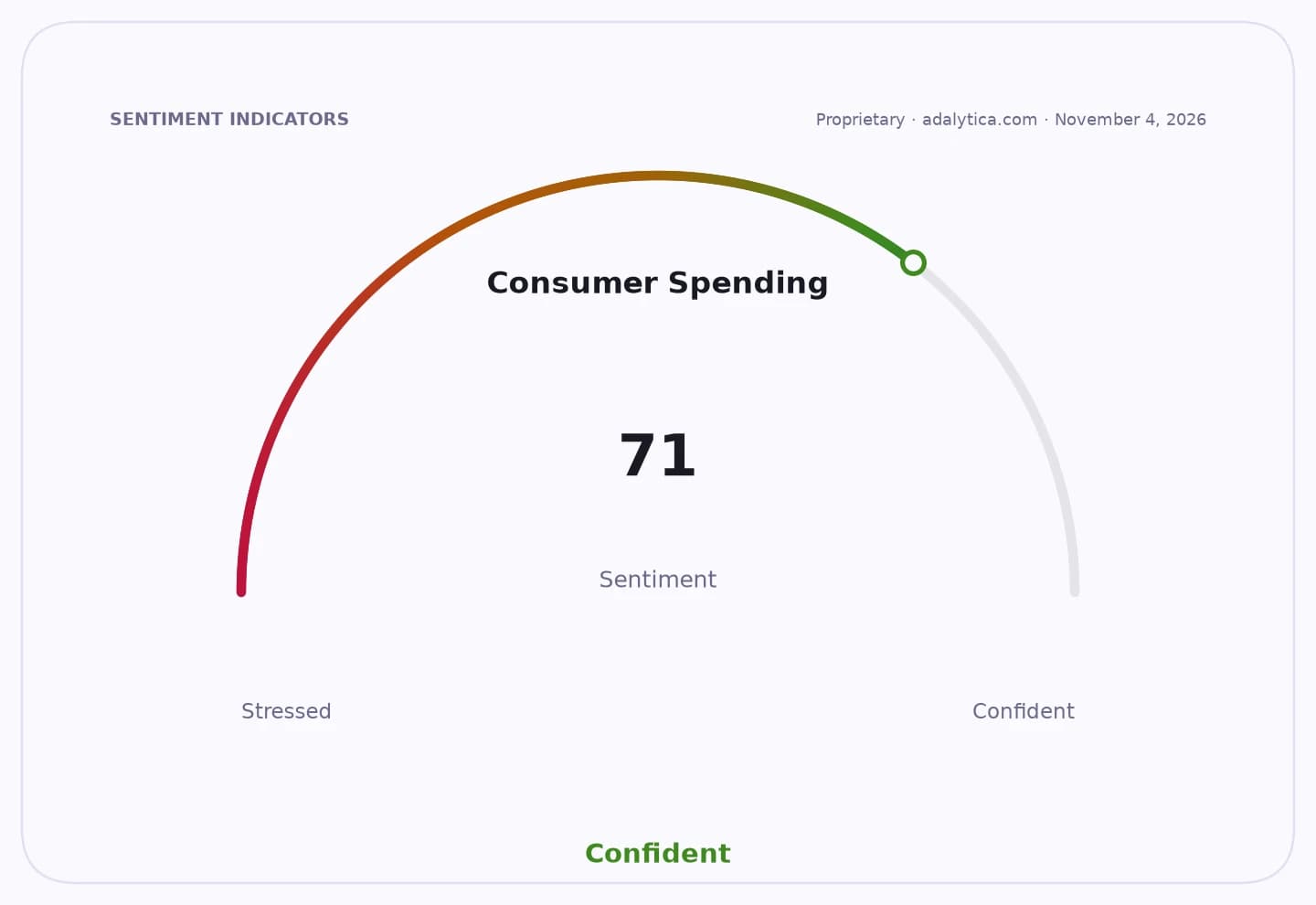
Thailand’s central bank is sounding the alarm on a fragile labour market just as household spending is already losing steam, a combination that could leave the economy leaning too heavily on exports, investment and temporary stimulus.
Thailand central bank flags weaker jobs and spending
Consumer Confidence
The Bank of Thailand said unemployment has risen to 1.1% from a recent low of 0.8%, while the number of insured workers registering for jobless benefits has been trending higher. That may sound modest by global standards, but in an economy where private consumption is still the main engine of domestic demand, even a small deterioration in employment conditions can quickly hit spending, debt repayment and confidence.
Sentiment Indicators
Consumer Confidence
That matters because Thailand is now facing a demand problem, not just a growth problem. The central bank has lowered its forecast for private consumption growth in 2026 to 2.3% from 2.6%, and said that without government stimulus, consumer spending would expand only 1.6% this year. It also expects consumption to slow further to 1.7% in 2027 as the current co-payment scheme expires, underscoring how dependent the recovery has become on short-lived fiscal support rather than a real rebound in household purchasing power.
The policy backdrop is stark. The government’s “Thais Help Thais Plus” scheme has already generated about 162 billion baht in cumulative spending, with the first phase estimated to have lifted GDP by 0.4 percentage points and the second phase adding another 0.1 point. But the central bank is effectively warning that this is a bridge, not a fix. Once the program fades, weak job creation and high household leverage may reassert themselves.
That is the key investment implication: Thailand’s domestic-demand trade remains defensive, while its export and investment beneficiaries look comparatively better positioned. Household debt-to-GDP has eased to 85.2% from 86.7%, but it is still high enough to restrain discretionary spending, especially if labour conditions soften further. In that environment, retailers, banks exposed to consumer credit and sectors reliant on mass-market spending face a tougher earnings backdrop than the headline growth numbers suggest.
For investors, the market is missing the second-order effect. A weaker labour market is not just a social indicator; it is a transmission channel for slower consumption, tighter credit demand and more fragile corporate revenue growth. If unemployment keeps edging up, the Bank of Thailand may be forced to stay accommodative longer, but easier rates alone will not repair balance sheets or restore spending power.
The most attractive positioning remains in businesses tied to public investment, exports and industrial upgrading, while the consumer recovery thesis looks increasingly dependent on policy support that is already fading. Thailand’s next leg higher will not come from a stimulus coupon alone — it will come when jobs, wages and debt service all improve at once.
| Entity | Gains | Losses |
|---|---|---|
| Exporters | ▲Better demand support | ▼Stronger baht risk if policy eases |
| Domestic consumers | ▲Temporary co-payment relief | ▼Slower income growth |
| Thai retailers | ▲Short-term stimulus lift | ▼Weak underlying spending |
| Consumer lenders | ▲Lower rates help borrowers | ▼Rising credit stress |