The real story in this market is not the Dow’s three-day slide — it is the bond market forcing investors to reassess how long high rates, expensive energy and tighter financial conditions can persist.
Treasury yields rise as stocks weaken
Treasury yields pushed to levels not seen in years, with the 10-year note jumping to 5.223%, its highest since June 2007, while the 30-year climbed to 5.501%, the strongest since 2004. That move matters far beyond bonds: the 10-year is the benchmark for mortgages, corporate borrowing and equity valuation models, so every basis point higher tightens the screws on consumers and companies alike.
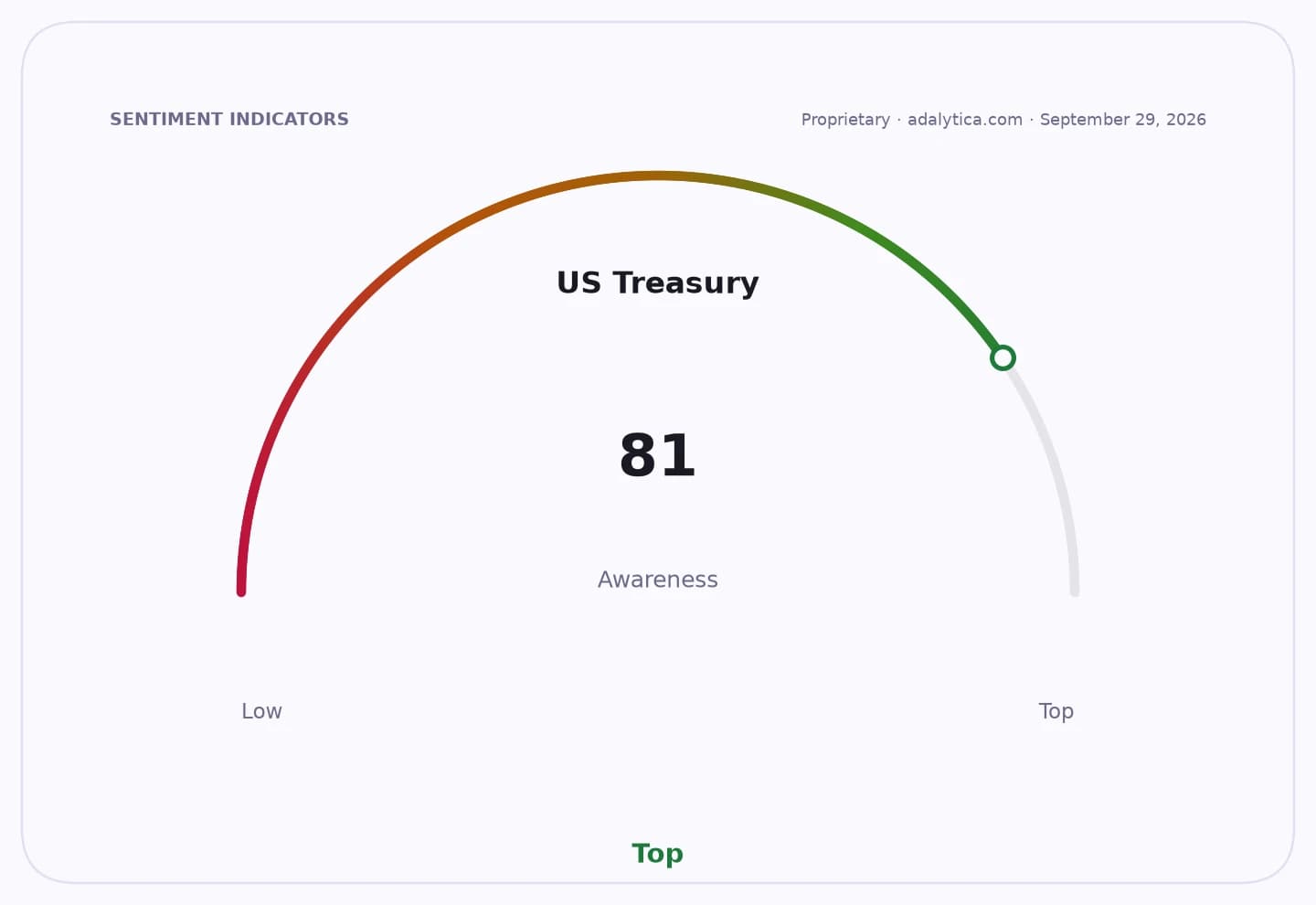
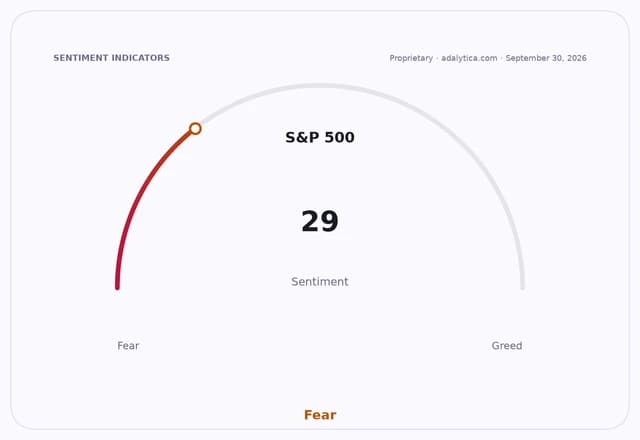
Sentiment IndicatorsⓘProprietary · adalytica.com · September 30, 2026
This is a snapshot — live sentiment, awareness and momentum for 130+ markets update continuously in the dashboard.Open AlphaPulse
At the same time, Brent crude rose more than 3% to finish above $106 a barrel and WTI settled at $94.61, keeping the inflation narrative alive just as investors were starting to hope for a cleaner disinflation path. When oil and yields rise together, the Fed gets less room to pause, and stocks lose one of the biggest supports for multiples.
That is why the market response has been so telling. The Dow fell 162 points, or 0.31%, while the S&P 500 barely moved and the Nasdaq inched higher, a sign that the leadership remains narrow even as the broader tape weakens. Adalytica’s S&P 500 trade signals are now in “Fear,” and its US Treasury bond signals show “Extreme Greed,” a combination that captures the current asymmetry: investors are crowding into duration protection even as equity sentiment deteriorates.
DGS10 vs FEDFUNDS — macro contextadalytica.com
Explore this data interactively — full history, time series and cross-market comparisons.Open AlphaPulse
The pressure is especially visible in rate-sensitive assets. TLT, the long-duration Treasury ETF, closed at 78.23 after another sharp drop, while the small-cap Russell 2000 proxy IWM sank to 279.01, a reminder that domestic cyclical borrowers are being squeezed first. The Dow-linked DIA also slipped to 512.88 and sits below its 50-day moving average, with the RSI in the high 30s and MACD still negative, a technical picture that reinforces the fundamental message from yields: momentum is breaking down, not building up.
Yet this is not a collapse story. S&P Global’s latest PMI readings still point to solid US growth, which is exactly why yields are rising. Stronger activity means the Fed can stay restrictive longer, even with the CME FedWatch tool showing traders now pricing nearly a 71% chance of another rate hike in October, up from about 55% a week earlier. The market is being forced to trade the “good news is bad news” paradox in real time.
For investors, the implication is clear: the winners are no longer the companies that depend on cheap money, but the businesses that can either pass through inflation or profit directly from volatility and capital-markets activity. That is why firms like Oracle can still get punished on project delays even in an AI-driven capex boom — higher rates raise the hurdle rate for every data center, every buyback and every leveraged balance sheet.
My view is that the market is underestimating how durable this rate shock can be. If the 10-year Treasury holds above 5%, the next leg of the trade is likely to favor cash-rich quality, energy, defense, insurers and select financials over long-duration growth and small caps. The Dow’s three-session decline is not the headline; it is the first visible crack in an equity market that is learning, again, that yields drive valuation.
| Entity | Gains | Losses |
|---|---|---|
| Treasury bond bears | ▲Higher yields, stronger carry | ▼Price losses |
| Banks and brokers | ▲More rate volatility, trading activity | ▼Credit stress risk |
| Energy producers | ▲Higher crude prices | ▼Demand destruction fears |
| Small caps and long-duration equities | ▲— | ▼Higher financing costs, multiple compression |