Trump’s approval is now underwater in eight of the nine states where prominent Republicans have begun breaking with him, a warning sign that could reshape the 2026 midterm map and the way GOP candidates talk about everything from Iran to grocery prices.
Trump Approval Underwater in Key Swing States
That matters because the states in question are not political backwaters. They include battlegrounds such as Michigan, Pennsylvania and Wisconsin, along with Republican-leaning states like Florida, Iowa, Kentucky and Ohio, where candidates still need Trump voters but cannot afford to alienate independents and cost-conscious households.
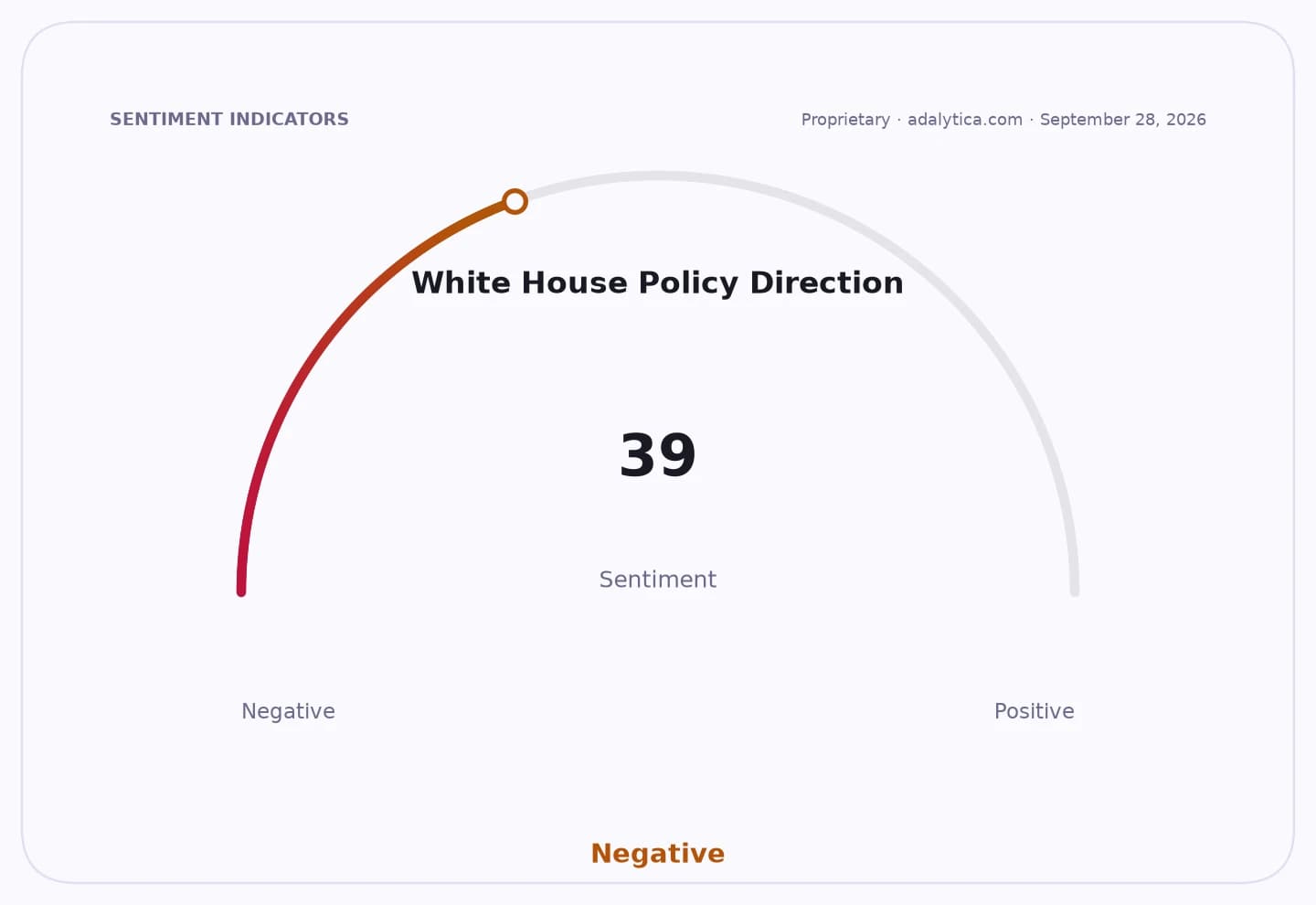
Sentiment IndicatorsⓘProprietary · adalytica.com · September 28, 2026
This is a snapshot — live sentiment, awareness and momentum for 130+ markets update continuously in the dashboard.Open AlphaPulse
The pattern is blunt. In Maine, Trump is 31% approved and 63% disapproved. He is 36% to 58% underwater in Michigan and 36% to 57% in Pennsylvania. Iowa stands at 35% to 55%, Wisconsin at 39% to 56%, Ohio at 38% to 54%, Florida at 40% to 55% and Kentucky at 40% to 50%. Utah is the lone exception, with approval at 46% and disapproval at 45%.
Nationally, the president’s approval sits at 35% versus 59% disapproval in Civiqs’ rolling tracker, which puts his net approval at minus 24 points. More importantly for investors and political watchers alike, the trend has deteriorated sharply since the start of Trump’s second term: Kentucky has swung from net plus 23 to minus 10, Iowa from plus 6 to minus 20, Ohio from plus 8 to minus 16 and Florida from plus 9 to minus 15.
Why should markets care? Because approval is not just a vanity metric in a presidential year — it is a proxy for political capital, and political capital shapes policy durability. The more Trump’s standing weakens in swing states, the harder it becomes for Republican candidates to campaign purely on loyalty. That opens the door to sharper distance on issues that affect consumer spending, energy prices, agriculture, tariffs and war powers.
The clearest rupture has come over the Iran war. Republicans in the House and Senate have backed efforts to curb presidential war powers or force congressional authorization, reflecting unease not just with foreign policy but with the domestic price tag attached to it. Several candidates have tied their objections directly to gasoline and checkout-line inflation, a reminder that voters still respond first to household economics.
That is the key investing takeaway: when politicians start framing national-security disputes around fuel costs, they are telling you what the electorate is likely to punish. Gasoline, diesel and import prices are the transmission mechanism from Washington to Main Street. If Republican candidates in Michigan, Ohio, Iowa and Wisconsin feel compelled to criticize the administration’s policies on those grounds, it suggests cost-of-living pressure remains powerful enough to override party discipline.
The break with Trump is not limited to foreign policy. In Florida, gubernatorial candidate Byron Donalds has pared back Trump references on his campaign homepage. In the same state, Representative María Elvira Salazar has criticized the administration’s immigration crackdown. In Utah, Senator John Curtis has sought scrutiny of business dealings involving Donald Trump Jr. These are not full-scale rebellions, but they are evidence that Republican politicians increasingly see selective distance as a better electoral strategy than blanket allegiance.
For investors, that could matter through the policy mix. A politically weakened president facing nervous Republicans may have less room to push aggressive tariffs, immigration crackdowns or open-ended military commitments if they begin to damage consumer sentiment or inflation expectations. Conversely, if Trump feels pressure to reassert control, policy volatility could rise. Either way, businesses exposed to trade, energy and defense should expect a noisier backdrop.
There is also a broader warning in the polling: the White House can cite the 2024 election and argue the mandate remains intact, but approval ratings are a real-time measure of whether that mandate still has traction in marginal states. Civiqs shows Trump has gone from positive net approval in 24 states on Jan. 20, 2025, to just 11 states now. That is not a random drift; it is a narrowing of political room.
| Entity | Gains | Losses |
|---|---|---|
| GOP candidates in swing states | ▲Electoral flexibility | ▼Loyalty to Trump base |
| Consumers/voters focused on costs | ▲More cost-focused messaging | ▼Less policy clarity |
| Energy and import-sensitive sectors | ▲Possible pressure relief if tariffs ease | ▼Volatility from policy fights |
| Trump and White House agenda | ▲Short-term turnout leverage | ▼Political capital in key states |