Donald Trump’s second impeachment has triggered a fight that goes beyond his presidency: whether the Senate can still try him after he leaves office and, if so, whether Congress can bar him from ever holding federal office again.
Trump impeachment trial and Senate disqualification

That question matters because the outcome would determine not just Trump’s immediate political future, but the scope of congressional power over a former president accused of inciting an attack on the Capitol. It also carries market relevance because the next phase of the crisis will shape the Biden transition, the odds of further legislative gridlock and the level of policy uncertainty facing investors in Washington-sensitive sectors.
Sentiment IndicatorsⓘProprietary · adalytica.com · September 17, 2026
This is a snapshot — live sentiment, awareness and momentum for 130+ markets update continuously in the dashboard.Open AlphaPulse
The House approved articles of impeachment by 232 votes to 197, with 10 Republicans joining Democrats, making Trump the first U.S. president impeached twice. The resolution accused him of encouraging supporters to storm the Capitol and of posing a continuing threat to national security, democracy and the Constitution if left in power. But the larger constitutional issue now is timing: Senate Majority Leader Mitch McConnell has left open the possibility of a trial, though he said no vote would be held before the chamber reconvenes Jan. 19, a day before Joe Biden is sworn in.
That delay has sharpened a legal dispute with no modern precedent. Some constitutional lawyers argue the Senate loses authority once Trump is no longer president, since impeachment is tied to removal from office. Others say the process can continue because the point is not only removal but disqualification, a separate penalty that would block Trump from future federal office. The only historical analogue cited in the debate is the 1876 Senate trial of former War Secretary William Belknap, who was acquitted after resigning before the House vote, but the Senate still concluded it could judge conduct committed in office.
The practical stakes extend well beyond legal theory. If the Senate convicts Trump, it could vote to disqualify him from future office, an outcome that would reshape the Republican Party’s presidential field and remove a potential 2024 contender from the ballot of possibility. If it declines to proceed or fails to reach the required two-thirds threshold, the House may still try to use Section 3 of the 14th Amendment, which bars anyone who engaged in insurrection from holding office, as a simpler path requiring only majority votes in both chambers.
That alternative is part of why the dispute is so politically explosive. Democrats could, in theory, use a simple majority to block Trump from future office even if the impeachment trial stalls. Republicans, meanwhile, argue that a post-term trial would be unconstitutional and set a dangerous precedent. The Supreme Court is unlikely to intervene, since impeachment trials are generally treated as a political question assigned exclusively to the Senate.
A separate but related issue is whether Trump could try to pardon himself or seek protection from an acting president. Legal scholars remain deeply divided on self-pardon authority, and the Constitution offers no clear test case. Trump has previously claimed he has an “absolute right” to pardon himself, but the move would almost certainly invite fresh litigation and deepen the constitutional fight after he leaves office.
For investors, the immediate market impact is less about the trial itself than about the policy path it could open or close. A Senate conviction or a broader congressional move to bar Trump from office would reduce the odds of a rapid political comeback and may ease some tail risk around future governance shocks. But a prolonged fight, especially one that spills into Biden’s first days, could keep Washington risk elevated and slow efforts to restore legislative normalcy after the riot.
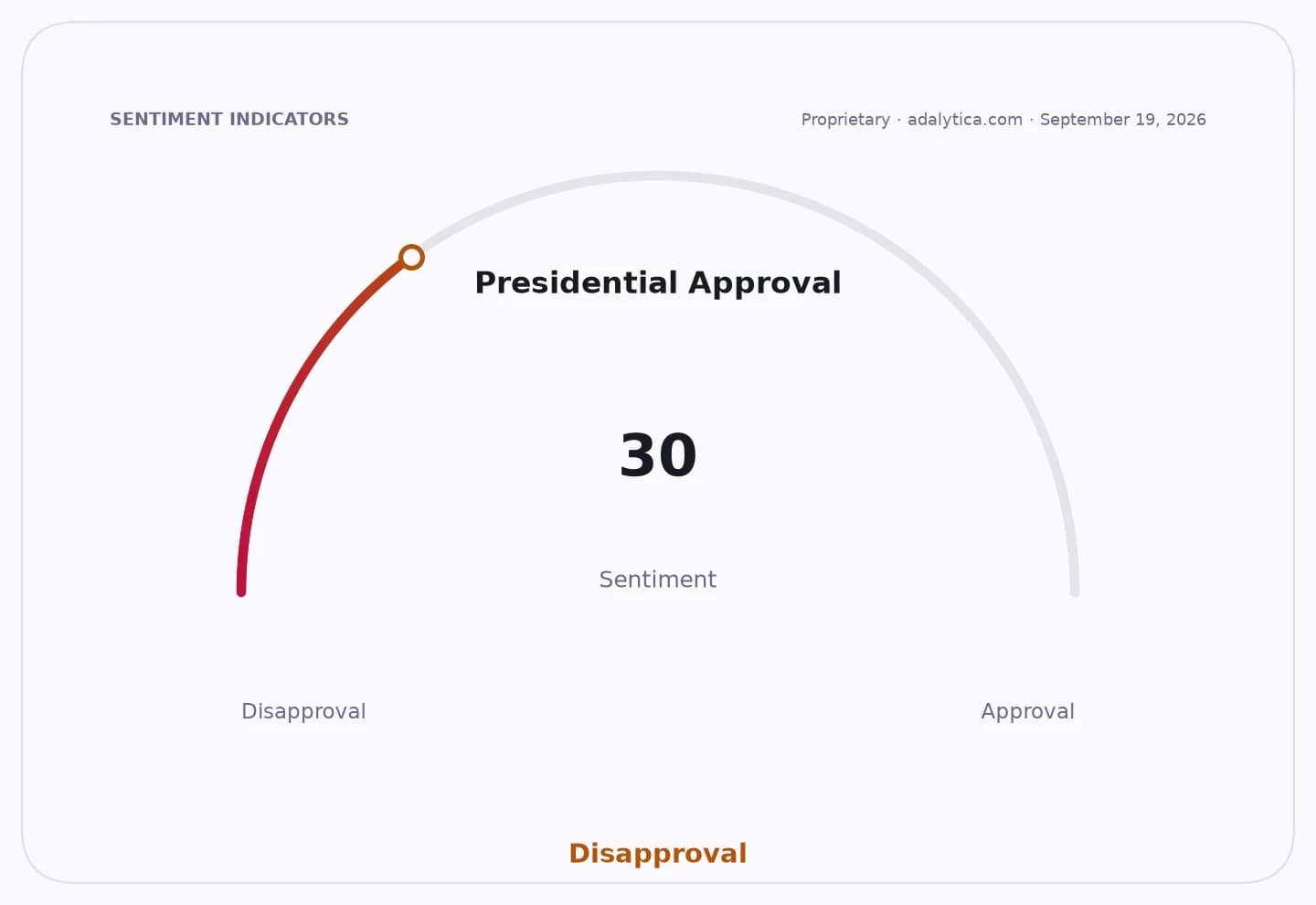
Adalytica’s U.S. presidential approval sentiment gauge is neutral at 33, while its U.S. White House policy direction sentiment jumped to 63 from 22 a day earlier, reflecting heightened expectations that Biden will try to reset the agenda. Broader global stability sentiment remains in fear territory, and the S&P 500 trade signals also sit in fear, underscoring how political uncertainty is still feeding into market caution.
The central issue now is whether the Senate treats Trump’s impeachment as a finished case tied to his term or as a constitutional mechanism that can still end in disqualification. However the chamber answers that question, the ruling will set the template for how far Congress can go in policing presidential conduct after a president leaves office.
| Entity | Gains | Losses |
|---|---|---|
| Democrats | ▲chance to bar Trump from office | ▼risk of backlash if seen as overreaching |
| Trump | ▲delayed immediate punishment | ▼future candidacy and legacy |
| Senate Republicans | ▲procedural leverage | ▼party unity and election positioning |
| Investors | ▲clearer legal endpoint if resolved | ▼prolonged Washington uncertainty |