Twilio is emerging as Wall Street’s preferred way to play AI software over Palantir, with analysts seeing 32% upside for the cloud communications company versus 26% for the data platform specialist over the next 12 months.
Twilio vs Palantir: Wall Street favors TWLO upside

That relative call matters because it flips one of the market’s most crowded AI trades. Palantir has become the market’s emblem of premium-priced AI software, but after a year in which Twilio shares have climbed 46% while Palantir has been flat, investors are increasingly looking for AI beneficiaries with faster earnings leverage and less demanding valuations.
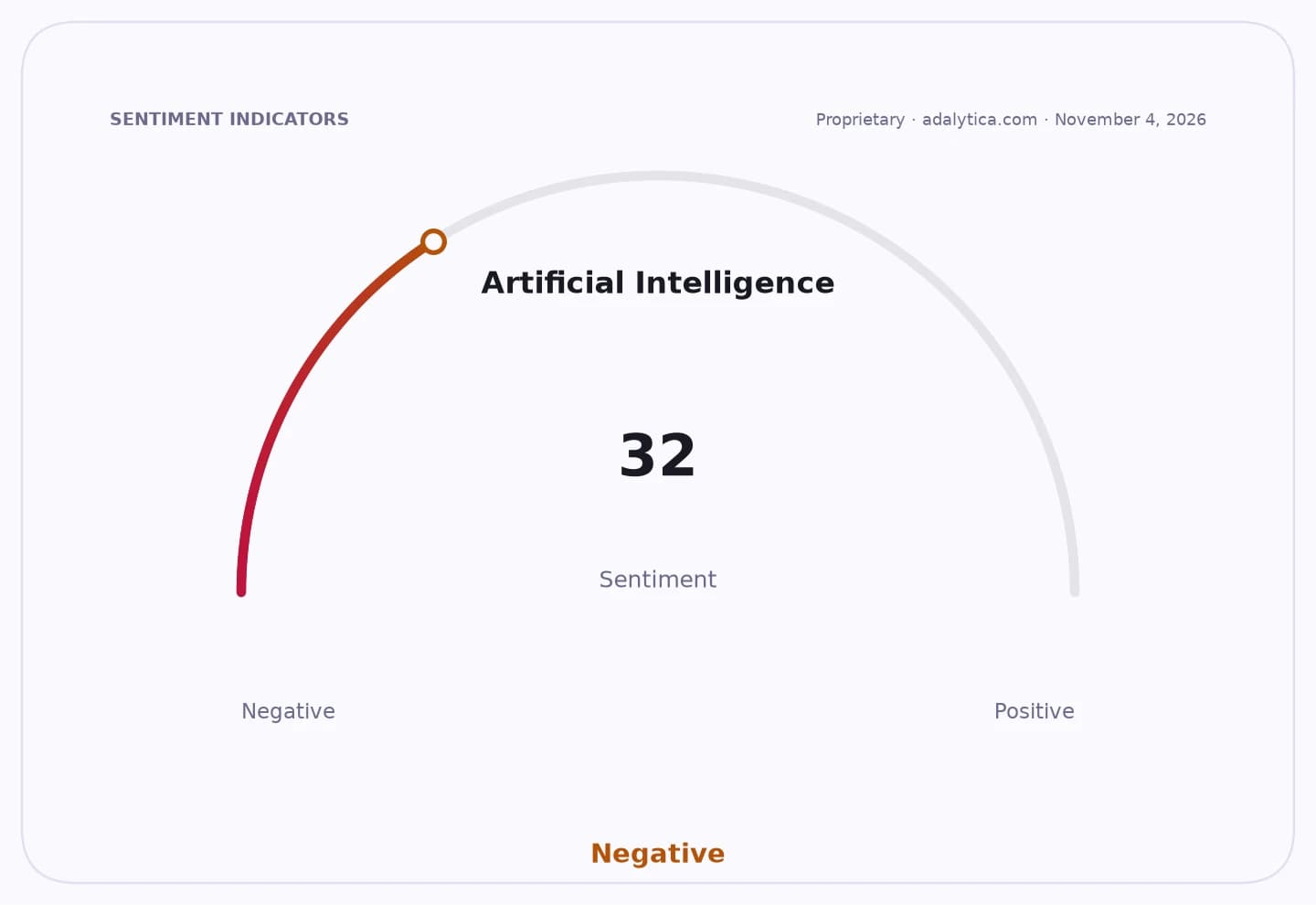
Sentiment Indicators

Twilio’s median price target of $274 stands above its recent share price around $208, while Palantir’s median target of $225 is only modestly ahead of its roughly $176 close on Nov. 3. The bigger message is not just that Twilio has more upside on paper, but that analysts appear more comfortable paying for its growth path at a lower multiple than for Palantir’s already rich valuation.
The case rests on fundamentals, not just momentum. Twilio’s second-quarter revenue rose 20% year over year to $1.56 billion, ahead of Wall Street’s $1.51 billion estimate, while non-GAAP earnings per share increased 32% to $1.65, also topping consensus. Management then lifted its 2026 revenue growth outlook to 20% from 18%-18.5% and guided fourth-quarter revenue to about $1.6 billion, above expectations.

More important for the longer-term debate is customer behavior. Twilio said its dollar-based net expansion rate improved to 114% in the third quarter, a sign that existing clients are spending more, not less, on its platform. For software investors, that metric often matters as much as headline revenue because it indicates whether AI features are deepening wallet share or simply adding one-off sales.
Twilio has been leaning into conversational voice AI and other automation tools that let businesses build and deploy agents across voice, email, text, chat and video. That is a different AI pitch from Palantir’s, but it speaks to the same market thesis: software that can sit inside customer workflows and generate measurable productivity gains can command sustained demand.
Palantir remains the higher-profile name, and its business is still growing much faster in absolute terms, helped by US government contracts and strong demand from commercial clients. But that growth also comes with a higher bar. The stock’s recent weakness, with shares down 3.25% on Nov. 3 and nearly 12% over the latest two sessions in the data provided, suggests the market is not willing to extend the same premium indefinitely.
Twilio’s chart is also giving the stock a technical tailwind, though the latest pullback has cooled the move. Shares closed at $213.50 on Nov. 4, still above the 200-day moving average of $190.14 but well below the 50-day average near $255.88, with RSI readings around 29 indicating the stock is approaching oversold territory after a sharp run. Palantir, by contrast, has slipped below both its 50-day and 200-day averages, with RSI near 29 as well, underscoring how quickly sentiment has reversed across the AI software trade.
The broader backdrop is mixed for the sector. Adalytica’s AI sentiment gauge shows “Extreme Fear,” reflecting how abruptly enthusiasm has cooled after a strong stretch for the trade. Yet the earnings story has not disappeared. AI remains a secular growth market, and companies that can convert it into recurring usage and margin expansion are still being rewarded — just not always at the same valuation.
For investors, the distinction is becoming sharper: Palantir offers the more visible AI narrative, but Twilio may offer the cleaner combination of acceleration, improving customer spend and cheaper valuation. If analysts are right, the market may keep favoring software names that can monetize AI without demanding the richest multiple in the group.
| Entity | Gains | Losses |
|---|---|---|
| Twilio (TWLO) | ▲Higher upside, lower valuation | ▼Still needs sustained execution |
| Palantir (PLTR) | ▲Strong AI brand, premium growth | ▼Rich multiple under pressure |
| Existing Twilio customers | ▲AI tools, better automation | ▼Less room for pricing relief |
| AI software longs | ▲Earnings-backed growth names | ▼Crowded premium valuations |