The UK is moving from consultation to execution on its first digital sovereign bond, appointing the key market participants who will help bring a blockchain-based gilt to market in early 2027.
UK plans first digital sovereign bond for 2027
That matters because the project is no longer a technology pilot or a policy talking point. By naming leaders now, the government is signalling that it intends to test whether tokenised debt can reduce issuance frictions, broaden settlement options and ultimately make the sovereign funding machine more efficient. For investors, the bigger question is whether the UK can create a template that other issuers follow — or whether the bond becomes a symbolic first rather than a scalable one.
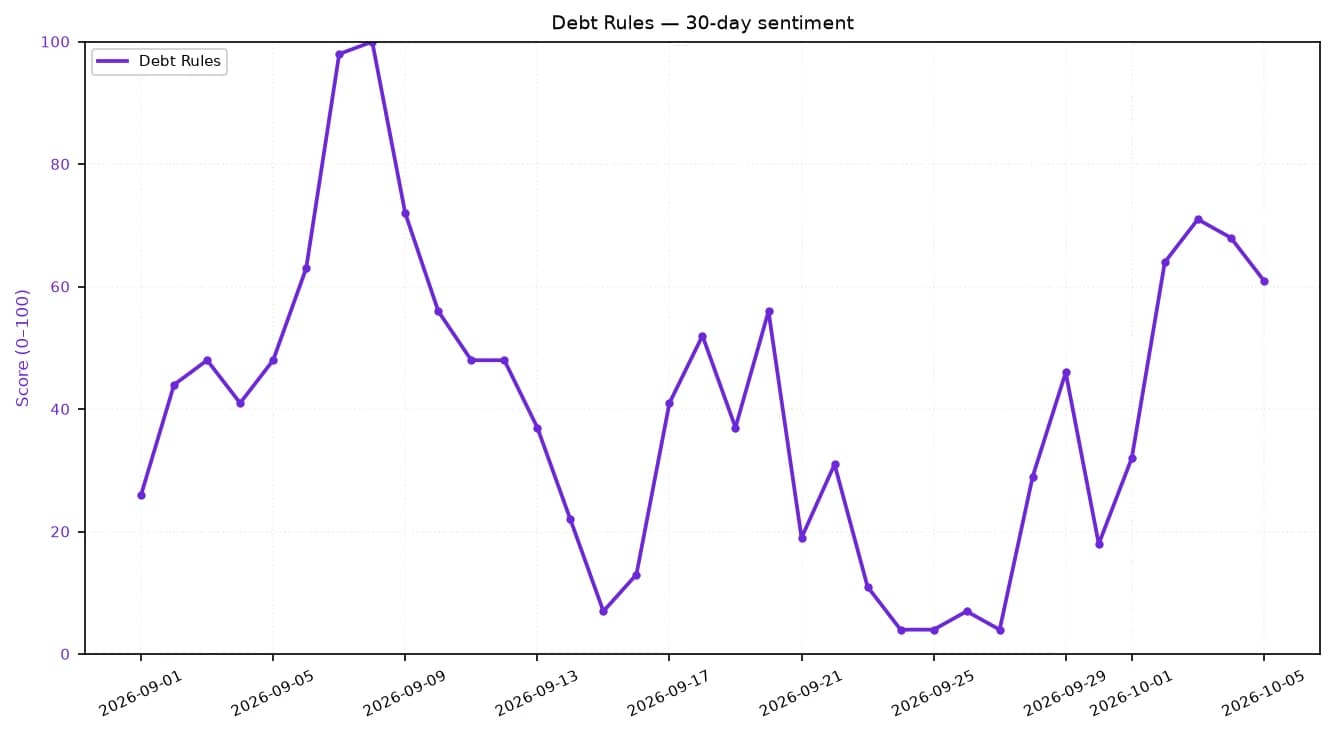
Sentiment IndicatorsⓘProprietary · adalytica.com · October 7, 2026
This is a snapshot — live sentiment, awareness and momentum for 130+ markets update continuously in the dashboard.Open AlphaPulse
The launch comes at a time when sovereign borrowing costs remain elevated by historical standards. The benchmark US 10-year Treasury yield was around 5.3%, while the Federal Reserve’s policy rate sat near 3.7%, underscoring how restrictive global monetary conditions still are even after the tightening cycle peaked. In that environment, governments have a clear incentive to look for ways to lower administrative and operational costs around debt issuance, even if the underlying coupon expense is still driven by market rates rather than technology.
For the UK, the appeal is twofold. First, a digital bond could improve post-trade efficiency by shortening settlement chains and reducing reconciliation costs. Second, it offers a politically visible way to position London and the UK’s debt management office at the front of the race to modernise capital markets infrastructure. That is particularly relevant as governments, central banks and financial institutions increasingly view tokenisation as a practical upgrade path rather than a speculative crypto theme.
Investor reaction has so far been more cautious than euphoric. UK bond proxies have not priced in a breakthrough. GBX, a UK gilt-related tracker, has fallen to 40.09 from 52.28 in January, trading below both its 50-day and 200-day moving averages, with RSI readings near 29, which points to a technically oversold but still weak trend. That suggests the market is more focused on duration risk, fiscal supply and rates volatility than on the long-term promise of digital issuance.
The project also comes against a mixed backdrop for dollar and Treasury sentiment. Adalytica’s US Treasury bond signal remains neutral, while its US dollar reading has softened from earlier strength, reflecting a market that is still adjusting to the path of policy easing and the persistence of higher-for-longer real yields. In that setting, any initiative that can make sovereign funding more transparent or more liquid may draw attention from asset managers, primary dealers and market infrastructure providers.
The bull case is straightforward: if the UK can demonstrate that a digital gilt settles faster, trades more cleanly and attracts new buyer segments, it could become a model for future sovereign issuance. The bear case is just as clear: unless the instrument offers a meaningful economic advantage over conventional gilts, investors may treat it as a niche product with limited secondary-market depth.
For now, the importance lies less in the bond itself than in what the UK is trying to prove. If early 2027 brings a credible launch, it would mark one of the first real tests of whether digital sovereign debt can move from fintech ambition to core market plumbing.
| Entity | Gains | Losses |
|---|---|---|
| UK government | ▲Modernised issuance platform | ▼Legacy market inertia |
| Debt investors | ▲Faster settlement options | ▼Familiar gilt structure |
| Market infrastructure providers | ▲New tokenisation demand | ▼Traditional clearing frictions |
| Conventional debt systems | ▲— | ▼Efficiency gap pressure |