US intelligence and security agencies have accused Chinese artificial intelligence companies of copying American AI models “on an industrial scale,” escalating a technology fight that could reshape competition, regulation and military risk across the sector.
US agencies accuse Chinese AI firms of model copying

The joint warning from the National Security Agency, FBI and Cybersecurity and Infrastructure Security Agency says Chinese firms are systematically extracting protected functions from US models to train their own systems, a practice known as model distillation. Washington says that allows smaller rivals to match leading models without bearing the same development costs, eroding the United States’ technological edge.
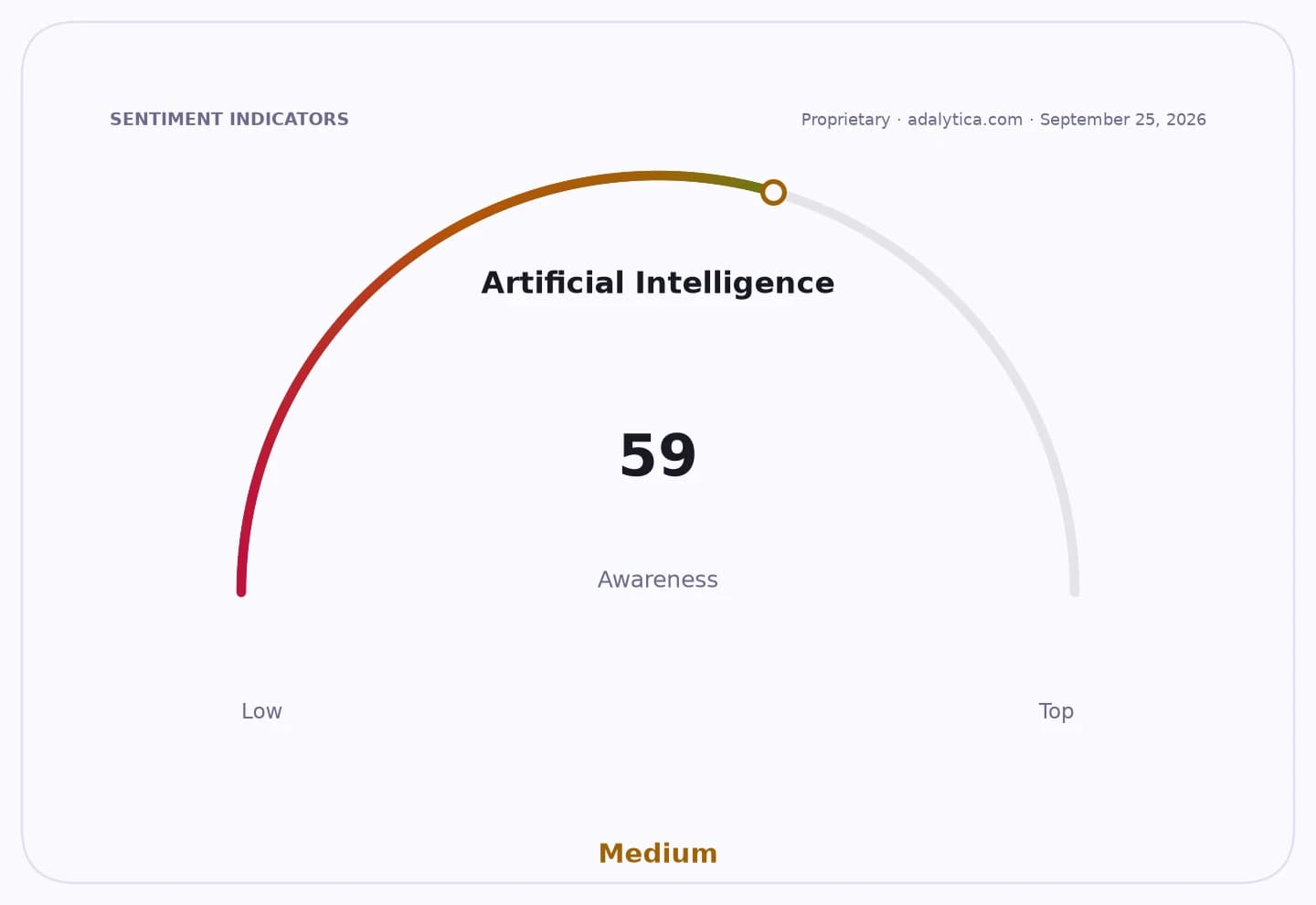
Sentiment IndicatorsⓘProprietary · adalytica.com · September 9, 2026
This is a snapshot — live sentiment, awareness and momentum for 130+ markets update continuously in the dashboard.Open AlphaPulse
The stakes go beyond commercial rivalry. The agencies said faster progress at Chinese AI companies could strengthen military capabilities and cyberattack potential, with possible use against the US and its allies. They urged industry coordination to counter the practice, signaling that AI model security is moving closer to a national security priority rather than a pure intellectual property dispute.
The accusation also lands in a market already focused on who captures the economics of generative AI. Nvidia, the dominant supplier of chips for AI training, has been among the biggest beneficiaries of the buildout, with its shares recently trading at $223.66 after a powerful run earlier this year. Microsoft, another key AI investor and partner to OpenAI, ended at $491.80, while Alibaba, often cited by US rivals in AI copying disputes, closed at $109.57.
The warning follows earlier allegations from OpenAI against DeepSeek and from Anthropic against Alibaba and Moonshot AI, suggesting the dispute is widening beyond a single company. That matters for investors because a successful model-copying playbook could compress returns on frontier AI spending, intensify pressure on valuations and raise the risk of tighter export controls, licensing fights and government scrutiny.
The issue also feeds into a broader security backdrop in which firms are increasingly treating model weights, training data and deployment systems as strategic assets. Anthropic’s decision to withhold its latest model from the UK’s AI Security Institute underscores the same trend: the most advanced AI tools are becoming harder to share, easier to weaponize and more expensive to defend.
For investors, the immediate question is whether Washington turns this warning into policy, enforcement or new restrictions on model access, chips and cloud infrastructure. Any response that raises compliance costs or slows cross-border AI development could hit Chinese platforms hardest while reinforcing the moat around US leaders, but it could also increase friction for the entire AI supply chain.
| Entity | Gains | Losses |
|---|---|---|
| US AI leaders | ▲stronger moat | ▼more scrutiny |
| Chinese AI firms | ▲cheaper model access | ▼US enforcement risk |
| Nvidia | ▲higher security demand | ▼export-control risk |
| Microsoft/OpenAI | ▲competitive protection | ▼IP and licensing pressure |