U.S. business activity picked up in September, with private-sector output reaching a three-month high and pointing to an economy that is still expanding even as higher borrowing costs and a softer labor market keep pressure on demand.
U.S. business activity picks up in September

The latest S&P Global readings suggest growth is firming at the start of the fourth quarter rather than rolling over. That matters for markets because a steadier pace of expansion reduces recession risk, but it also keeps the Federal Reserve in a difficult position: growth is resilient enough to avoid an outright slowdown, yet not so clean that policymakers can ignore inflation pressures or the risk that activity re-accelerates.

S&P Global’s data show U.S. business activity accelerating in September, while broader industrial production is also projected to edge higher, with the September reading forecast at 103.25 from 103.07 in August. Manufacturing remains the weaker part of the economy, but the service side — the larger share of U.S. output — is doing enough to keep overall momentum positive.
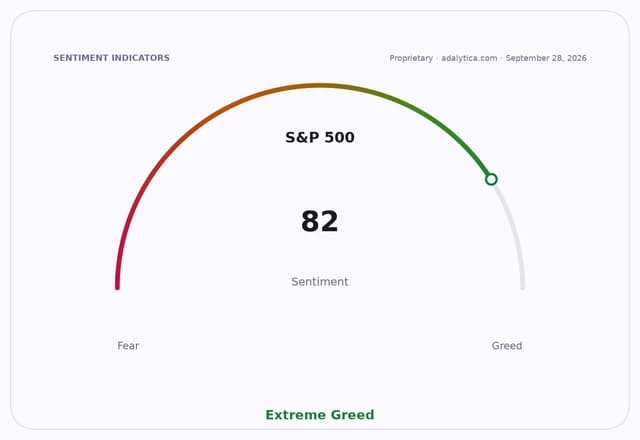
That combination helps explain why equities have held up despite policy uncertainty. The S&P 500, tracked by SPY, has climbed to 771.35, above both its 50-day and 200-day moving averages, while the RSI remains near neutral at 52.5. Industrials, via XLI, have also stayed above the 200-day moving average even after a recent pullback, suggesting investors still see an extension of the expansion trade even as some cyclicals have cooled.
The macro backdrop is less decisive in Treasuries. The 10-year yield has moved to around 5.19%, a level that implies markets still see meaningful rate pressure and no quick return to easy financial conditions. At the same time, unemployment is projected to hold around 4.02% in September, near August’s 4.1%, which supports the view that the labor market is cooling only gradually rather than deteriorating sharply.
For investors, the message is two-sided. Bulls can argue that stronger business activity, stable joblessness and a modest rise in industrial output reduce the odds of a hard landing and support earnings for domestically oriented companies, from transports to capital goods and consumer services. Bears will point out that if growth is improving while inflation remains sticky, the Fed may have less room to ease, keeping discount rates elevated and limiting multiple expansion.
The next test is whether September’s pickup broadens beyond services into manufacturing and whether consumer-facing activity can hold up into year-end. If it does, the market is likely to keep rewarding cyclical exposure; if not, the recent strength could prove to be a late-cycle burst rather than the start of a more durable re-acceleration.
| Entity | Gains | Losses |
|---|---|---|
| U.S. services firms | ▲Stronger demand | ▼Rate-sensitive margins |
| Industrial companies | ▲Better growth outlook | ▼Weak manufacturing orders |
| Equity bulls | ▲Lower recession risk | ▼Higher-for-longer Fed |
| Bond bulls | ▲— | ▼Higher yields, stickier rates |