The U.S. is entering the next decade with a defense budget that is increasingly crowded out by debt service and entitlement spending, raising the risk that Washington will struggle to fund a prolonged war or a major military buildup.
U.S. defense budget faces debt and entitlement pressure

That is the central warning from a Washington Post analysis, which argues that trillion-dollar deficits and a swelling federal debt load are no longer just a fiscal problem but a national security constraint. The issue matters economically because the government’s balance sheet is absorbing more of every tax dollar, leaving less room for surge spending if the U.S. faces a conflict over Taiwan, NATO obligations in Europe, or renewed fighting in the Middle East.
Sentiment IndicatorsⓘProprietary · adalytica.com · September 9, 2026
This is a snapshot — live sentiment, awareness and momentum for 130+ markets update continuously in the dashboard.Open AlphaPulse
The budget math is moving against defense. The Post said defense now accounts for about 13% of federal spending, but the Congressional Budget Office expects that share to fall into the single digits by 2035. By 2032, more than half of all federal outlays are projected to go to Social Security and major health programs, a shift that squeezes discretionary spending just as the Pentagon needs to modernize conventional forces and the nuclear triad at the same time.
That is a problem for investors because U.S. defense contractors depend on a government that can keep rearming, replenishing munitions and funding multi-year platforms even as fiscal politics tighten. Lockheed Martin, Northrop Grumman and RTX all trade against the assumption that national security spending will remain structurally supported, but the market is also pricing in the reality that Washington’s priorities are becoming harder to finance. Lockheed’s shares recently fell back below both the 50-day and 200-day moving averages, while Northrop and RTX have also weakened sharply from recent highs, reflecting concern that funding volatility could hit program timing and order flow.
The pressure is not just abstract. The Post pointed to the cost of personnel, which takes roughly 40 cents of every Pentagon dollar, and to the fact that major modernization programs are already delayed. The U.S. must replace aging bombers, submarines, land-based missiles and other parts of the nuclear arsenal while also adapting to cheaper drone warfare, which can still be expensive at scale. That makes the fiscal squeeze more dangerous: a future conflict would not only require larger budgets, it would likely require faster spending in categories the current budget is least equipped to absorb.
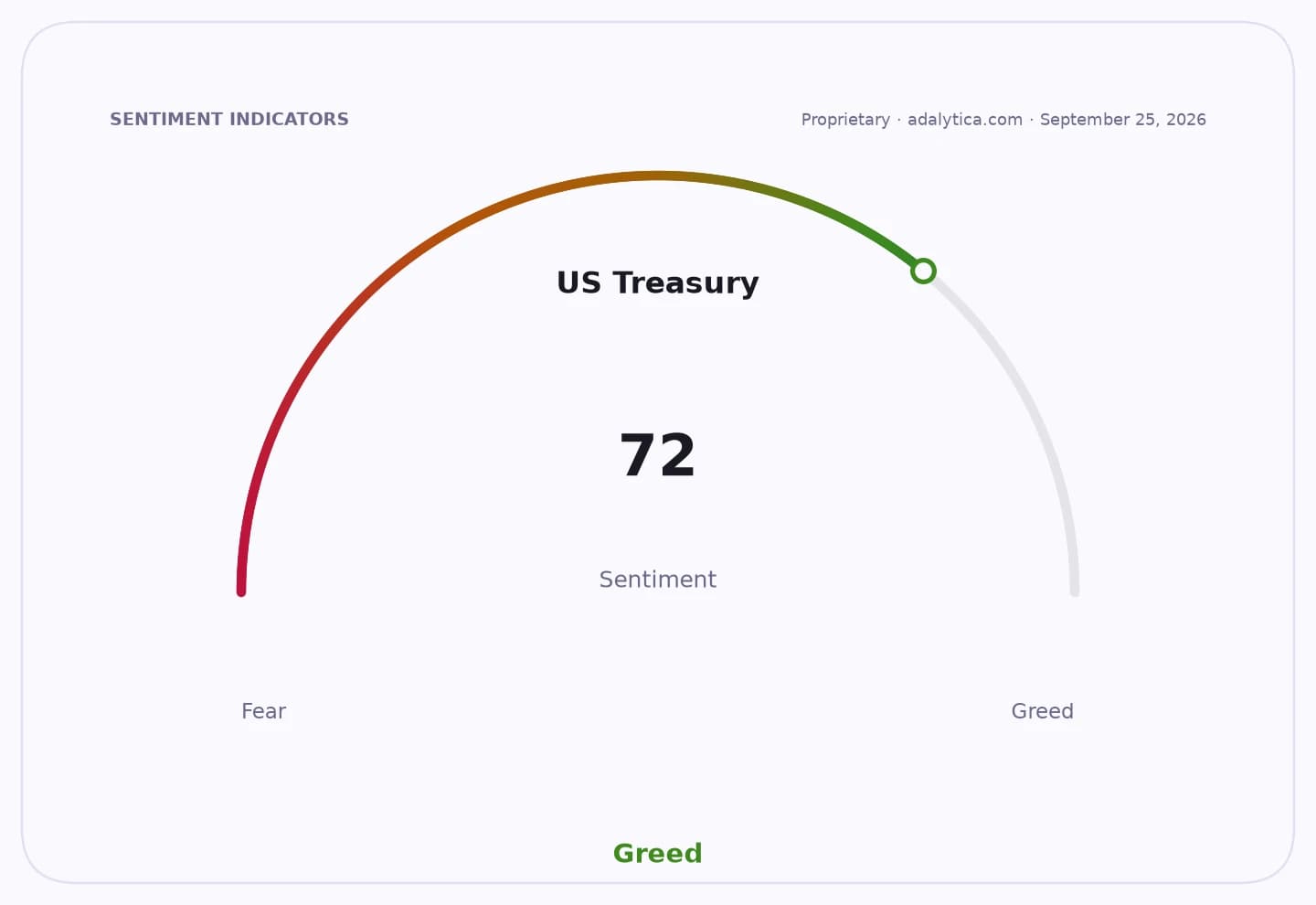
The macro backdrop reinforces that tension. Treasury yields remain elevated, with the 10-year around 4.8%, keeping financing costs high for the government and for defense primes funding capital needs and working capital. Adalytica’s U.S. Treasury bond signal shows “Extreme Greed,” suggesting a strong bid for duration even as fiscal worries persist, a combination that highlights investor demand for safety while also underscoring concern about public borrowing.
For defense stocks, the bull case is that the threat environment is worsening faster than the fiscal constraint, forcing Congress to keep funding missiles, submarines, air defense and replenishment even if it means more borrowing. The bear case is that debt service and entitlements increasingly dominate the federal ledger, turning defense into a slower-growing, more politically constrained line item. The likely outcome is not a collapse in spending, but a more uneven and contested budget environment in which contractors with exposure to modernization, munitions and missile defense may fare better than those reliant on large, long-cycle programs.
The broader narrative is that America’s strategic flexibility is now tied to its fiscal flexibility. If debt continues to rise faster than the government’s capacity to reprioritize spending, the U.S. may still be the world’s strongest military power — but one with less room to absorb the cost of a long war.
| Entity | Gains | Losses |
|---|---|---|
| Social Security and health programs | ▲Protected funding priority | ▼Defense budget share |
| Treasury bond holders | ▲Safe-haven demand | ▼Higher fiscal-stress premiums |
| Missile defense and munitions contractors | ▲Replenishment demand | ▼Long-cycle discretionary programs |
| U.S. defense planners | ▲Urgency for modernization | ▼Budget flexibility |