The US dollar is recovering above its 20-day exponential moving average as investors rotate out of risk assets and into defensive positions ahead of Friday’s US nonfarm payrolls report.
US dollar recovers ahead of payrolls report

The move matters because the dollar is regaining support at a moment when markets are reassessing the durability of the rally in equities tied to artificial intelligence infrastructure. A broader selloff in that segment has lifted demand for haven assets, helping the dollar index stabilize after recent weakness and reinforcing the currency’s role as a refuge when global growth sentiment deteriorates.
Sentiment Indicators
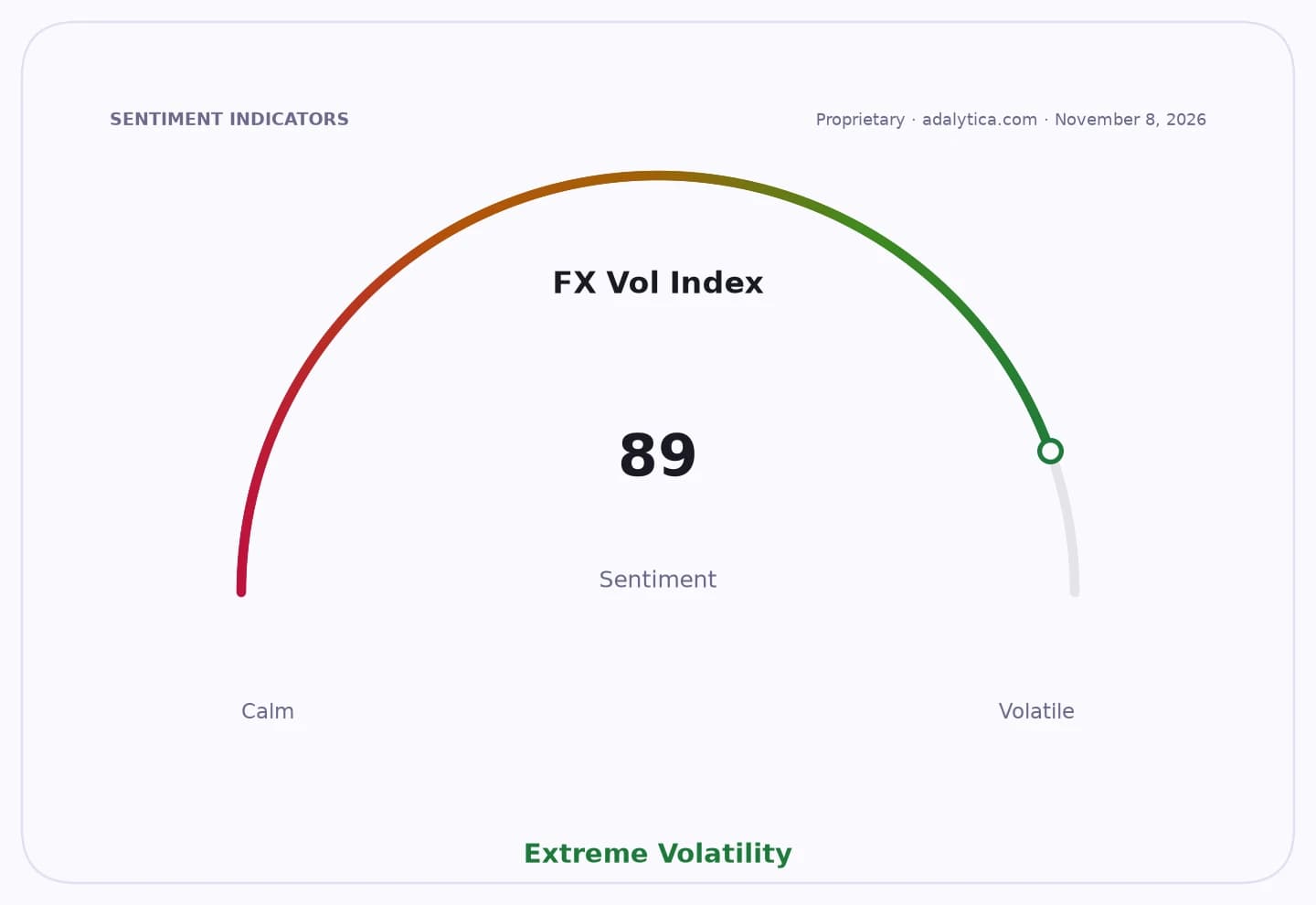
That backdrop is showing up across related markets. The US dollar trade signal tracked by Adalytica.com has surged to 89, flagged as “Extreme Greed,” with a seven-day rise of 73 points. At the same time, FX volatility sentiment remains elevated at 71, while Treasury bond sentiment sits at 91, indicating investors are still buying protection even as they position for a potentially decisive payrolls release.
Technically, the recovery in the dollar index above its 20-day EMA suggests short-term momentum has improved, though the broader trend is not yet unambiguously stronger. The dollar ETF UUP closed at 29.15, above its 50-day moving average of 28.72 and its 200-day average of 27.99, with RSI at 60.2 and a positive MACD reading, conditions that typically point to firm, if not stretched, bullish momentum. The euro ETF FXE finished at 103.02, still below its 50-day average of 104.49 and 200-day average of 106.23, while the yen ETF FXY ended at 57.72, just under its 50-day average of 58.24, underscoring that dollar strength is broad-based rather than confined to one currency pair.
US Dollar — 30-day sentimentadalytica.com
Explore this data interactively — full history, time series and cross-market comparisons.
Investors are now focused on whether payrolls validate the market’s defensive turn. A stronger-than-expected jobs report would likely extend dollar gains by supporting the case for higher-for-longer US rates, especially with the 10-year Treasury yield holding around 4.88%. That would pressure gold, emerging-market currencies and other rate-sensitive assets. A softer print would probably unwind some of the haven bid, ease Treasury yields and give the euro and yen room to recover.
For now, the narrative is straightforward: risk aversion, not growth optimism, is doing the work behind the dollar’s rebound. The next catalyst is the labor market report, which will determine whether the move becomes a durable break higher or just a pre-data positioning squeeze.
| Entity | Gains | Losses |
|---|---|---|
| US dollar | ▲Haven demand | ▼Risk-sensitive currencies |
| Dollar bulls | ▲Short-term momentum | ▼Weak-dollar positions |
| Treasury bonds | ▲Safe-haven inflows | ▼Yield-sensitive assets |
| Euro and yen | ▲— | ▼Relative strength versus USD |