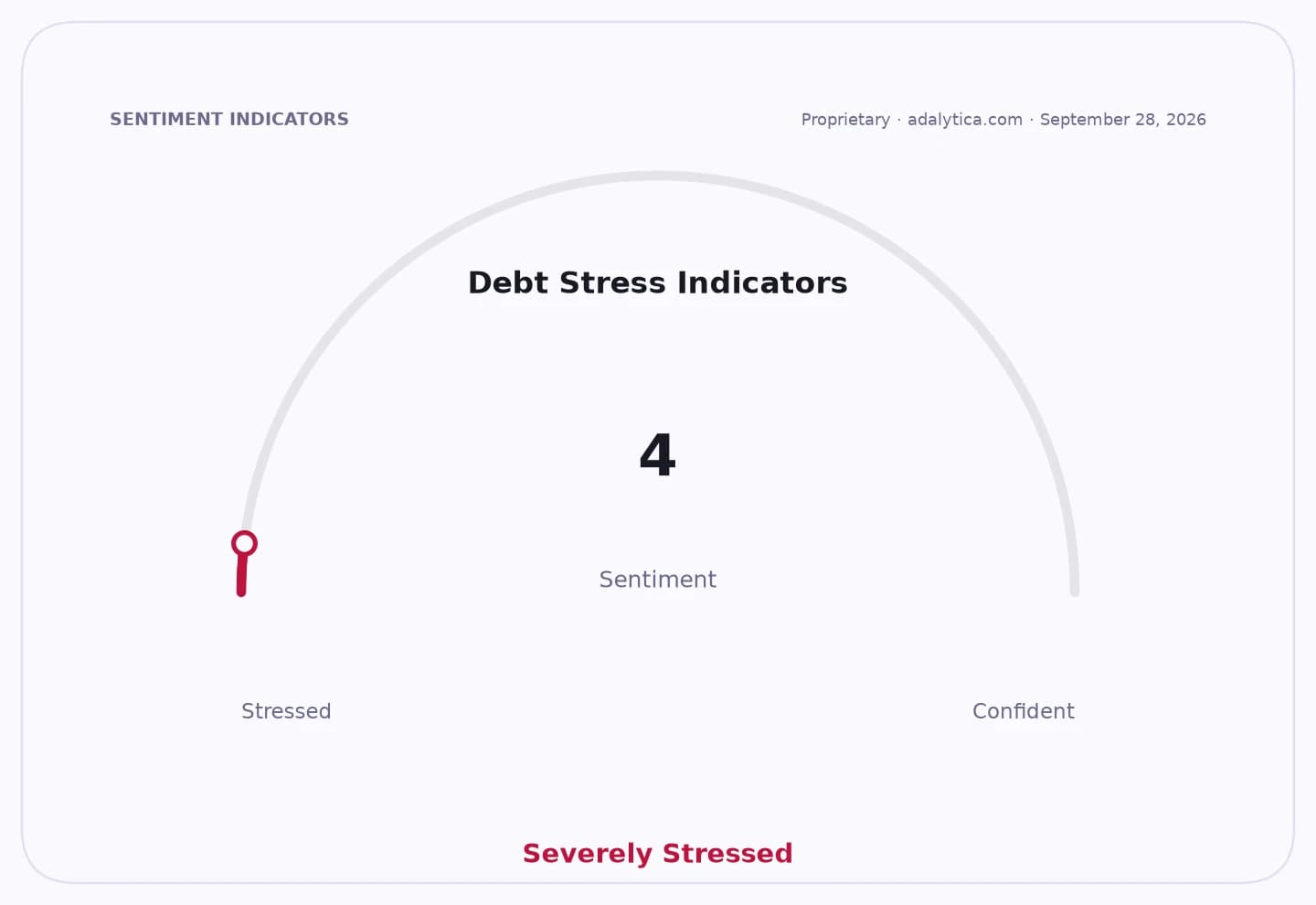
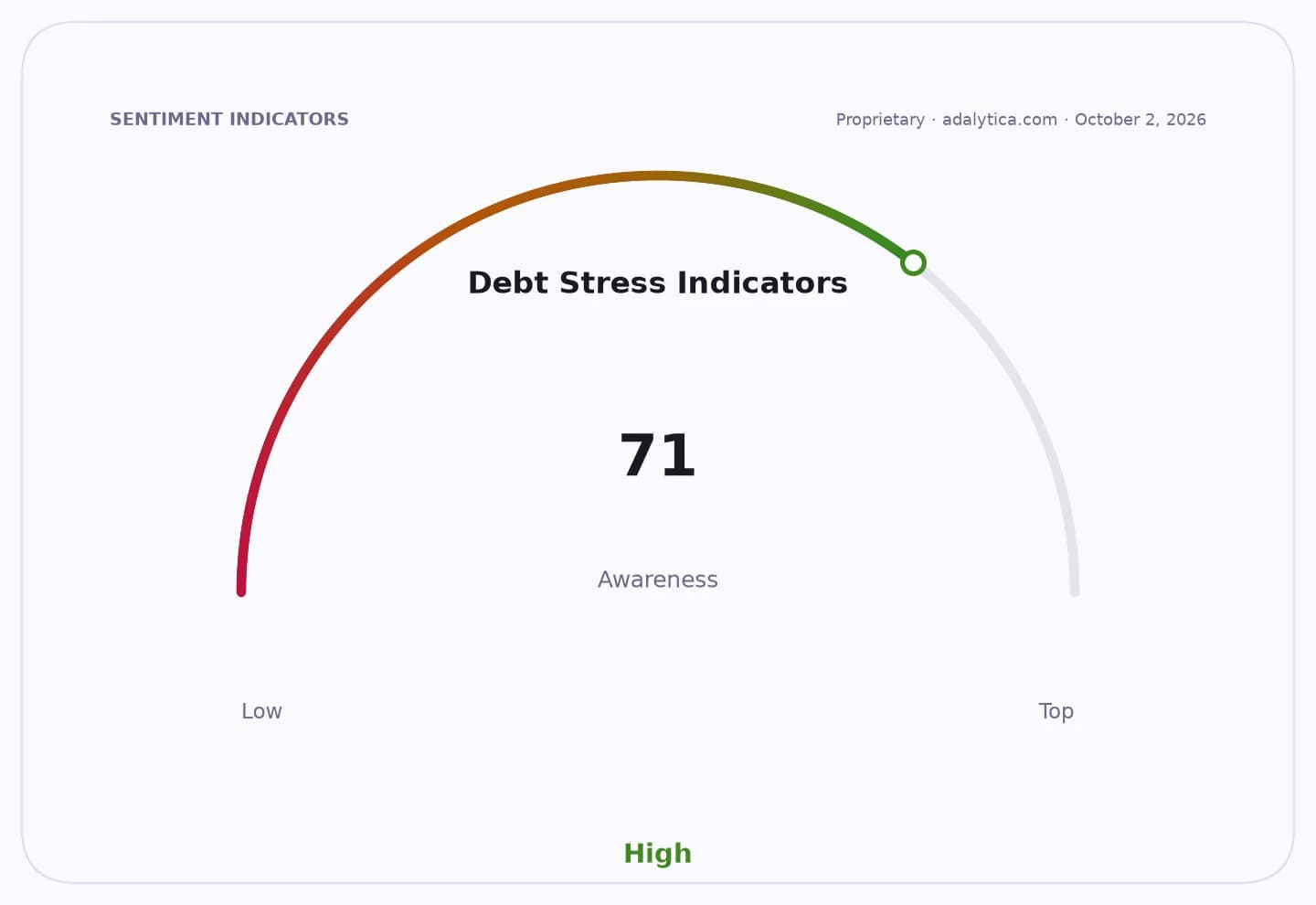
One in five U.S. households is behind on debt payments, the highest share since the Great Recession, and that should be read as a warning that the consumer engine is losing altitude just as inflation and borrowing costs keep squeezing budgets.
U.S. household debt delinquency hits post-GFC high
That matters because household delinquency is not just a social problem; it is an early stress signal for the broader economy. When families fall behind on credit cards, auto loans, mortgages or student debt, the strain eventually shows up in slower consumer spending, tighter bank lending and higher losses for lenders. For a U.S. economy still heavily dependent on consumer demand, that is a real macro risk.
Sentiment IndicatorsⓘProprietary · adalytica.com · October 19, 2026
This is a snapshot — live sentiment, awareness and momentum for 130+ markets update continuously in the dashboard.Open AlphaPulse
The new Federal Reserve survey of 4,367 households lands in an environment where the math has become brutal for lower- and middle-income borrowers. About 61% of people are earning less than $50,000, while Goldman Sachs found 34% of households making $50,000 to $100,000 are living paycheck to paycheck. With essentials such as groceries, insurance, utilities and housing taking a bigger share of income, even a small shock can push a manageable budget into delinquency. That is why the warning from lenders and consumer advocates is less about one missed bill than about a fragile balance sheet breaking under pressure.
Investors should pay close attention to the lenders most exposed to U.S. household credit. Capital One Financial and Synchrony Financial sit near the front line of consumer stress, and their shares have been volatile as markets weigh whether charge-offs are peaking or still climbing. Capital One’s stock has recently traded around its 50-day average after a sharp run-up and pullback, while Synchrony has been fighting its own stretch of weakness. In both cases, the market is already repricing consumer credit risk, but the delinquency data suggests the debate is not over. If late payments continue to rise, earnings power at credit-card and subprime-adjacent lenders could come under more pressure than consensus assumes.
There is also a second-order effect the market may be underestimating: a rise in distressed households usually helps deposit-rich banks and counseling services relative to pure consumer lenders, because better-capitalized institutions can absorb stress and, in some cases, gain share as competitors tighten underwriting. At the same time, higher delinquency can keep pressure on the broader S&P 500, which according to Adalytica’s trade signals has been in “Extreme Fear,” reflecting how quickly risk appetite can reverse when credit quality deteriorates.
For households trying to catch up, the practical playbook is straightforward: call the lender early, ask about payment adjustments or forbearance, and document every agreement. But for investors, the bigger takeaway is more important. The U.S. consumer is not collapsing, but it is getting thinner. That usually favors a barbell strategy: stay cautious on lenders most exposed to revolving credit stress, and look for the beneficiaries of tighter underwriting, collections, and defensive financial positioning as delinquency trends work through the system.
| Entity | Gains | Losses |
|---|---|---|
| Capital One (COF) | ▲Higher servicing leverage if credit stabilizes | ▼Rising delinquencies and charge-offs |
| Synchrony Financial (SYF) | ▲Share gains if weaker rivals retrench | ▼Consumer-credit stress and weaker loan growth |
| Major U.S. banks | ▲Safer funding, defensive positioning | ▼Tighter credit demand in the economy |
| U.S. households | ▲Debt relief tools and forbearance options | ▼Higher late fees, refinancing strain |