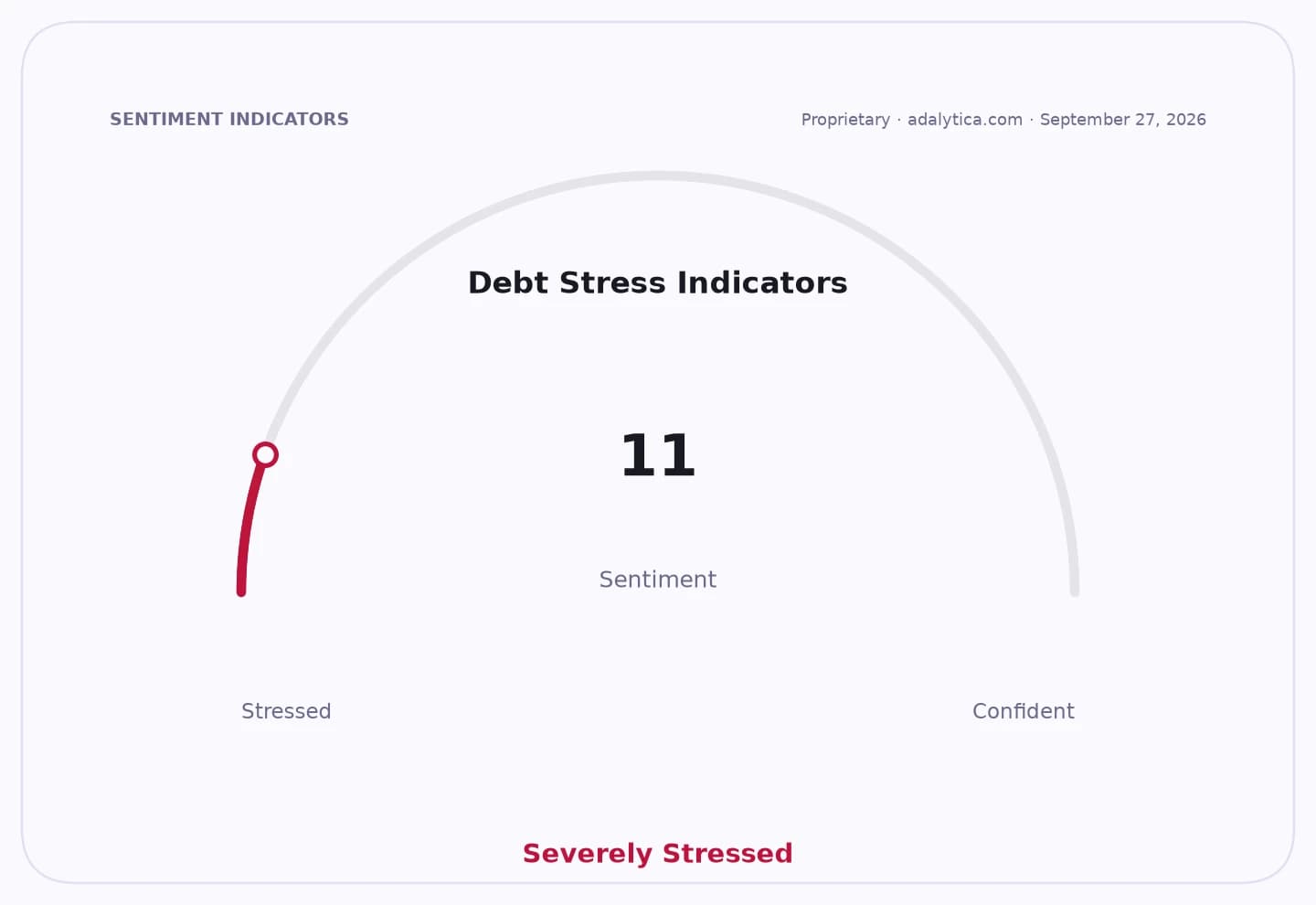
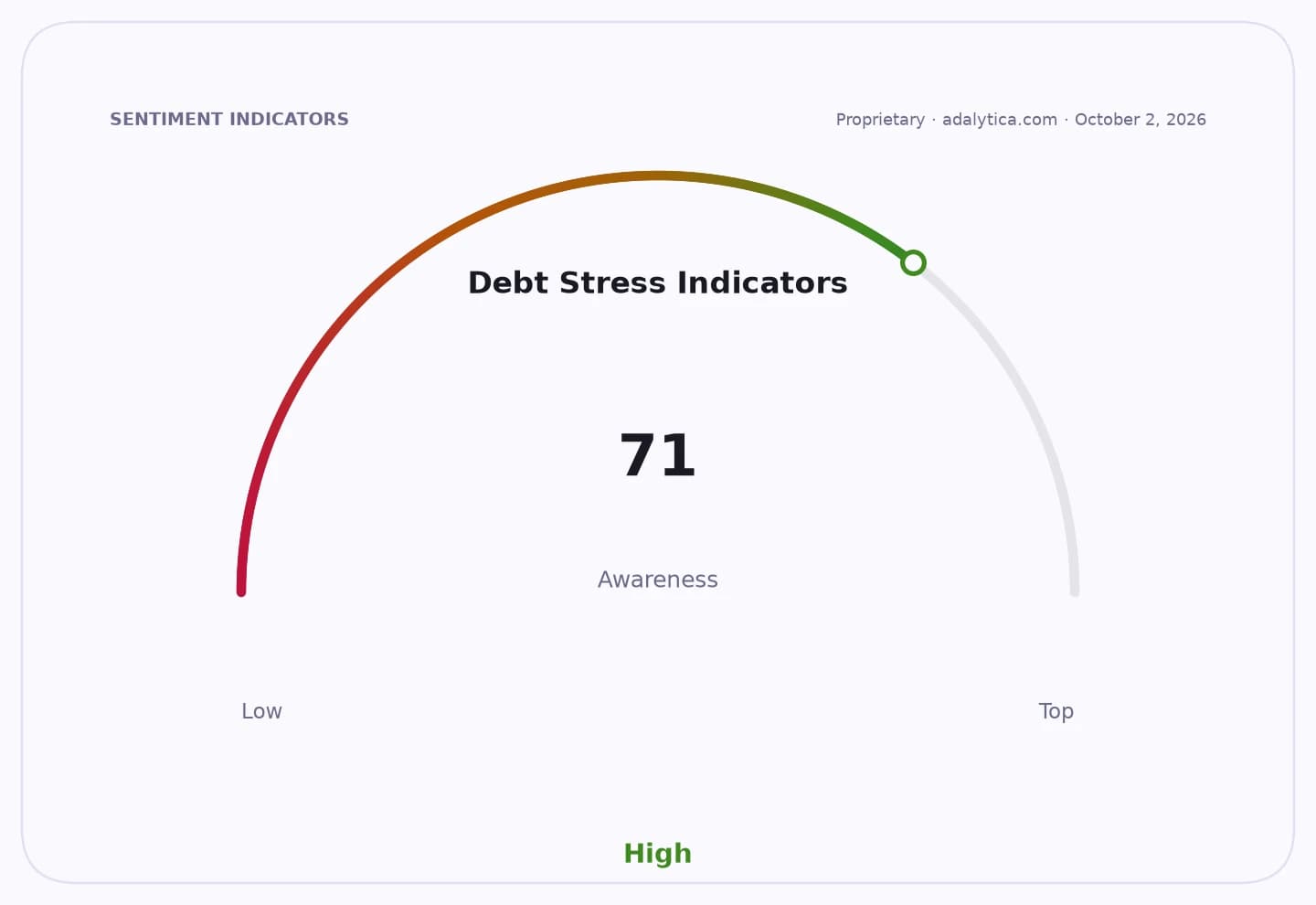
Americans are falling behind on debt payments at a pace not seen since the post-crisis recovery, a sign that years of higher borrowing costs are finally biting into household balance sheets and could slow consumer spending.
US debt delinquencies hit post-crisis highs

For the three-year period ended 2025, nearly 20% of families were behind on loan payments, up from about 12% in the prior survey, according to a Federal Reserve survey released Friday. That is the highest share since 2010, when the economy was still healing from the Great Recession, and it underscores how pressure from credit cards, auto loans and other forms of consumer debt is widening beyond the lowest-income borrowers.
Sentiment IndicatorsⓘProprietary · adalytica.com · October 12, 2026
This is a snapshot — live sentiment, awareness and momentum for 130+ markets update continuously in the dashboard.Open AlphaPulse
The jump matters because the US consumer remains the backbone of the economy. If a larger share of households is missing payments, lenders typically tighten credit, delinquencies can migrate into charge-offs and households pull back on discretionary spending to preserve cash. That creates a second-round drag on growth just as the labor market cools from earlier strength and interest rates remain elevated by historical standards.
The Fed survey points to an economy where nominal income growth has not been enough to offset financing costs for a growing slice of borrowers. That is especially relevant for revolving debt, where interest resets quickly, but also for auto loans and other instalment debt that have become more expensive as households refinance or take on new balances at higher rates. Even borrowers who are still current are likely feeling the squeeze through lower savings rates and more cautious spending.
For banks and nonbank lenders, the data raises the prospect of rising provisions for credit losses and weaker consumer loan performance. Credit card and auto finance lenders are usually among the first to see deterioration when households come under stress, and the pressure can spread to securitization markets if investors demand more compensation for consumer credit risk. The fact that delinquencies are back at levels last seen in the aftermath of the financial crisis suggests lenders may need to hold more capital against consumer exposure and maintain tighter underwriting.
The warning also arrives at an awkward moment for policymakers. A soft landing depends on consumers continuing to spend even as the Federal Reserve keeps policy restrictive enough to restrain inflation. But persistent debt stress could make the economy more vulnerable to a sharper slowdown if job growth weakens or wage gains fade. For the Fed, the data complicate the picture: high rates are doing their job on inflation, but they are also increasing the odds of financial strain among households already stretched by years of price gains.
Investors are likely to read the survey as another reason to scrutinize consumer lenders, retailers and issuers dependent on discretionary demand. Lenders with weaker underwriting or heavier exposure to lower- and middle-income borrowers face the clearest risk, while higher-quality credit and deposit-rich banks may look relatively defensive. At the same time, signs of broad household stress can eventually support expectations for lower rates, which would be a tailwind for rate-sensitive assets if the economy slows enough to force the Fed’s hand.
The bull case is that delinquency data often lag the broader cycle, and household balance sheets still carry cushion from earlier wage gains and pandemic-era savings. The bear case is that the worst effects of higher rates have yet to fully flow through to consumers, meaning today’s delinquency spike could be an early warning rather than a peak. Either way, the message from the Fed survey is clear: consumer credit quality is deteriorating, and that risk is now large enough to matter for the broader economy.
| Entity | Gains | Losses |
|---|---|---|
| Fed / policymakers | ▲Better read on household stress | ▼Complicated soft landing |
| Banks and card lenders | ▲Higher pricing power on new credit | ▼Rising delinquencies and provisions |
| Treasury bonds | ▲Safer-haven bid if growth slows | ▼Less if stress fades without recession |
| Consumers with strong credit | ▲Relative access to cheap funding | ▼Households reliant on revolving debt |