American hiring is still doing enough to keep global markets leaning risk-on, with August nonfarm payrolls rising 162,000 and unemployment holding at 4.1%, reinforcing the view that the U.S. economy can avoid a hard landing even as growth cools.
U.S. Payrolls Keep Stocks Risk-On, Bonds Weak

That matters far beyond the labor market. When jobs stay firm, consumer spending holds up, corporate revenue is less likely to roll over and the Federal Reserve gets more room to keep policy restrictive rather than rush into cuts. For investors, that is the tightrope: resilient employment supports equities and cyclical assets, but it also keeps bond yields and the dollar from falling too far, limiting the kind of broad multiple expansion that typically powers the next leg higher.
Sentiment IndicatorsⓘProprietary · adalytica.com · September 5, 2026
This is a snapshot — live sentiment, awareness and momentum for 130+ markets update continuously in the dashboard.Open AlphaPulse

The market has already been pricing that push and pull. The SPDR S&P 500 ETF Trust has rebounded to 773.17, well above its 200-day moving average of 709.32, even after a midyear drawdown that briefly dragged it to 646.90. The 50-day moving average sits at 756.14, suggesting the index has rebuilt momentum, while RSI readings near 46.9 and 35.6 show the rally is not yet in frothy territory. In plain terms, investors are still buying the idea of U.S. economic durability, but they are not treating it like a full-blown boom.
The fixed-income and currency backdrop tells the same story. The iShares 20+ Year Treasury Bond ETF is trading at 82.07, below both its 50-day and 200-day moving averages, showing that long-duration bonds remain under pressure because strong labor data makes the Fed harder to bully into aggressive easing. The U.S. Dollar Fund is also holding at 85.17, above its 200-day average of 71.59, reflecting how U.S. resilience continues to anchor global capital in dollar assets. When the labor market is firm, the dollar often stays sticky, and that matters for multinationals, emerging markets and commodity prices.
PAYEMS vs UNRATE — macro contextadalytica.com
Explore this data interactively — full history, time series and cross-market comparisons.Open AlphaPulse
The bigger narrative is that American jobs still help decide the direction of global markets because they shape the two variables investors care about most: growth and rates. Healthy payrolls support earnings, but they can also delay the rate cuts that stock bulls want. That is why the current setup is so asymmetric. If jobs remain solid without reaccelerating inflation, equities can keep grinding higher. If labor cracks, the Fed can ease — but the risk then shifts to profits and credit.
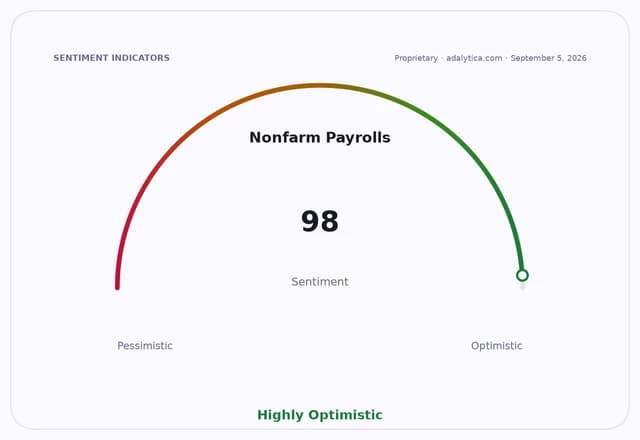
Adalytica’s nonfarm payrolls sentiment reading is at 98, or “Extreme Greed,” which suggests traders are leaning hard into the soft-landing trade. By contrast, consumer-confidence recession sentiment is at 11, or “Extreme Fear,” underscoring how fragile household psychology still is underneath the headline strength. That divergence is exactly where the next move in stocks will come from: not from whether jobs are “good” or “bad,” but from whether the data stay strong enough to preserve growth without forcing rates back up.
For investors, the playbook is clear. Stay constructive on U.S. large caps, quality cyclicals and the infrastructure behind labor-intensive spending, but keep an eye on rate-sensitive exposure and long-duration Treasuries, which remain hostage to the next payroll print. The market is still telling us that American jobs decide the path of global assets — and right now, they are deciding in favor of equities, not bonds.
| Entity | Gains | Losses |
|---|---|---|
| U.S. stocks | ▲Stronger earnings backdrop | ▼Higher-for-longer rates |
| Treasury bonds | ▲Potential Fed cuts later | ▼Sticky labor-driven yields |
| U.S. dollar | ▲Safe-haven demand | ▼Faster global risk-on flows |
| Multinationals | ▲Steady U.S. demand | ▼FX translation pressure |