US Treasury yields eased on Wednesday as investors sought safety amid renewed Middle East tensions and positioned for weekly US jobless claims, with the 10-year yield falling to 4.99% and the two-year at 4.70%, keeping the market focused on whether geopolitical risk and softer labor signals can extend the recent bond rally.
US Treasury yields ease on Middle East tensions
US Dollar
The move matters because Treasuries remain the benchmark for global borrowing costs, equity valuation and corporate funding. A sustained decline in yields would relieve pressure on rate-sensitive assets, but it would also reflect a market increasingly willing to price in slower growth or weaker labor momentum. For investors, that leaves the next labor release and any escalation in the Middle East as near-term catalysts for the direction of rates, the dollar and risk appetite.
Sentiment Indicators
The benchmark 10-year yield was down 1 basis point at 4.99%, while the policy-sensitive two-year yield rose 2 basis points to 4.70% before the latest forecast pointed to a small further easing to 4.944% and 4.649%, respectively. The pullback has pushed Treasury prices higher, with the iShares 20+ Year Treasury Bond ETF, TLT, closing at 80.99, above its 50-day moving average of 80.29 and well below its 200-day average of 83.26, while its relative strength index sat at 74.1, a reading that suggests the rally has turned technically extended.
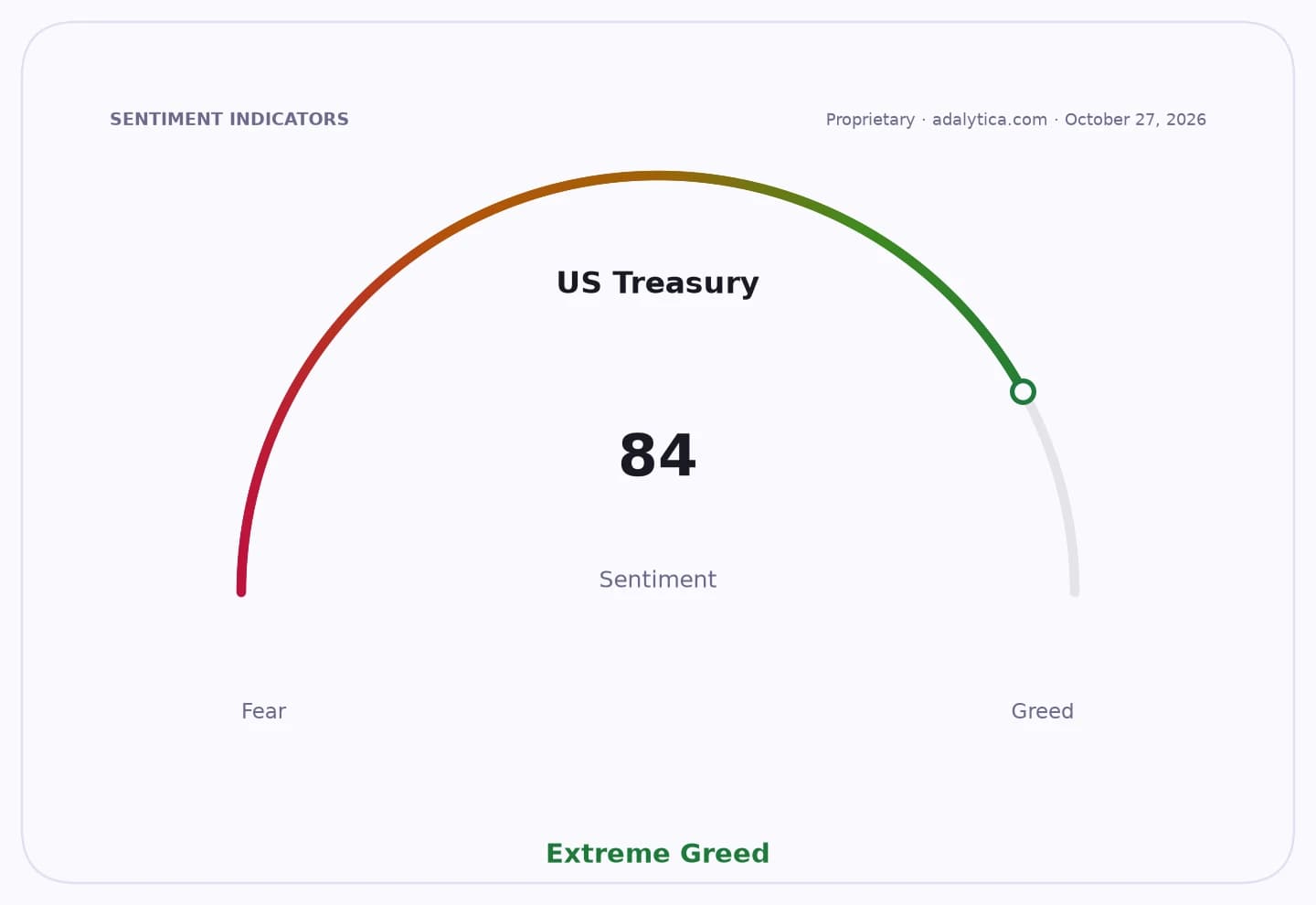
That technical picture is important because it shows the market is already leaning hard toward duration. Adalytica’s Treasury trade signals also flagged extreme greed in TLT, even as its awareness reading pointed to extreme fear, a combination that suggests heavy positioning into safety trades rather than broad conviction in a full-rate-cut repricing.
The yield move came as fresh reports of violence in Yemen and attacks linked to the Houthis kept regional risk in focus. Such flare-ups tend to support Treasuries and gold by encouraging defensive allocation, while weighing on the dollar if investors anticipate a softer US rate path. The dollar signal snapshot showed extreme fear, while gold’s price strengthened to $373.51 after a recent slide, reflecting some bid for havens even as the metal remained below its 50-day average of $392.67.
For equity investors, the implications are mixed. Lower yields can support growth stocks and long-duration assets, but if they are driven by geopolitical stress or a weakening labor backdrop, the market may interpret them as a warning rather than a green light. The S&P 500 signal snapshot still showed extreme greed in awareness even as sentiment remained in fear, underscoring a market that is responsive but not yet fully defensive.
The immediate test is whether jobless claims confirm a cooling labor market without tipping into broader weakness. If claims soften only modestly, Treasury yields could stabilize near recent levels and the bond rally may stall after becoming stretched. If claims surprise higher, the case for a deeper bond bid strengthens, with the two-year yield likely more sensitive than the 10-year as traders reassess the path for Federal Reserve policy. On the other hand, any escalation in Middle East tensions would reinforce the safe-haven trade and could keep pressure on risk assets into the next US data release.
| Entity | Gains | Losses |
|---|---|---|
| Treasury bulls | ▲Higher bond prices | ▼Higher yields |
| Borrowers | ▲Lower funding costs | ▼Tighter credit conditions |
| Gold | ▲Safe-haven demand | ▼Dollar strength |
| Equities | ▲Support from lower yields | ▼Geopolitical and growth risk |