Valencia is emerging as a test case for how Europe’s public administrations can adopt artificial intelligence without surrendering control over sensitive data, as VDS 2026 brings more than 12,000 technology professionals into the city to focus on digital sovereignty.
Valencia VDS 2026 focuses on digital sovereignty
That matters economically because the next phase of AI adoption in Europe is increasingly a procurement, infrastructure and governance story, not just a software story. Public agencies are under pressure to modernize services, automate workflows and cut costs, but they are also facing stricter data protection rules, heightened political scrutiny and rising concerns over where information is stored, who can access it and how models are trained. The result is a larger market for secure cloud, cybersecurity, data governance and compliant AI systems, while the room for unchecked deployment is shrinking.
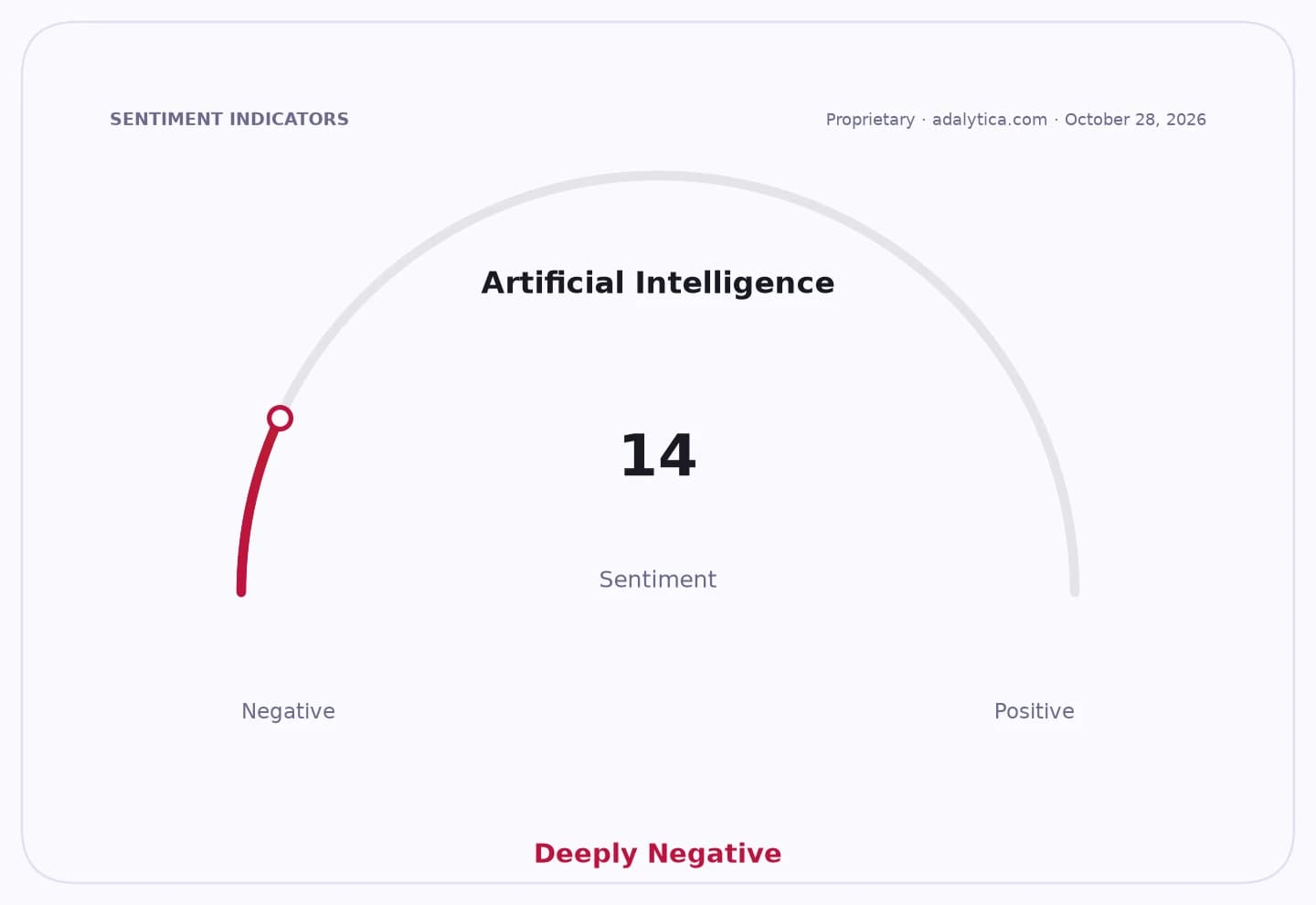
Sentiment IndicatorsⓘProprietary · adalytica.com · October 28, 2026
This is a snapshot — live sentiment, awareness and momentum for 130+ markets update continuously in the dashboard.Open AlphaPulse
The conference theme reflects a broader shift in policy and capital spending. Governments and public institutions want the productivity gains from AI, yet they are wary of dependency on a small group of foreign technology suppliers. That makes digital sovereignty a competitive issue for cloud providers, software vendors and systems integrators, especially in Europe, where regulators have already signaled that the EU’s AI Act could raise compliance costs and affect the provision of advanced AI services. Companies selling AI infrastructure and enterprise software will need to prove not only performance, but also transparency, auditability and control.
Investor attention is likely to stay focused on the balance between opportunity and regulation. Microsoft, Alphabet and Amazon all face the same strategic question: how to expand AI-driven demand while absorbing the costs of security, privacy and regional compliance. Microsoft’s shares have remained well above their 200-day moving average, but recent technical readings show momentum has cooled after a strong run, underscoring how quickly enthusiasm can fade when governance risks re-enter the discussion. Alphabet has also seen weakness in recent sessions, while Amazon’s stock has been more stable but still trades in a range that suggests investors are waiting for clearer evidence that AI spending is translating into durable returns.
For Europe, the stakes are broader than any single company. Public administrations are among the largest potential buyers of AI-enabled services, and their buying criteria can shape the market toward localized data storage, sovereign cloud architectures and vendors that can guarantee regulatory compliance. That would benefit European infrastructure and cybersecurity providers, while creating friction for global platforms that rely on scale and centralized data processing.
The message from Valencia is that AI adoption is no longer just about capability. It is about control, trust and jurisdiction. For investors, the winners are likely to be the companies that can sell AI into regulated environments without triggering sovereignty concerns; the losers could be those that treat governance as an afterthought.
| Entity | Gains | Losses |
|---|---|---|
| European governments | ▲More control over data | ▼Slower deployment |
| Cloud and security vendors | ▲Higher compliance demand | ▼Pricing pressure |
| Microsoft, Alphabet, Amazon | ▲AI adoption opportunities | ▼Sovereignty scrutiny |
| Public-sector buyers | ▲Better governance tools | ▼Vendor lock-in risk |