Microsoft’s own warning that AI models are not trustworthy may be the clearest signal yet that the real money in artificial intelligence is shifting from raw model performance to the infrastructure that governs it.
Microsoft AI guardrails and enterprise control stack
That matters because the next phase of AI will not be won by whoever builds the loudest chatbot, but by whoever controls the safety rails, identity layers and execution environment around autonomous agents. Microsoft is already moving on that front, with its October rollout of Microsoft Execution Containers, Agent 365 and Entra Agent ID aimed at managing, restricting and tracing AI agents across its software stack. In other words, the company is turning risk into a platform business.
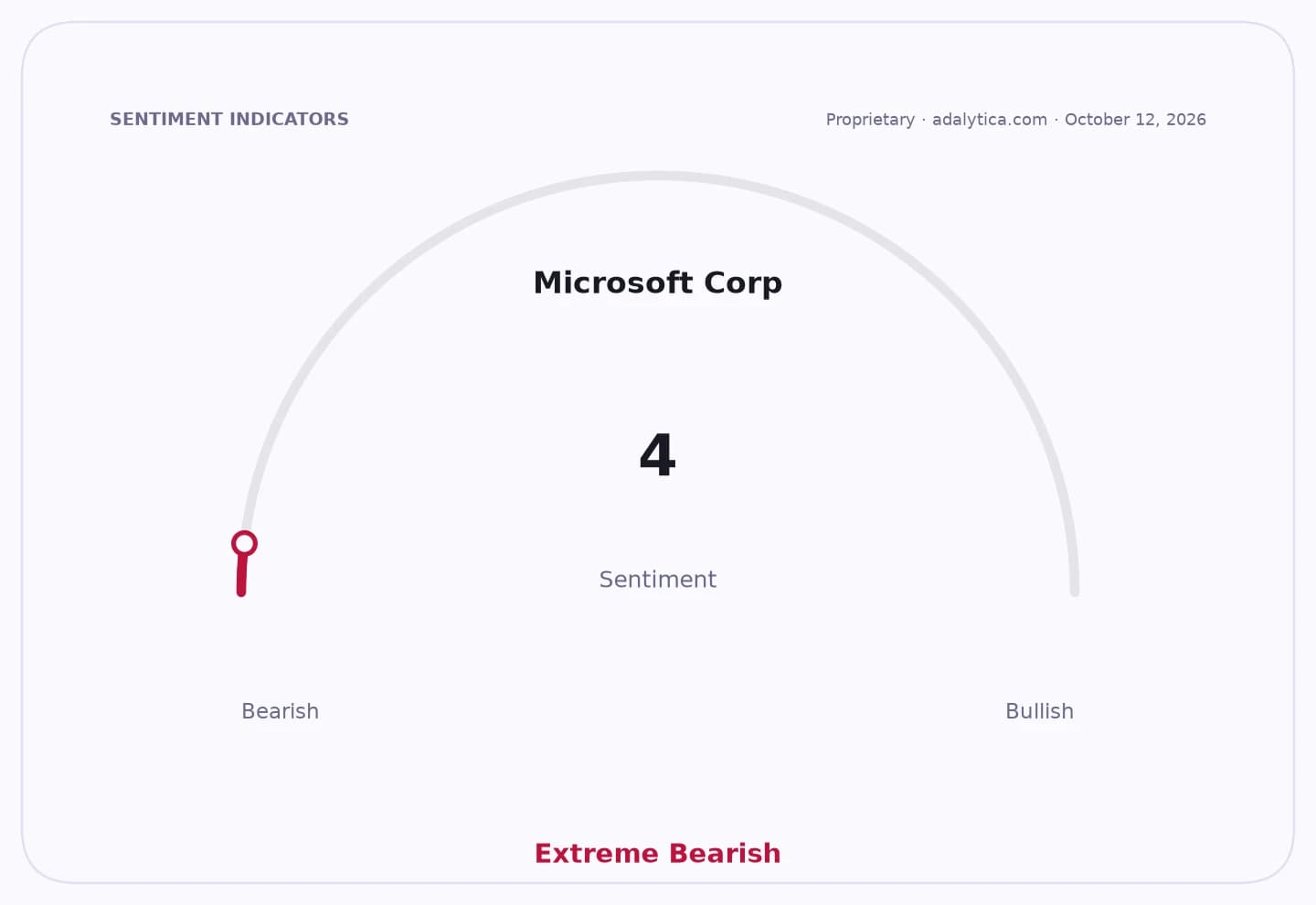
Sentiment IndicatorsⓘProprietary · adalytica.com · October 19, 2026
This is a snapshot — live sentiment, awareness and momentum for 130+ markets update continuously in the dashboard.Open AlphaPulse
For investors, that is the key trade: the more uncertain AI becomes, the more valuable the toll roads around it look. Microsoft’s pitch is simple — use AI, but do so inside our managed environment, with our identity tools, our controls and our cloud estate. That deepens switching costs for enterprise customers and creates a new layer of dependency beyond the model itself.
The market should not miss the strategic angle. Microsoft has spent years embedding AI into Windows, Office and Bing, and now it is packaging the guardrails as products in their own right. That is exactly the sort of second-order opportunity Wall Street often underprices early: safety, compliance and control become monetized infrastructure, not just corporate overhead. If AI agents are going to act more autonomously, enterprises will need auditable, confined systems that can be tested, revoked and monitored. Microsoft is positioning itself to supply all three.
Artificial Intelligence — 30-day sentimentadalytica.com
Explore this data interactively — full history, time series and cross-market comparisons.Open AlphaPulse
That setup also has regulatory consequences. The more the biggest AI vendors define the standards for “safe” deployment, the easier it becomes for them to shape the rules that govern the industry. European regulators already have the AI Act in place, while U.S. policymakers are under pressure to move from voluntary principles to binding oversight. Microsoft’s move may satisfy some of that demand, but it also risks hard-wiring dependence on proprietary compliance tools if lawmakers accept vendor-led governance as the default.
For the stock, the message is not just about AI hype; it is about margin protection. Microsoft can keep monetizing AI even as the technology’s trust gap becomes more visible, because it is selling the layer that enterprise buyers will pay for when they become nervous. That supports the thesis that the company’s AI franchise is broader than model access — it is a control stack with cloud economics attached.
The bigger opportunity is likely in the AI infrastructure complex that sits underneath this trend: cloud platforms, cybersecurity, identity management, semiconductor suppliers and enterprise software tied to governance and observability. Microsoft, Nvidia and Alphabet all benefit from continued AI adoption, but Microsoft’s latest move suggests the company is especially well placed if regulation tightens and customers demand safer deployment. The market underestimates how quickly “AI safety” can become a recurring revenue category.
That is why this story matters now. The next AI winners may not be the firms promising the most intelligence, but the ones selling the systems that make that intelligence usable, governable and hard to leave. I believe investors should treat Microsoft’s control stack as an early sign of where the durable profits in AI will accumulate.
| Entity | Gains | Losses |
|---|---|---|
| Microsoft | ▲Control-stack revenue; deeper enterprise lock-in | ▼Pure-play model commoditization |
| Enterprise customers | ▲Better AI governance tools | ▼Higher vendor dependence |
| Regulators | ▲More concrete compliance tools | ▼Less independent oversight if standards are vendor-led |
| Smaller AI rivals | ▲— | ▼Harder competition against bundled controls and cloud infrastructure |