Vietnam’s state budget is running ahead of plan even as spending accelerates, giving policymakers more room to fund growth-supportive investment without immediately straining fiscal accounts.
Vietnam Budget Revenue Rises 11% in First 10 Months
Total state budget revenue in the first 10 months of 2026 reached 2,438.9 trillion dong, equal to 96.4% of the full-year estimate and up 11.0% from a year earlier, the General Statistics Office said. State budget spending rose 14.8% over the same period to 2,108.7 trillion dong, with capital expenditure jumping 49.7% and helping finance economic development, national defense, administration and debt payments.
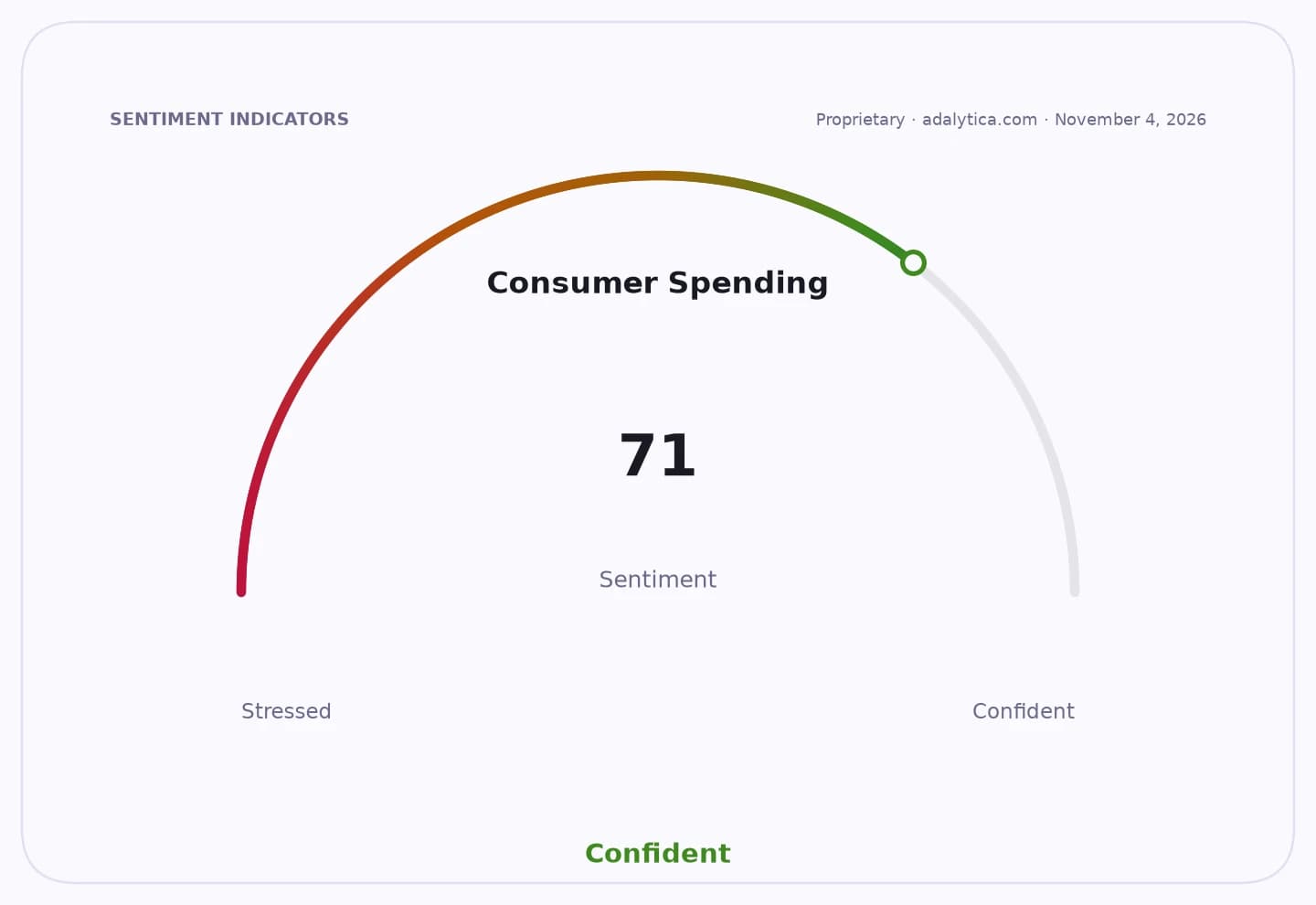
Sentiment Indicators
The broad picture is one of a government leaning into growth support while keeping revenues resilient despite tax, fee and land-rent relief measures aimed at households and businesses. That matters because fiscal policy has become a key buffer for Vietnam as it tries to sustain domestic demand, maintain infrastructure spending and offset external volatility tied to trade and global financial conditions.
The revenue mix suggests the balance remains healthy. Domestic collections, which make up the bulk of the budget, rose 11.4% to 2,102.8 trillion dong and accounted for 86.2% of total revenue. Oil revenue climbed 38.3%, while customs-linked receipts increased 3.6%, pointing to a still-functional trade channel even as the export outlook remains sensitive to slower global demand and tariff risks.
On the spending side, the sharp rise in development outlays is the most economically important detail. Investment spending reached nearly 735 trillion dong in 10 months, suggesting the government is still trying to push public capital into transport, infrastructure and other growth-enhancing projects. That supports near-term activity, but it also leaves policymakers with less room if revenue momentum slows or if financing costs rise.
For investors, the data are mildly constructive for Vietnamese assets because they reinforce the case for macro stability and continued public investment. Stronger-than-expected revenue can ease pressure on the fiscal deficit and support sovereign credit confidence, while heavier capital spending may help construction, materials, transport and related sectors. The offset is that faster expenditure also means the budget’s cushion is not unlimited, so any weakening in tax intake or export-linked receipts could matter more later in the year.
The numbers also fit a broader policy narrative in which Hanoi is trying to balance support for growth with budget discipline. Local governments have been urged to tighten spending and accelerate key infrastructure projects, especially in urban transport. If that pattern continues, fiscal policy should remain an important engine of domestic demand heading into 2027 — but one that investors will watch closely for signs of strain if growth slows or spending overshoots revenue again.
| Entity | Gains | Losses |
|---|---|---|
| Vietnamese government | ▲More fiscal room | ▼Less buffer if growth slows |
| Infrastructure contractors | ▲Higher public spending | ▼Tight project execution risk |
| Bond investors | ▲Stronger budget credibility | ▼Higher future issuance risk |
| Taxpayers/businesses | ▲Ongoing fee relief | ▼Potentially tighter future collection |