The Vanguard Total International Stock ETF is offering investors something the S&P 500 cannot: broad exposure to the world’s biggest non-U.S. companies at a bargain price.
VXUS Offers Cheaper Global Stock Exposure

That matters because the global market is still dominated by a handful of American giants, leaving many U.S.-focused portfolios heavily concentrated in the same names and the same growth themes. VXUS gives investors a simple way to rebalance that exposure, add international dividend income, and own critical semiconductor and industrial leaders without buying them one by one.
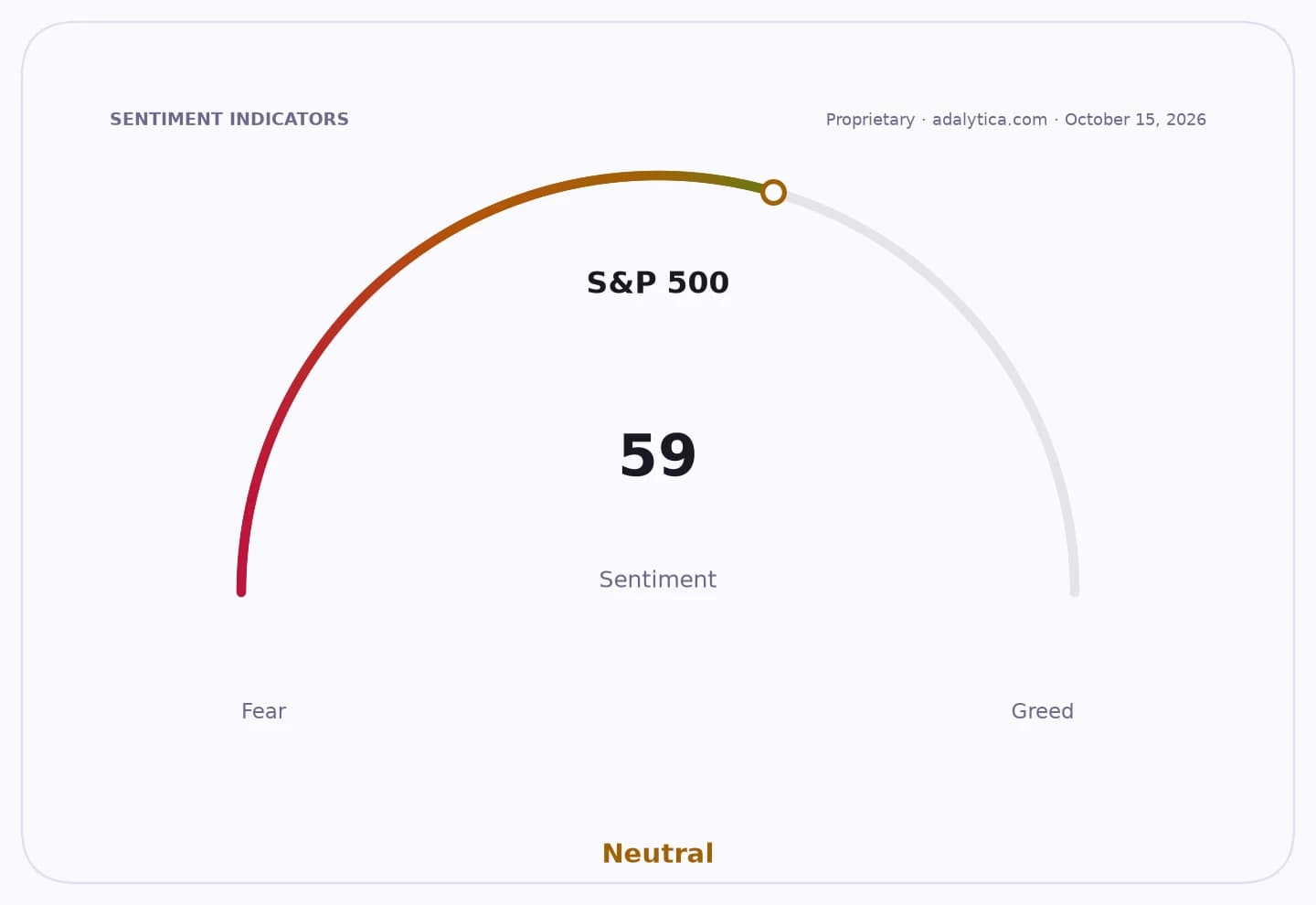
Sentiment IndicatorsⓘProprietary · adalytica.com · October 17, 2026
This is a snapshot — live sentiment, awareness and momentum for 130+ markets update continuously in the dashboard.Open AlphaPulse
The case for the fund starts with its sheer breadth. VXUS owns 8,790 stocks across developed and emerging markets, with Japan, Taiwan, the U.K., Canada, China and South Korea among its largest country weights. Its four biggest holdings are Taiwan Semiconductor, Samsung Electronics, SK Hynix and ASML, but even those together account for just 8.7% of the fund. That is a very different profile from the Vanguard S&P 500 ETF, where the top four holdings make up 26.2%.
For investors, that difference is the story. U.S. indexes have become increasingly top-heavy, with a small group of megacap stocks driving an outsized share of returns. VXUS spreads that risk across thousands of businesses and gives investors access to market leaders that are absent from domestic index funds. Taiwan Semiconductor remains the world’s leading foundry, while ASML sits at the center of the chip supply chain with its extreme-ultraviolet lithography systems. Samsung and SK Hynix, meanwhile, are key players in memory chips, a market that stands to benefit from long-term demand tied to artificial intelligence, cloud computing and data centers.
The valuation gap also helps explain why some long-term investors may want international exposure now. VXUS trades at about 16.2 times earnings and yields 2.3%, compared with the S&P 500 ETF’s 25.2 multiple and 1.1% yield. That does not mean overseas stocks are destined to outperform U.S. shares — American companies still enjoy deeper capital markets, stronger governance and, in many cases, faster growth — but it does suggest VXUS can play an important role for investors who want a cheaper, higher-yielding complement to U.S. holdings.
The fund’s costs are barely an issue. VXUS charges 0.05%, only a touch above the S&P 500 ETF’s 0.03%, which means investors can get global diversification without paying much for it. With $164.9 billion in assets, it is also large enough to be a core holding rather than a niche trade.
The bigger investing lesson is that diversification does not mean giving up quality. It means recognizing that innovation is global, and that some of the most important companies in semiconductors, machinery and consumer electronics are based outside the U.S. For investors building wealth over the next decade and beyond, VXUS is worth watching as a straightforward way to balance a U.S.-heavy portfolio and own international leaders at an attractive price.
| Entity | Gains | Losses |
|---|---|---|
| VXUS investors | ▲Broader diversification | ▼Less U.S. concentration |
| U.S.-only index funds | ▲Simplicity and domestic growth exposure | ▼Global diversification |
| Taiwan Semiconductor, Samsung, SK Hynix, ASML | ▲Access through a core ETF | ▼Direct indexing dominance |
| S&P 500-heavy portfolios | ▲— | ▼Higher concentration risk |