Wall Street’s biggest banks are increasingly borrowing in yuan, deepening a Hong Kong market that Beijing sees as a strategic tool for making the Chinese currency more useful outside its borders.
Wall Street Banks Raise Yuan Funding in Hong Kong
The shift matters because it is not being driven by the old trade that once made dim-sum bonds a cheap synthetic dollar funding source. Instead, it reflects a new and more durable demand: access to China’s vast pool of savings at a time when mainland yields are low and domestic investors are hungry for returns. That has helped turn the offshore yuan from a niche funding currency into one that global banks can actually use at scale.
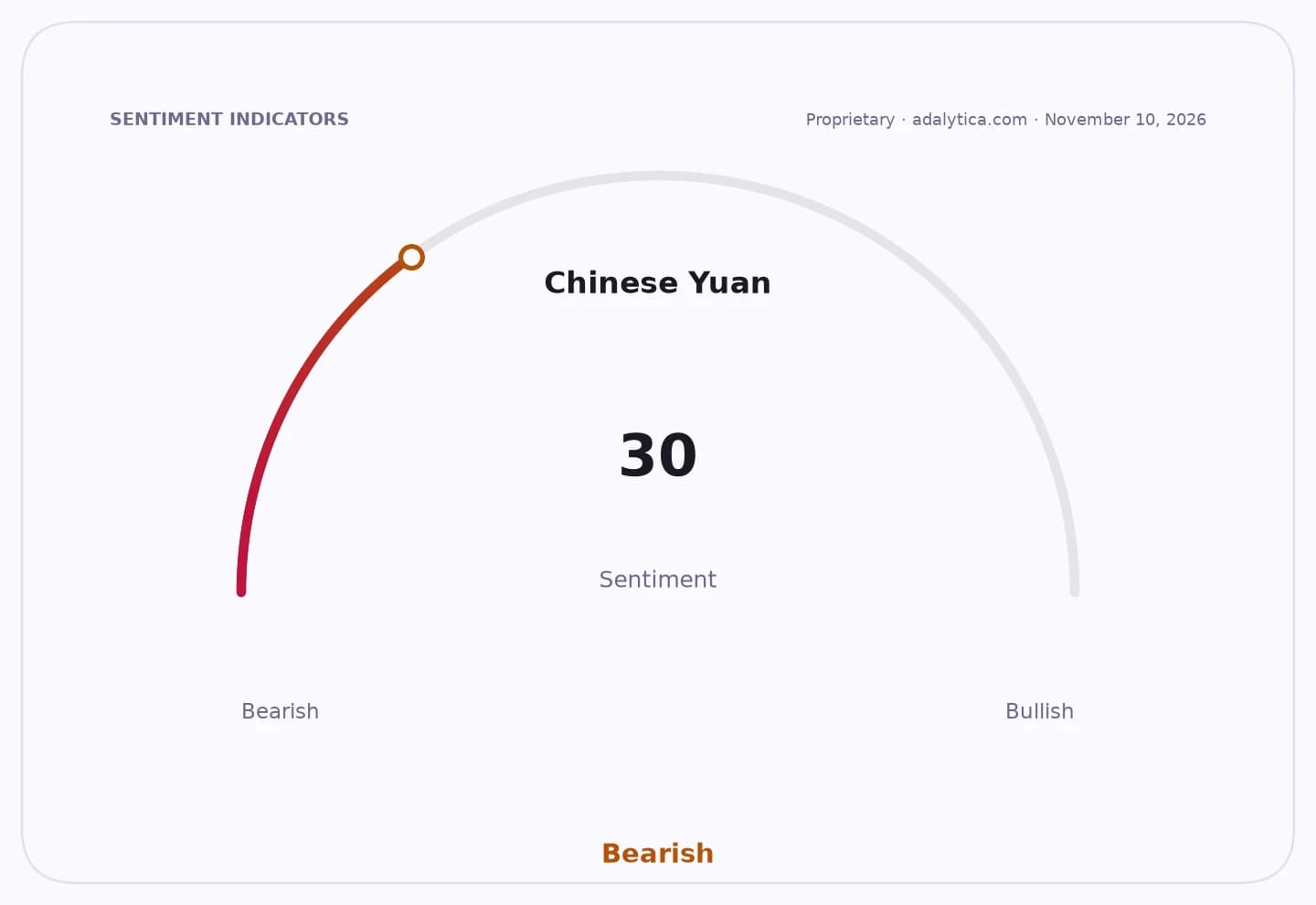
Sentiment Indicators
Systemically important banks have sold 134 billion yuan, or about $20 billion, of dim-sum bonds so far this year, nearly triple the total for all of 2025, according to Bloomberg data. Citigroup, Barclays and BNP Paribas are the largest issuers, while Wells Fargo’s volume has risen more than tenfold and Goldman Sachs has roughly tripled its issuance. Bank of America says the offshore yuan has overtaken the pound to become the third-largest funding currency for global banks.
For investors, the implication is that China’s currency internationalization is advancing through market plumbing rather than rhetoric. The Southbound Bond Connect is giving mainland investors a controlled channel to buy offshore debt, allowing Beijing to recycle savings without opening the capital account. That is helping Hong Kong’s bond market become a bigger yuan funding hub, while also creating a broader investor base that now includes sovereign wealth funds, central banks and other buyers beyond Asia.
The development also has geopolitical weight. Washington is increasingly focused on reducing exposure to China, yet Western banks are helping deepen the offshore yuan market at the same time. Beijing’s push is partly defensive: after Russia’s reserves were immobilized in 2022, Chinese policymakers saw the risks of overreliance on dollar assets, Western correspondent banks and dollar-based payment networks. Tools such as Project mBridge can reduce some frictions, but they only matter if there are liquid yuan markets where overseas holders can reinvest their proceeds.
The market backdrop is also supportive. Mainland property remains weak, local yields are low and Chinese institutions are searching for return, which keeps demand for yuan paper firm. That is a very different setup from the first dim-sum boom after the global financial crisis, when investors were betting on yuan appreciation and accepted tiny coupons. The second surge, driven by property developers, ended badly with China Evergrande’s collapse. This time, the issuer mix is more financial and the buyer base is broader.
The bull case is that this is a genuine structural shift: if China keeps widening access for mainland savings and if overseas trade settlement in yuan keeps growing, Hong Kong could become a more durable offshore funding center. The bear case is that the market still rests on policy tolerance from Beijing and on a China economy that is not yet strong enough to absorb rapid capital liberalization. Any renewed pressure on the yuan, or a sharper tightening of cross-border controls, could quickly slow the trade.
For now, though, the direction is clear. The yuan remains far from challenging the dollar, with a little over 2% of global central-bank reserves, but Wall Street’s growing use of dim-sum bonds shows how market participants are adapting to a more fragmented monetary order. In practice, American and European banks are not retreating from China’s financial orbit; they are helping deepen it.
| Entity | Gains | Losses |
|---|---|---|
| Hong Kong bond market | ▲More yuan issuance | ▼Dollar funding dominance |
| Wall Street banks | ▲Cheaper yuan financing | ▼Reliance on dollar markets |
| Beijing | ▲Greater yuan international use | ▼Faster capital outflows |
| Dollar system | ▲Less exclusive role | ▼Share of global funding use |