America’s spending machine still hasn’t broken, and that is the most important investment clue in the “Spend Dat” moment: consumers are keeping cash circulating even as confidence collapses, debt stress rises and the culture of hustle turns financial excess into entertainment.
Walmart, Amazon, XLY Benefit From Consumer Spending
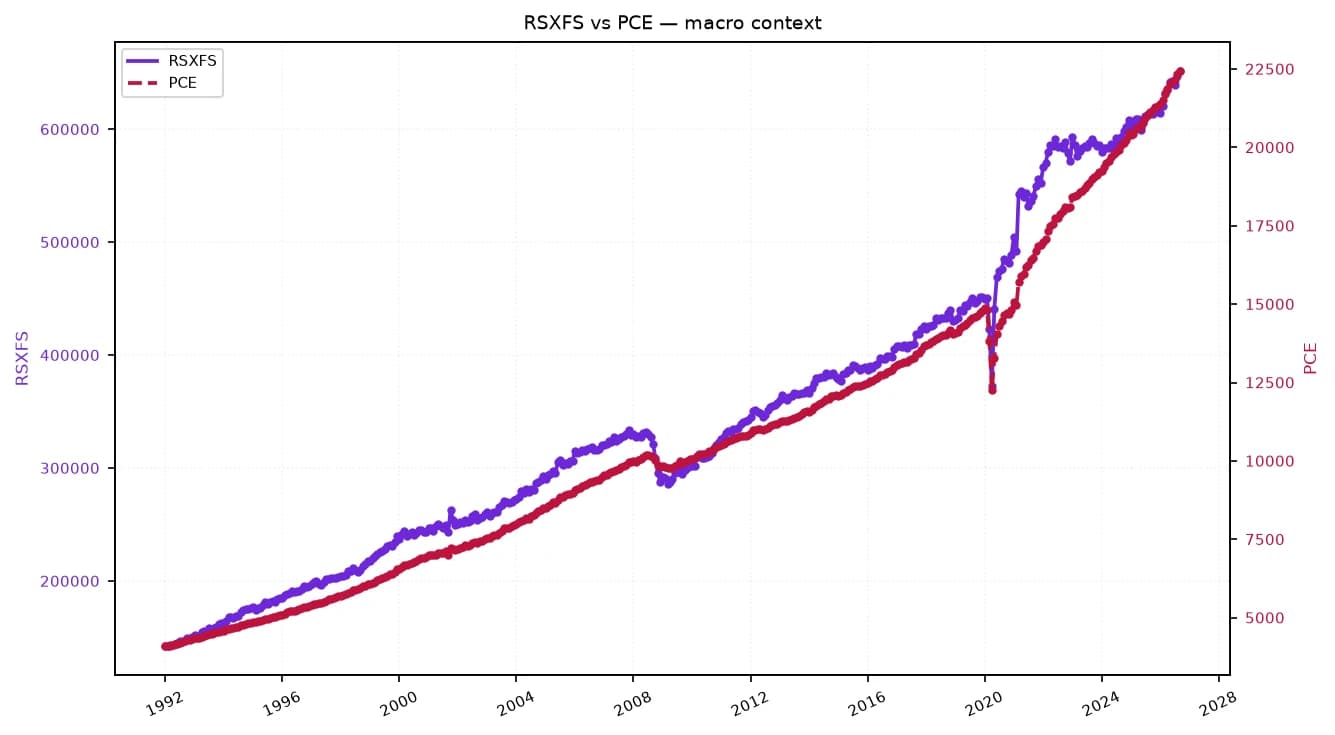
The story is not that U.S. households are healthy. It’s that the economy has become increasingly dependent on consumption at any cost, from buy-now, pay-later borrowing to speculative side bets and “grift” culture that normalizes spending as identity. That matters because consumer demand remains the backbone of GDP, and when it stays resilient in the face of inflation and softer sentiment, the companies that sell discretionary goods, services and digital convenience keep getting a second wind.
The data say exactly that. Consumer spending, tracked in the PCE series, rose to 22,452.8 in September 2026 from 20,458.7 at the end of 2024, while the broader measure of retail-related activity in the RSXFS series climbed to 652,115 from 608,097 over the same period. At the same time, the University of Michigan sentiment index slumped to 48.1 in September 2026 from 55.2 in July, underscoring the gap between how people feel and how they keep spending. That disconnect is the heart of the trade.
Investors should care because this is exactly the sort of backdrop that rewards the picks-and-shovels of consumer persistence: large-format retailers, e-commerce platforms and discretionary ETFs that benefit when households keep transacting even while they grumble about the economy. The Consumer Discretionary Select Sector SPDR Fund, XLY, has recovered to 121.01 from a spring slide to 107.07, with its price back above both the 50-day and 200-day moving averages. Its RSI reading of 61.8 and rising MACD suggest the tape is leaning back toward risk, not away from it.
Walmart and Amazon fit that same frame. Walmart’s shares were last at 125.66, well above the 50-day moving average of 112.93 and the 200-day average of 118.41, while Amazon closed at 266.93, above both its 50-day and 200-day averages and near the top end of its recent trading range. In other words, the market is paying up for the companies best positioned to intermediate a consumer base that may be financially stretched, but is still buying.
That is why “Spend Dat” resonates beyond pop culture. The real economy is being powered by a willingness to borrow, spend and perform prosperity even as fiscal restraint, debt anxiety and weaker sentiment point the other way. In a market like this, the winners are not the households pretending they are fine. They are the companies that monetize the illusion.
The next move is likely to be a continued split between cash-generating consumer giants and the weaker names that need a stronger consumer than the one we actually have. For investors, the high-conviction play is to stay overweight the durable beneficiaries of compulsive spending — especially Walmart, Amazon and XLY — while treating the most cyclical consumer names as a trap until sentiment and real cash flow truly recover.
| Entity | Gains | Losses |
|---|---|---|
| Walmart | ▲Defensive spending flows | ▼Margin-sensitive rivals |
| Amazon | ▲E-commerce demand | ▼Weaker discretionary retailers |
| XLY | ▲Broad consumer rebound trade | ▼Consumer bears |
| Cash-strapped households | ▲Short-term access to goods | ▼Long-term balance sheets |