Amazon’s faster revenue growth is turning the retailer’s split with Target into a simple market message: AI and cloud demand are cushioning one company while a cautious consumer is capping the other’s upside.
Amazon Revenue Growth Tops Target on AI Demand

The gap matters because it shows where growth is still available in US retail. Amazon’s third-quarter revenue rose 12% to $201.9 billion, driven by a 39% jump at AWS to $46 billion as companies kept spending on cloud and artificial intelligence infrastructure. Even the core North American retail business grew 6%, suggesting Amazon is still taking share in e-commerce while adding a second engine from enterprise technology. Target, by contrast, reported second-quarter fiscal 2026 net sales up 5.3% to $26.5 billion and comparable sales up 3.8%, a recovery that is welcome but still modest for a business more exposed to discretionary spending and household budgets.
Sentiment Indicators
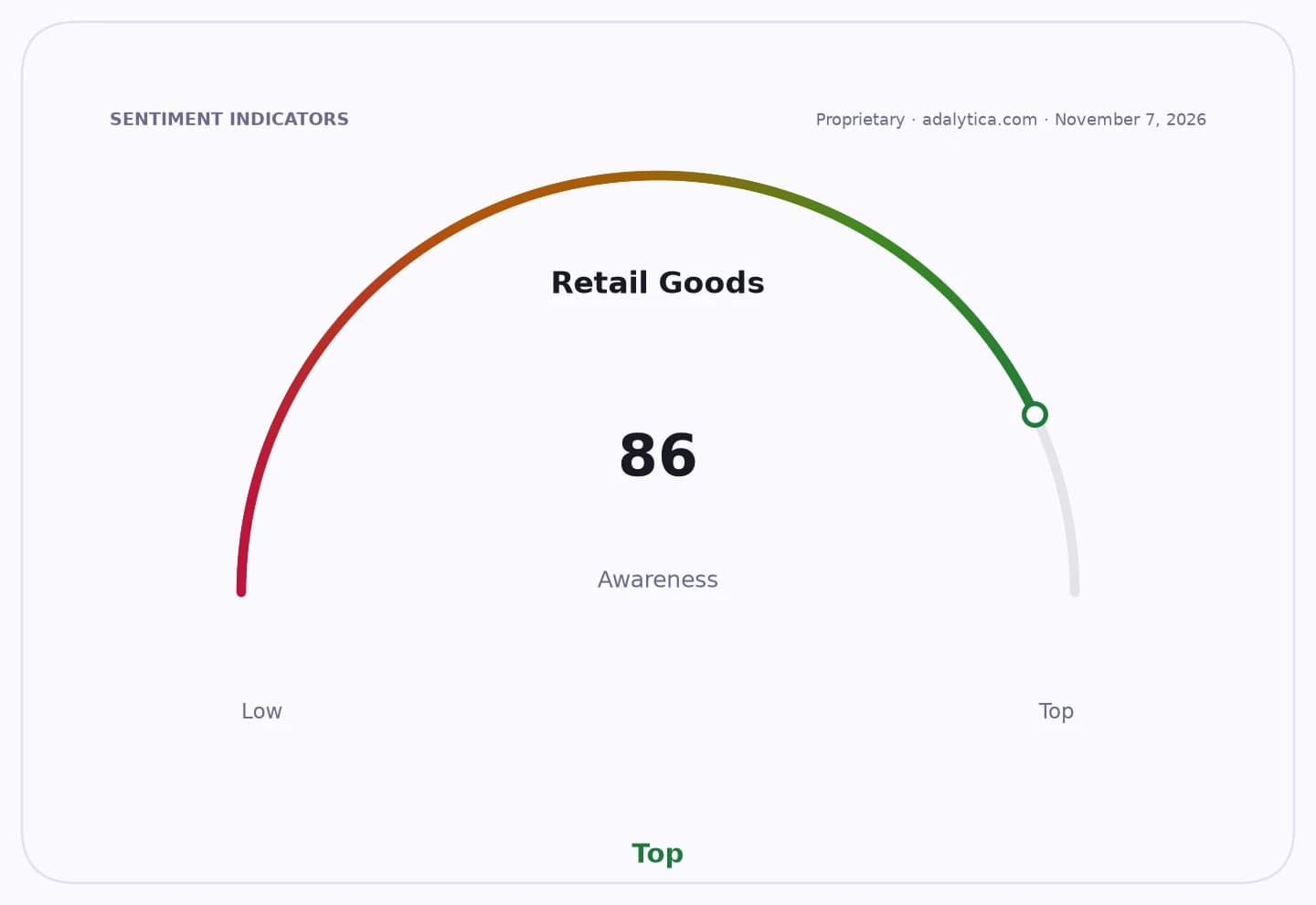
That divergence is reinforced by the macro backdrop. US unemployment was 4.1% in October, pointing to a labor market that is still intact, but not strong enough to unleash broad-based spending. Adalytica’s Consumer Spending Sentiment gauge was neutral at 43, with awareness in “fear” territory, underscoring a consumer that is spending selectively rather than broadly expanding basket sizes. In that environment, retailers tied to essentials and online convenience have a better chance of growing than chains dependent on apparel, home goods and other nonessential categories.
For investors, Amazon’s story is increasingly about how long AI-related capital spending can keep lifting AWS and whether that growth can offset the drag from heavier infrastructure investment. The stock, at $259.30 on Nov. 6, sat above both its 50-day and 200-day moving averages, with RSI readings in neutral territory, indicating the market is still giving the AI thesis the benefit of the doubt after recent volatility. Bullish investors will argue that Amazon’s mix of retail, ads, subscriptions and cloud creates multiple paths to earnings growth. The bear case is that AI spending becomes so heavy that cash flow lags the revenue gains.
Target’s appeal is more defensive: a turnaround in traffic and digital sales could still support the shares if consumers stabilize and promotions work. But the stock’s move around $158 on Nov. 6 leaves it far more dependent on a successful discretionary-spending rebound. Its technical setup has improved from earlier weakness, yet it remains far more sensitive than Amazon to any renewed pressure on household budgets.
The broader narrative is that retail is splitting into two very different businesses. One is being pulled higher by AI infrastructure and cloud computing; the other is waiting for consumers to spend more freely. Until that changes, Amazon is the one with multiple growth levers, while Target remains a bet on a cautious shopper eventually loosening the purse strings.
| Entity | Gains | Losses |
|---|---|---|
| Amazon | ▲AWS and AI demand | ▼Heavy infrastructure spending |
| Target | ▲Traffic recovery | ▼Discretionary spending squeeze |
| AI cloud buyers | ▲More compute capacity | ▼Higher IT bills |
| Cautious consumers | ▲Lower impulse spending | ▼Less retail momentum |