Walmart’s latest quarter shows exactly why the retailer keeps winning: it is still growing, still taking share and still finding higher-margin ways to make money — but the stock is no longer trading like a sleepy defensive name.
Walmart Shares Rise on Growth and Margin Gains

That matters because Walmart’s appeal has never just been steady sales. The investment case has increasingly been about whether the company can turn its scale into better profits through e-commerce, advertising, marketplace and membership revenue. Those businesses are helping lift margins, which is the kind of mix shift long-term investors want to see in a company that already dominates U.S. retail.
Sentiment Indicators
Consumer Spending
The numbers behind the move are hard to ignore. Walmart shares are up to about $129.58 from $113.62 in early January, and the stock has spent much of the past few months trading above its 50-day moving average. That usually tells you the market is rewarding the earnings story, not just the safety trade. But it also means valuation expectations are higher than they were when the stock looked merely cheap and dependable.
That is the key tension for investors. A company like Walmart rarely needs a flashy narrative to compound value. Its moat is built on scale, logistics, grocery traffic and pricing power, and it has plenty of room to keep expanding digital sales and monetizing customer visits in ways that competitors find hard to replicate. Those are exactly the kinds of advantages that can support durable earnings growth over years, not quarters.
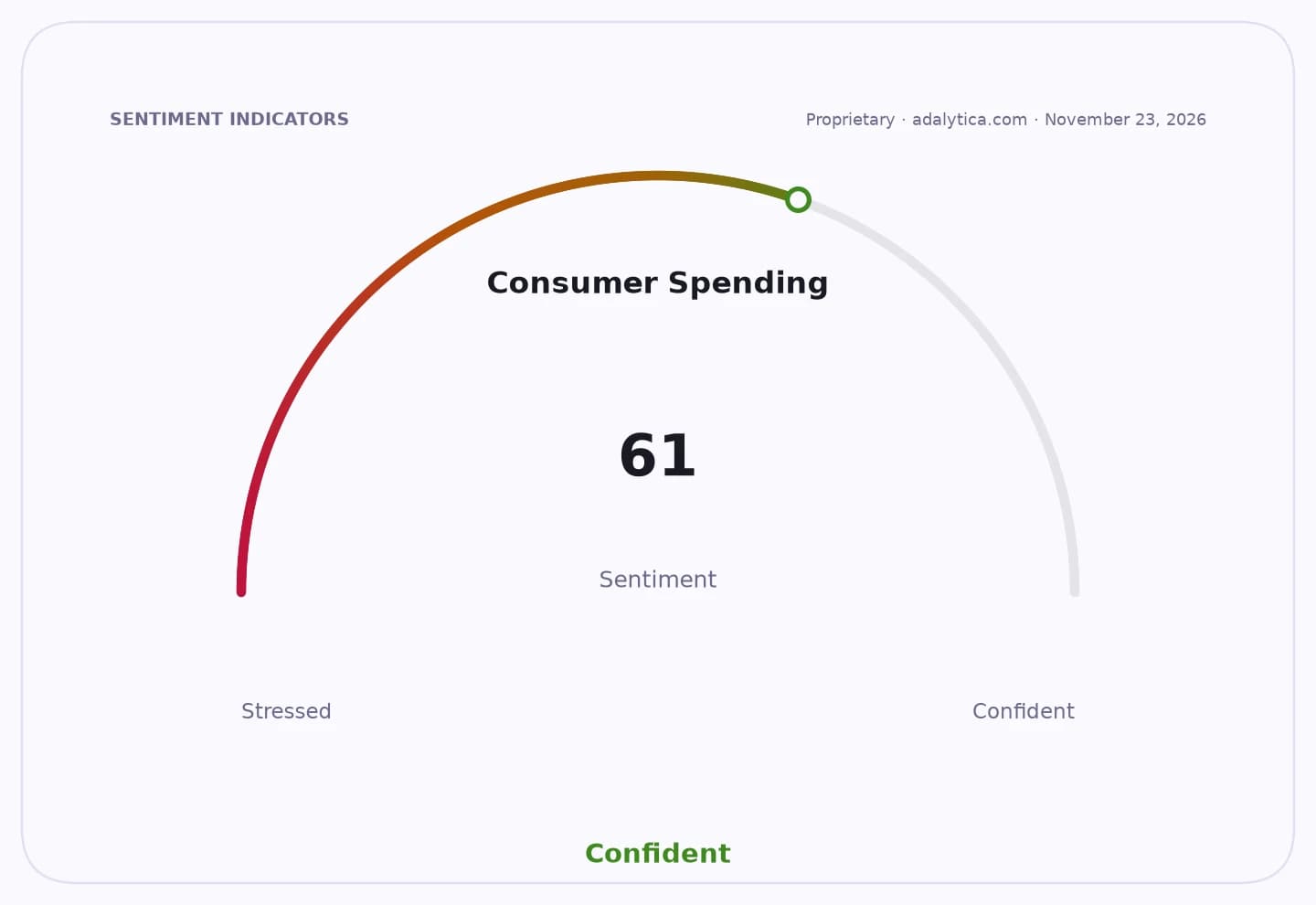
Consumer Spending
The contrast with peers helps sharpen the story. Costco remains a premium-quality operator, but its stock at roughly $1,097 reflects that quality. Target, by comparison, has been far more volatile, even as it tries to stabilize its business. Walmart sits in the middle: not as expensive as the market’s most adored consumer names, but no longer a bargain either.
Technical indicators also suggest the market is treating Walmart as a momentum name for now. The shares are above both the 50-day and 200-day moving averages, while RSI readings have swung from overbought levels earlier in the month to a more moderate reading in the low-60s. That does not make Walmart a trading stock, but it does show investors have already bid up the “boring” story.
There is a broader lesson here for long-term investors. When a defensive business starts winning on both growth and profitability, the market usually notices. Walmart’s challenge is less about proving the model works and more about justifying the richer price investors are now willing to pay for it. If management keeps delivering steady comps, stronger digital economics and better mix, the stock can still work over a multiyear horizon. If not, the valuation could make patience harder.
For investors who want quality and can think in years, Walmart still belongs on the watchlist. Just do not confuse boring with cheap.
| Entity | Gains | Losses |
|---|---|---|
| Walmart | ▲Higher-margin growth | ▼Cheap-valuation thesis |
| Long-term shareholders | ▲Steady compounding | ▼Instant upside seekers |
| Costco | ▲Premium-quality peer comps | ▼Relative valuation gap narrows |
| Target | ▲Need for a turnaround lens | ▼Market-share pressure |