Warsaw shares tumbled on Friday as a broad risk-off move hit Europe, with banks bearing the brunt of the selloff and dragging the WIG20 toward the psychologically important 4,000-point level.
Warsaw stocks fall as banks drag WIG20 lower

The benchmark index was down 4.2% at about 4,030 points around 2:25 p.m., while the wider WIG lost 3.6%. The heaviest pressure was on financials: PKO BP fell 6.4%, Pekao and PZU both dropped about 5.5%, and mBank also came under selling. Heavyweight names outside the sector were not spared, with PGE, KGHM and CD Projekt off 4.5% to 5.2%, underscoring that the move was not just about banks but about a broad reduction in exposure to Polish equities.
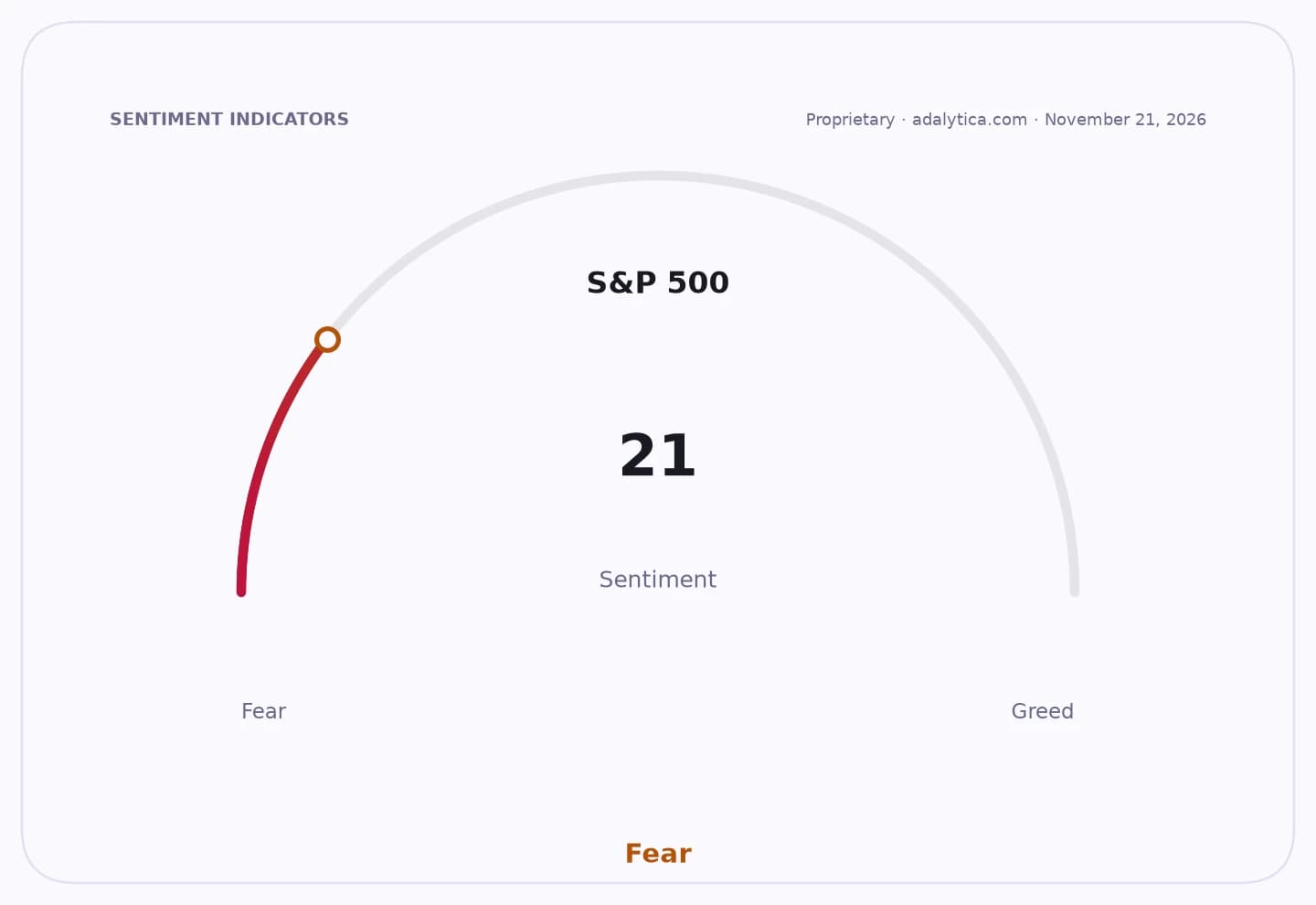
Sentiment Indicators
The backdrop matters because banks are among the most economically sensitive parts of the market. They account for a large share of index capitalisation, so sharp declines there can quickly spill into the broader exchange, hit turnover and tighten financial conditions through equity valuation effects. More than 1.6 billion złoty changed hands in WIG20 stocks and more than 2 billion złoty across the market, showing that this was not a thin-session drift but an orderly, heavy rotation out of risk.
The selloff also reflects a convergence of global and local pressures. Internationally, the move followed Thursday’s drop on Wall Street, which rippled through Asia and then Europe. Locally, reports of Polish airspace being violated in connection with Russia’s war on Ukraine added a geopolitical premium that can make international investors more cautious on domestic assets. That is particularly relevant for banks, which tend to be among the first holdings trimmed when foreign portfolios turn defensive.
Monetary-policy expectations added another layer. More hawkish signals from the Federal Reserve are reinforcing the idea that U.S. rates may stay higher for longer, a setup that tends to pressure equity valuations globally and especially rate-sensitive growth names. At the same time, the złoty weakened, with the euro rising to about 4.46 złoty and the dollar to 4.05 złoty, which can further unsettle risk assets and increase the appeal of cash and dollar exposure.
From a technical perspective, the move has also broken a calmer stretch for several bank stocks. PKO BP’s slide came after the shares had been trading near their 50-day moving average, while the stock’s relative strength index has fallen back toward the neutral-to-weak zone after earlier strength. Pekao and MBank showed similar pattern damage, with the former retreating from a recent strong run and the latter giving back part of its rebound. For momentum investors, that raises the risk that a broad market correction is turning into a more sustained de-risking in bank leaders.
For investors, the key question is whether Friday’s drop marks a one-day shock or the start of a deeper repricing of Polish financials. Bulls will argue that domestic banks still benefit from strong trading volumes, resilient earnings and a market that has already absorbed much of the rate-cycle repricing. Bears will point to rising geopolitical risk, a weaker currency and the possibility that global yields remain elevated, all of which can keep pressure on valuation multiples and foreign inflows.
If the WIG20 fails to defend 4,000 points, banks will remain the decisive sector to watch. A stabilisation in global sentiment could bring short-covering and bargain hunting, but if risk aversion persists, the financial sector may stay the first place where investors reduce exposure to Poland.
| Entity | Gains | Losses |
|---|---|---|
| Cash / defensive assets | ▲Lower volatility demand | ▼Equity risk appetite |
| Short-term sellers | ▲Momentum from selloff | ▼Long-only bank holders |
| Exporters with foreign revenue | ▲Weaker złoty tailwind | ▼Domestic-facing borrowers |
| WIG20 banks | ▲— | ▼Index support, valuation multiples |