The Chinese yuan’s recent run has left little room near term for more appreciation, and Rabobank’s forecast suggests the currency is more likely to consolidate than surge from here.
Yuan Seen Consolidating Near 6.70, Rabobank Says
The bank sees USD/CNY at 6.70 in three and six months, only slightly below the latest 6.7050 quote, before a move to 6.65 over 12 months. That implies just another 0.8% yuan gain over the next year, a restrained call after three straight months of strengthening against the dollar.
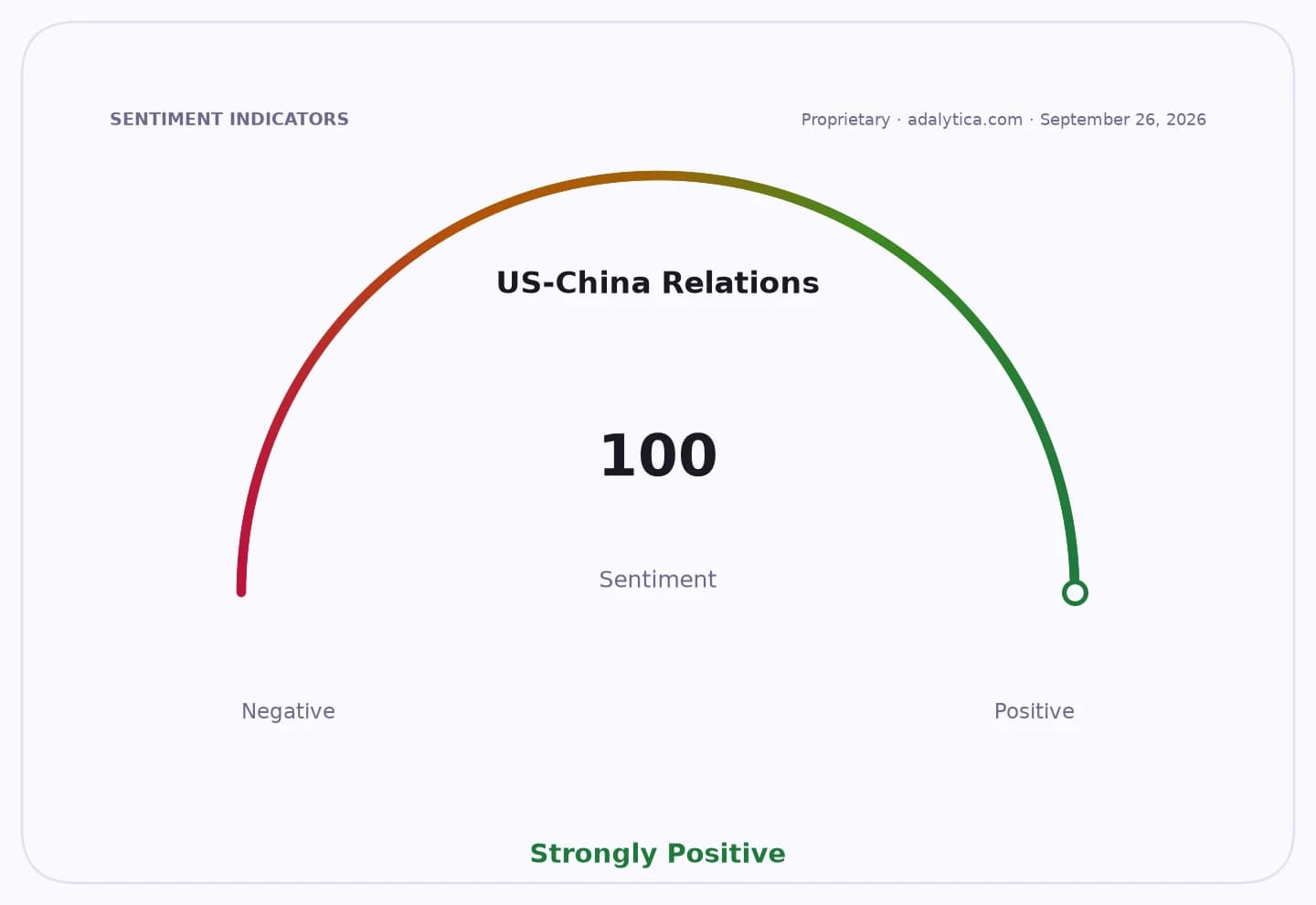
Sentiment IndicatorsⓘProprietary · adalytica.com · October 2, 2026
This is a snapshot — live sentiment, awareness and momentum for 130+ markets update continuously in the dashboard.Open AlphaPulse
The forecast matters because it captures a market that has already moved most of the way toward the bank’s near-term view while the macro backdrop remains mixed. The yuan fell 0.62% in July, 0.36% in August and 0.33% in September in USD/CNY terms, but the broader trend has been one of gradual appreciation as confidence in China’s recovery improves and the dollar softens. Adalytica’s yuan trade signals currently show neutral sentiment, while the dollar’s own readings are in extreme fear territory, underscoring how much of the currency adjustment has already been priced in.
Rabobank’s caution is rooted in the quality of China’s rebound, not just the level of growth. Private RatingDog manufacturing PMI rose to 52.1 in September and the official factory gauge returned to expansion at 50.1, while services and employment also improved. But the bank says some of the pickup in client demand was driven by precautionary inventory accumulation, which can front-load orders without proving a durable consumption recovery.
Chinese Yuan — 30-day sentimentadalytica.com
Explore this data interactively — full history, time series and cross-market comparisons.Open AlphaPulse
That distinction matters for the currency because a stockpiling-led upswing can fade quickly, limiting the case for a sustained yuan breakout. Rabobank also expects China’s growth to slow from 4.5% in 2026 to 4.2% in 2027, suggesting the economy is not yet on a path that would force a much stronger currency re-rating.
Policy is another reason the bank sees only a pause before further gains. Rabobank has trimmed its expectation for additional easing by the People’s Bank of China to a single 10 basis point cut in the seven-day reverse repo rate, rather than two cuts that would have taken it to 1.30%. That implies officials are less inclined to chase growth with aggressive stimulus, partly because better activity data and record exports reduce pressure to cut, and partly because easier policy could aggravate financial-stability risks.
For investors, that creates a narrow trading range near term. The yuan’s technical position also argues for caution: USD/CNY is hovering around 6.70, with the 50-day moving average near 6.73 and the 200-day average around 6.83, while RSI readings are middling rather than stretched. In other words, the currency has room to hold gains, but not enough momentum to suggest a decisive new leg stronger without fresher catalysts.
The bigger external risk is political, not domestic. The US-China tariff truce has been extended into January, but Rabobank says relations with Europe could worsen if trade talks fail, keeping a lid on confidence. That leaves the yuan vulnerable to pauses whenever trade friction resurfaces, even if the medium-term bias remains modestly firmer.
For now, Rabobank’s call points to a market that has already done much of the work and is waiting for the next macro signal. The likely outcome is a period of consolidation around 6.70, followed by only gradual appreciation if China’s recovery broadens and policy stays relatively restrained.
| Entity | Gains | Losses |
|---|---|---|
| Yuan bulls | ▲Gradual appreciation bias | ▼Lack of near-term upside |
| Dollar bulls | ▲Near-term pause in USD/CNY falls | ▼Further erosion if China data improves |
| China exporters | ▲Competitive currency stays supportive | ▼Stronger yuan over time |
| Importers and overseas buyers | ▲Less policy-driven volatility | ▼Higher import costs if yuan firms |