A growing backlash against restrictive job contracts is putting Australian workers, employers and recruiters on notice, with the biggest economic risk being that tighter hiring rules and disputed contract terms could slow labor mobility just as firms remain cautious on headcount.
ADP, staffing stocks face weaker hiring demand

The issue matters because contract clauses that limit pay growth, flexibility or future job options can keep wages sticky and job switching costly, particularly when businesses are already trimming staff and leaning more heavily on contingent labor. That can suppress consumer spending, distort reported employment strength and leave households more exposed if layoffs rise.
Sentiment IndicatorsⓘProprietary · adalytica.com · October 17, 2026
This is a snapshot — live sentiment, awareness and momentum for 130+ markets update continuously in the dashboard.Open AlphaPulse
Investor relevance is clearest in staffing, payroll and employment-services names, where hiring freezes, shorter assignments and slower permanent placement can hit revenue mix and margins. ADP, which says its business is directly tied to client employment levels and uses contracts that blend base fees and per-employee fees, is sensitive to any broad cooling in hiring demand, while peers such as ManpowerGroup and Robert Half are exposed to the same shift in labor-market confidence.
The market backdrop is uneven. ADP shares have climbed to $288.90, well above both its 50-day moving average of $272.02 and its 200-day average of $235.95, but the stock’s RSI reading of 78.7 suggests it is technically overbought after a sharp run. ManpowerGroup, by contrast, has slid to $41.49 from $60.27 in early September, with its RSI at 16.7, while Robert Half has fallen to $33.31 from $41.91, also near deeply oversold levels, underscoring how quickly investors have rotated away from staffing exposure.
Job Market — 30-day sentimentadalytica.com
Explore this data interactively — full history, time series and cross-market comparisons.Open AlphaPulse
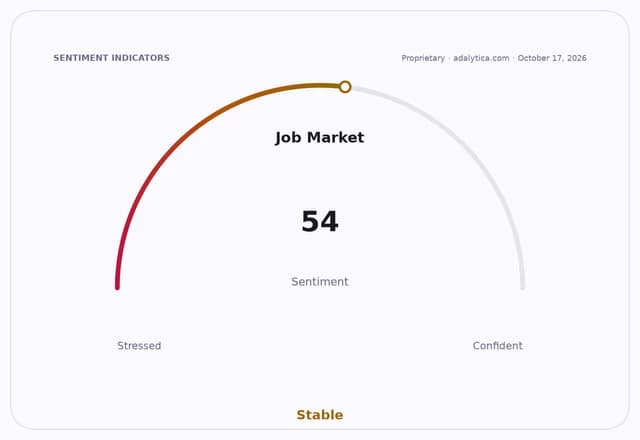
The broader job picture is still fragile. Adalytica’s job market sentiment snapshot sits at 54, neutral, after swinging sharply over the past week, while consumer-confidence recession sentiment remains weak at 32 and awareness is in “extreme fear,” pointing to a labor market where workers may be more willing to accept restrictive terms in exchange for security. That combination can help employers control costs in the near term, but it raises the odds of regulatory scrutiny and employee pushback if contract practices are seen as one-sided.
For investors, the next catalyst is whether job-market softness turns into visible pressure on hiring, placement volumes and wage growth across staffing and payroll providers. If that happens, the winners are employers looking to preserve flexibility; the losers are workers, recruiters and companies reliant on churn in the labor market.
| Entity | Gains | Losses |
|---|---|---|
| Employers | ▲More hiring flexibility | ▼Less worker leverage |
| Workers | ▲Fewer immediate openings | ▼More restrictive contracts |
| Staffing firms | ▲Higher urgency for placement | ▼Slower permanent hiring |
| ADP / peers | ▲Stable payroll base fees | ▼Weaker client employment growth |