AI data centers are heading into a more hostile political and regulatory climate after Democrats swept a string of battleground races and turned the industry into a campaign target over power prices, water use and land consumption.
AI Data Centers Face Tougher State Regulation
That matters because the AI buildout is no longer just a Silicon Valley story. It has become a major industrial project underpinning electricity demand, construction spending and semiconductor orders, while also creating local backlash over who pays for the power and infrastructure needed to support it. If state governments move to impose tougher permitting rules, tax changes or moratoriums, the effects could ripple from utilities and data center developers to chipmakers such as Nvidia and hyperscalers including Microsoft, Amazon and Google.
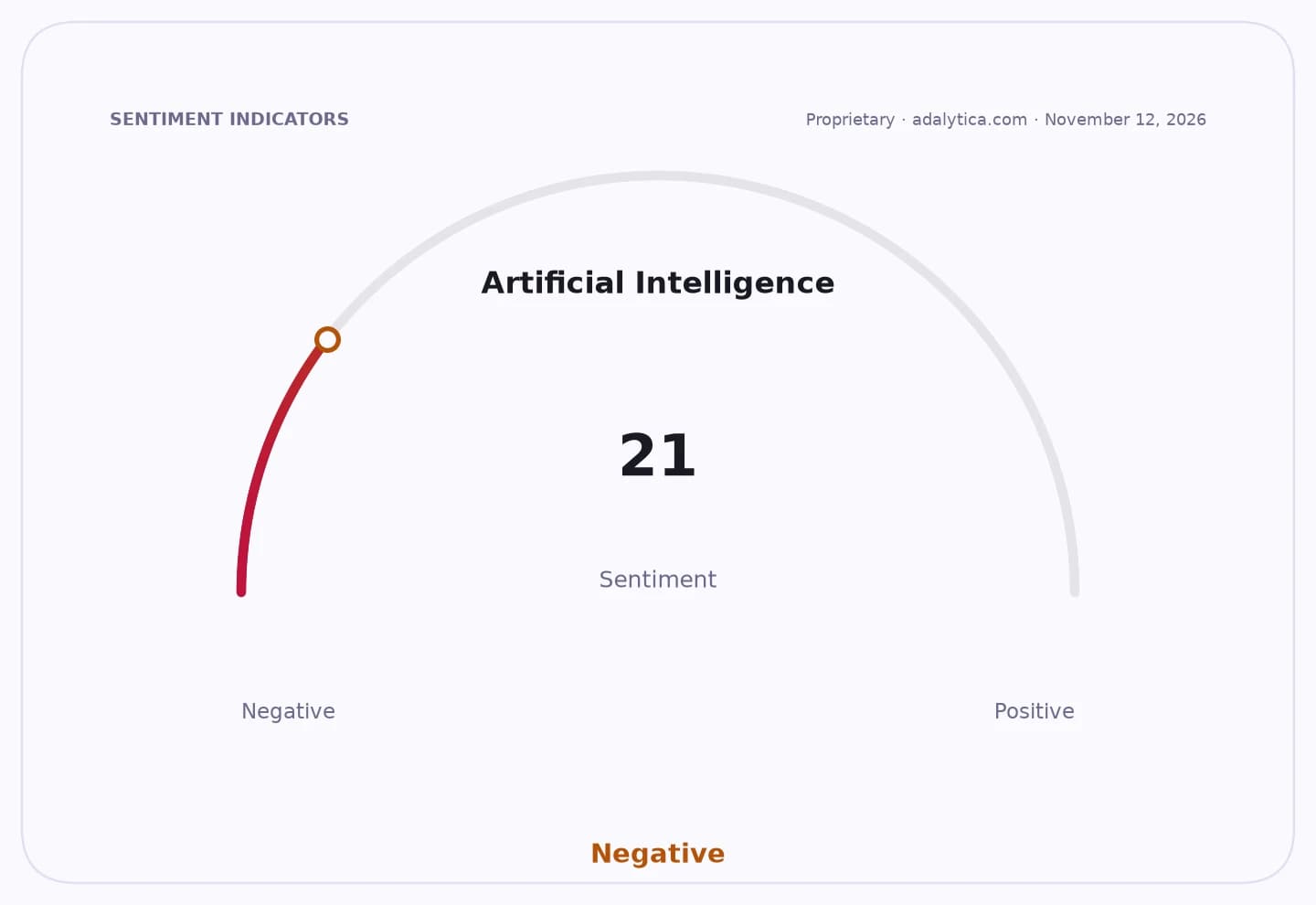
Sentiment Indicators
The election results suggest the pushback is broadening. Democrats flipped governorships in Texas, Ohio, Georgia, Nevada and Iowa, while also taking full control of state governments in Arizona, Wisconsin, Minnesota, Pennsylvania, Nevada and Michigan, according to the Associated Press. Data Center Watch said 32 of the 34 victorious governor candidates in races it tracked backed stronger regulation or restrictions, and 12 supported bans or moratoriums.
Even where data centers were not a top-line ballot issue, they were a potent symbol of affordability politics. Campaigns spent more than $380 million on television ads mentioning data centers, with Democrats outspending Republicans more than 3-to-1, according to AdImpact. Local opposition was even clearer: Redbud Consulting said 44 of 45 municipal referendums it tracked ended with voters approving restrictions, underscoring how little public appetite there is for new server farms nearby.
For investors, the timing is awkward. AI infrastructure spending has been one of the clearest growth drivers in the U.S. economy, helping support construction, equipment purchases and power demand even as broader growth cools. But the same boom now faces a new political discount. Morgan Stanley warned the election outcomes raise the odds of data center restrictions that could “split the country into areas that are open to new data centers and those without,” with Texas and Ohio highlighted as especially important markets.
That risk lands directly on the companies most exposed to the buildout. Nvidia has already fallen sharply, with its share price down to $163.72 on Thursday from $221.97 on Oct. 21, and the stock’s 14-day RSI at 23.8 points to heavily oversold conditions after a rapid selloff. Microsoft, by contrast, has held up better, closing at $523.07 on Thursday, while Amazon ended at $268.02. But the broader message is the same: if permitting gets harder or projects get delayed, the spending cycle that has powered the AI trade could stretch out or become more uneven.
The industry is trying to get ahead of the backlash. OpenAI published a framework Thursday calling for clearer rules and commitments to communities where it builds. The Data Center Coalition said companies will need to do more to win public trust, even as it warns that restrictions could deprive communities of tax revenue and investment.
The bull case for the sector is that demand is still real, the economics of AI are still expanding, and political resistance may be most severe at the local level rather than through a nationwide federal crackdown. The bear case is that state-level rules, utility constraints and community opposition now add another layer of friction just as capital costs remain elevated and AI infrastructure spending becomes too visible to ignore.
For tech giants, the election is a warning that the next phase of AI expansion will be judged less by model performance than by power bills, water access and local politics. The winners of the AI race may still build, but they may have to pay more, wait longer and justify their projects more often.
| Entity | Gains | Losses |
|---|---|---|
| Local communities | ▲More leverage over projects | ▼Missed tax revenue |
| State regulators | ▲More power over permitting | ▼Faster AI buildout |
| AI hyperscalers | ▲Clearer rules if adopted | ▼Higher costs, delays |
| Nvidia and data center suppliers | ▲Continued demand if projects proceed | ▼Slower construction cycle |