AI is making companies faster, but that speed may be masking a more expensive loss: the slow erosion of judgment.
AI Speed May Erode Junior Judgment
That is the warning from Mariano Ventosa Rodríguez, vice-rector for digital strategy and AI at Madrid’s Universidad Pontificia Comillas, who argues that the real danger is not that artificial intelligence replaces work, but that it quietly removes the “friction” young professionals need to learn how to think. In his view, firms are measuring output and speed while ignoring whether juniors are actually building the judgment that keeps organizations resilient when something goes wrong.
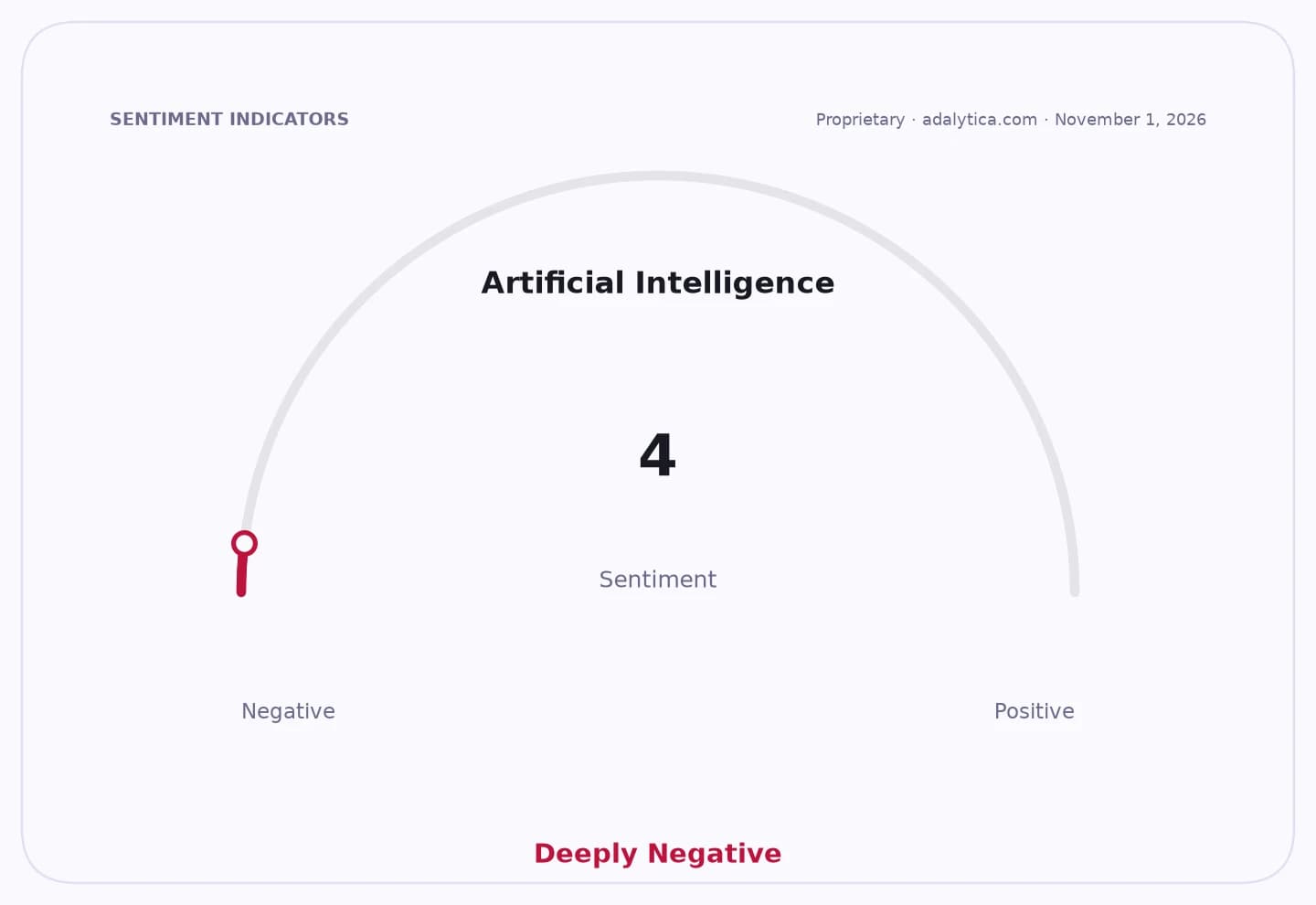
Sentiment Indicators
The economic stakes are bigger than an academic debate. If AI lets entry-level workers produce polished reports, analyses and presentations without doing the hard thinking underneath, companies may look more productive in the near term while weakening the talent pipeline that feeds middle management and senior decision-making later on. Ventosa said firms may be “flattening” their organizations, but they cannot prove it because they track productivity, not learning.
That matters because the productivity gains investors are cheering today can become a hidden liability tomorrow. The market is still treating AI primarily as a margin story — fewer hours, faster workflows, lower operating costs — but this is also a labor-quality story. If juniors are promoted faster because their output looks senior-level, businesses may be taking on more operational risk than their dashboards reveal. The first sign of trouble may not appear in quarterly earnings, but in execution errors, bad calls and higher remediation costs.
The message lands at a moment when AI spending is already distorting market leadership. Nvidia remains the clearest beneficiary of the buildout, even after a sharp pullback, with the chipmaker still sitting on enormous investor attention despite its stock having fallen to $166.19 from above $220 in October. Microsoft, meanwhile, is holding up far better, with shares around $523 after touching $555.80 earlier in November, showing that capital is still favoring platforms tied to enterprise AI adoption. But Ventosa’s warning is a reminder that the next phase of AI winners may not be the ones selling speed alone. The durable opportunity lies with companies that turn AI into a training aid, not a substitute for human judgment.
That is why the real investment question is not whether AI boosts productivity — it clearly does — but whether organizations can preserve the costly learning process that creates decision-makers. Ventosa’s prescription is telling: use AI after attempting the task first, and reward effort as well as output. In corporate terms, that means the firms best positioned for the next AI cycle will be those that redesign workflows, incentives and management systems so artificial intelligence amplifies human capability instead of hollowing it out.
For investors, the takeaway is straightforward. The market is still pricing AI as a speed and capex story. The bigger secular opportunity may be in the companies that help preserve institutional judgment — from AI workflow software and training platforms to infrastructure providers and enterprise systems that embed oversight, verification and human-in-the-loop controls. That is where the next asymmetric returns may emerge as the AI boom matures.
| Entity | Gains | Losses |
|---|---|---|
| AI software vendors | ▲Faster adoption | ▼Overreliance backlash |
| Nvidia | ▲More compute demand | ▼Any capex slowdown |
| Microsoft | ▲Enterprise AI monetization | ▼Margin pressure from spend |
| Junior workers | ▲Faster output | ▼Skill formation |