Wall Street’s rally is being driven by a renewed bid for Amazon and chipmakers, even as oil pushing back above $100 a barrel threatens to reheat inflation and keep interest rates higher for longer.
Amazon, Nvidia Gain as Oil Tops $100 Again
That matters because the market is once again being forced to price two competing forces at the same time: stronger earnings power from AI-linked technology spending and a fresh inflation shock from energy. The first is lifting the growth trade. The second is pressuring everything tied to discount rates, consumer demand and central-bank policy. For investors, that split is where the next big opportunities — and mistakes — will come from.
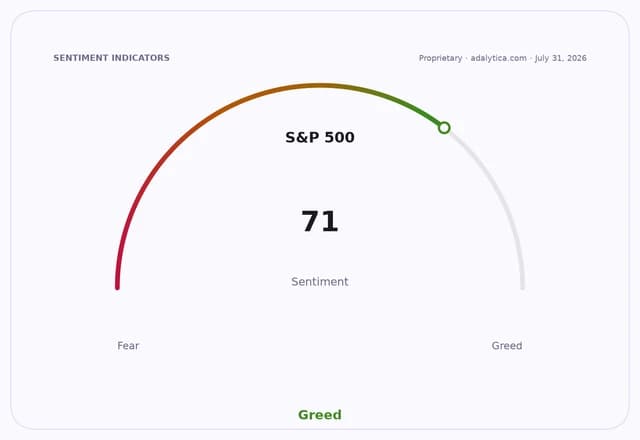
Sentiment IndicatorsⓘProprietary · adalytica.com · July 31, 2026
This is a snapshot — live sentiment, awareness and momentum for 130+ markets update continuously in the dashboard.Open AlphaPulse

Amazon was the standout, surging to $271.58 in the latest session from $235.50 a day earlier, a move that pushed the stock well above its 50-day moving average of $246.63 and its 200-day average of $235.01. Nvidia also recovered to $200.75 after recent weakness, while the SOXX-style semiconductor complex continues to benefit from the idea that AI infrastructure spending is still in the early innings. The technical backdrop improved too: Amazon’s RSI climbed to 64 and Nvidia’s to 47.7, suggesting buyers are returning after a sharp pullback.
The market is reading those gains as more than a short-term bounce. Amazon is emerging as one of the clearest beneficiaries of the AI capex cycle, with cloud demand, logistics automation and ad revenue all linked to the same secular investment wave. Nvidia remains the toll road on that spending. If hyperscalers keep pouring money into data centers, accelerators and networking, the earnings power of both names should keep compounding even if the broader economy slows.
The risk, however, is that crude’s move changes the macro story before the market is ready. West Texas Intermediate is forecast at $88.70 on July 28, but the recent jump after geopolitical tensions and renewed conflict in Iran has already revived inflation fears. The 10-year Treasury yield has climbed to 4.68%, underscoring the market’s discomfort with a world where growth is resilient but energy costs are rising again. That combination is toxic for rate-sensitive sectors and a warning sign for consumer-facing companies that depend on discretionary spending.
The inflation threat is not abstract. Adalytica’s CPI sentiment snapshot is in fear territory at 21, while the S&P 500 trade signal shows extreme greed at 99 on awareness, a mix that suggests investors are chasing risk even as macro stress builds. Oil prices above $100 can quickly bleed into transport, manufacturing and household budgets, and the damage rarely stays confined to the energy complex. It tends to work through margins first and demand later.
That is why this rally still favors quality growth over cyclicals. If oil stays elevated, the winners are likely to be companies with pricing power, structural demand and exposure to AI infrastructure rather than broad consumer beta. Amazon fits that profile better than most mega-cap peers, and Nvidia remains the purest expression of the compute buildout. Energy stocks, meanwhile, have their own support, with XLE pushing to 59.55 and holding above both key moving averages, but the trade is increasingly crowded as inflation hedges come back into favor.
For investors, the message is straightforward: the oil shock raises the macro noise, but it does not erase the secular AI and infrastructure thesis. I believe the better play is to stay positioned in the names that benefit from both capital spending and scarcity — Amazon, Nvidia and the broader chip stack — while respecting that higher fuel costs can keep the Federal Reserve cautious and cap upside in the rest of the market. If inflation keeps accelerating, the winners will be the companies selling the tools of the next investment cycle, not the companies most exposed to it.
| Entity | Gains | Losses |
|---|---|---|
| Amazon (AMZN) | ▲AI and cloud demand | ▼Higher discount rates |
| Nvidia (NVDA) | ▲Data-center capex | ▼Broad risk-off selling |
| Energy sector (XLE) | ▲Inflation hedge flows | ▼Crowded trade risk |
| Consumers and rate-sensitive stocks | ▲— | ▼Higher fuel and borrowing costs |