The Australian dollar is expected to grind higher against the US dollar through late 2026 and 2027, with consensus forecasts pointing to 0.7143 by December and 0.7305 within a year, a move that would help unwind some of the pressure from a dollar that still looks expensive after its latest run-up.
AUD/USD Forecast Points to Gradual Gains

That matters because AUD/USD is one of the market’s cleanest gauges of the relative path of two economies tied to different forces: Australia’s commodity and China exposure on one side, and the US Federal Reserve and safe-haven demand on the other. A firmer Australian dollar would ease imported inflation at the margin, reduce hedging costs for Australian buyers of US goods and assets, and alter returns for investors holding US dollar exposure through currency-sensitive funds.
Sentiment IndicatorsⓘProprietary · adalytica.com · September 26, 2026
This is a snapshot — live sentiment, awareness and momentum for 130+ markets update continuously in the dashboard.Open AlphaPulse

The forecast published by Exchange Rates UK puts the pair at 0.70750 by September 2026, 0.71430 by December and 0.72020 by March 2027, before rising to 0.73050 in about a year. Near-term projections are only modestly above the current spot rate of 0.71070, but the path implies a steady appreciation rather than a sharp breakout. The consensus view for Q4 2027 is even firmer at 0.73819, with 87% of surveyed providers leaning bullish.
The setup reflects a market that has stopped treating the US dollar’s recent strength as a one-way trade. The dollar has had support from higher US yields and periodic risk aversion, but the broader backdrop is starting to look less favorable for sustained gains. The 10-year Treasury yield has risen to 4.96% and the 2-year to 4.71%, while the curve remains only modestly positive at 0.26 percentage point, underscoring a still-restrictive US rate environment. Even so, the fact that AUD/USD is forecast higher suggests investors expect either some easing in US growth or policy expectations, or a more supportive turn in global risk appetite.
For Australia, the implications are mixed but generally constructive. A stronger currency tends to weigh on exporters by making shipments more expensive in US dollar terms, but it also lowers the local-currency cost of energy, machinery and other imports. That can help contain inflation and give the Reserve Bank of Australia more room to manage domestic demand without further tightening. For companies with large US sales or costs, the direction of the pair matters for translation and margin assumptions as much as for revenue.
The market tone is consistent with that view. FXA, the Australian dollar exchange-traded fund, has recently traded close to 69.51-69.76 after climbing as high as 70.41 earlier in the year, while RSI readings around the low 20s suggest the fund has been heavily sold in the near term. That does not by itself call a bottom, but it does show the market is not pricing an aggressive AUD rally yet. By contrast, the dollar ETF UUP has been firmer, with a recent close of 28.69 and an RSI at 87.0, a level that often signals stretched momentum. FXE, a proxy for the euro, has also weakened to 104.99 with an RSI of 10.9, reinforcing the sense that dollar strength has become crowded across currencies.
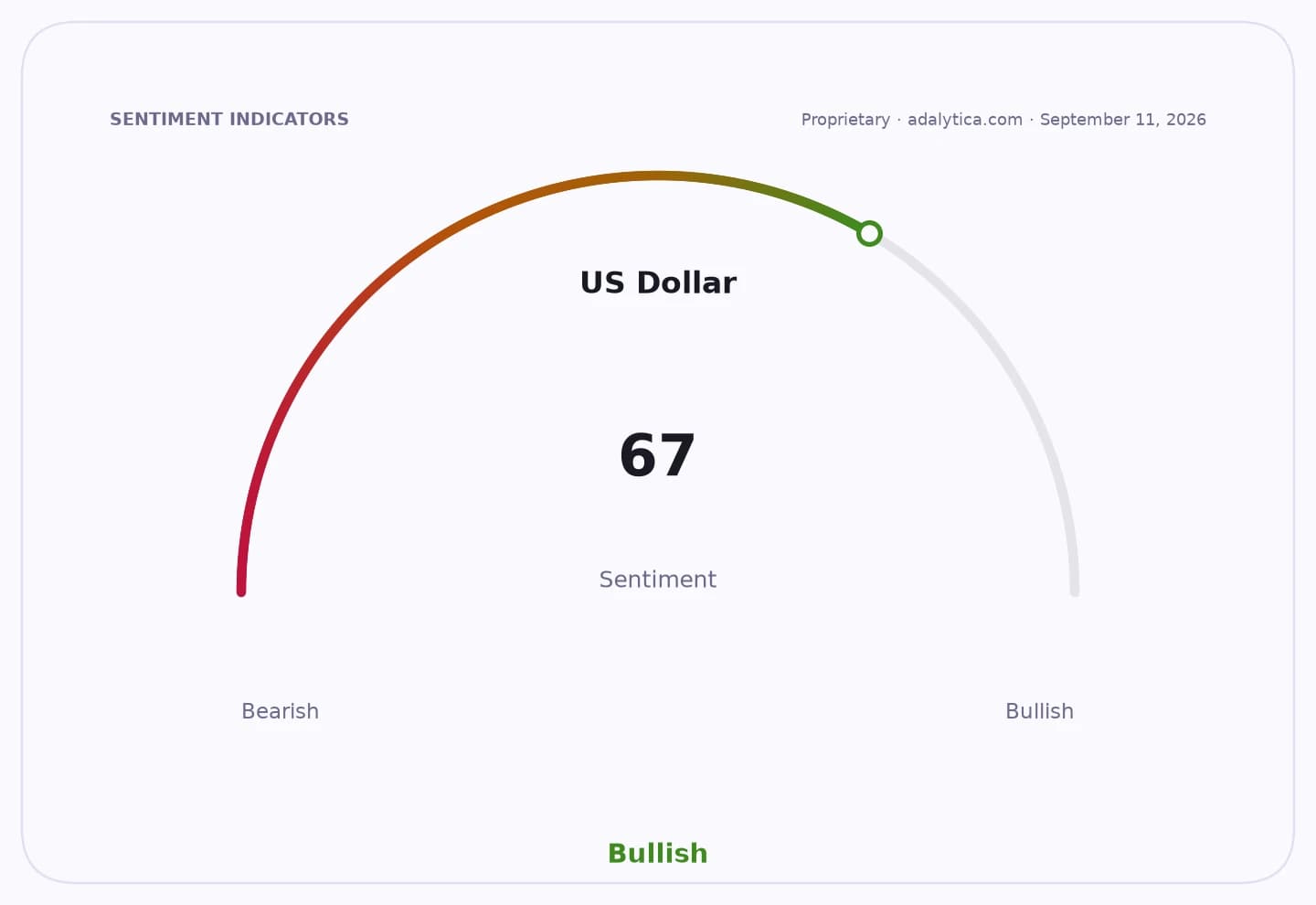
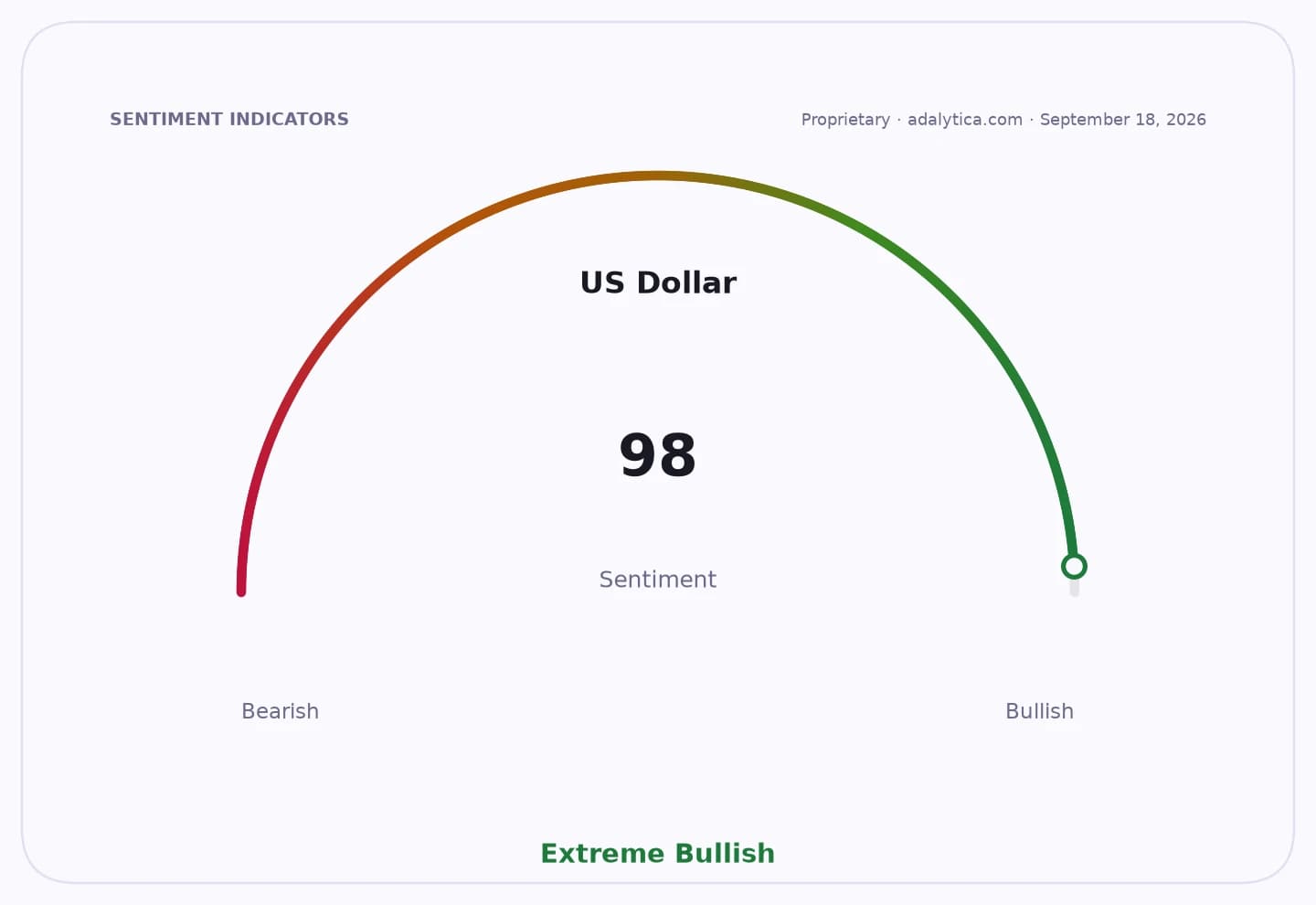
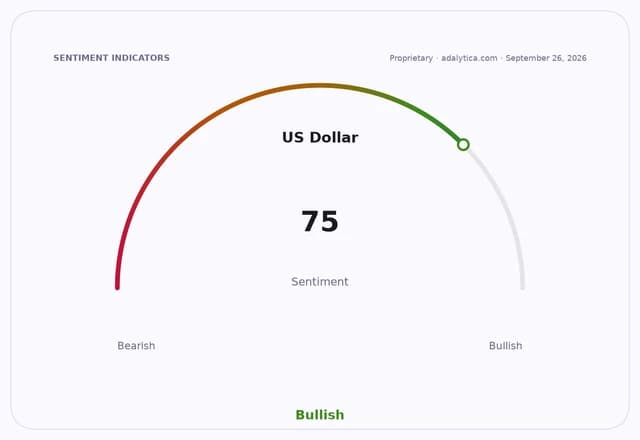
Adalytica’s US dollar trade signals also point to an increasingly one-sided setup. The dollar snapshot shows sentiment at 75, labeled “Greed,” while awareness sits at 2, labeled “Extreme Fear,” a combination that suggests enthusiasm may be high even as conviction is fragile. In other words, the dollar can still rally if yields climb or risk aversion deepens, but the balance of positioning and sentiment argues against assuming the latest move will last indefinitely.
For investors, the key question is whether the AUD forecast proves too conservative. A more durable improvement in global growth, a softer US rate path, or firmer Chinese demand would all support the Australian currency and make the current 0.71 area look like a base rather than a ceiling. The bearish case is straightforward: if the Federal Reserve stays tighter for longer, or if global risk appetite deteriorates, AUD/USD could remain pinned below the forecast path and challenge the lower end of the provider range, which runs down to 0.67001 for late 2027.
The market is therefore shifting from a simple dollar-dominance trade to a more nuanced currency regime, where the Australian dollar has room to recover but still depends on the pace of US easing and the durability of global demand. For now, the forecast leans toward gradual AUD appreciation rather than a dramatic rerating, and that makes the next few central bank meetings and major US data releases the most important catalysts to watch.
| Entity | Gains | Losses |
|---|---|---|
| Australian exporters | ▲Higher foreign revenue in local terms | ▼Less price competitiveness abroad |
| Australian importers | ▲Cheaper US goods and inputs | ▼Fewer benefits from USD pricing power |
| AUD bulls | ▲Gradual upside toward 0.73 | ▼Risk of Fed-led dollar strength |
| USD bulls | ▲Near-term yield support | ▼Crowded positioning and valuation risk |