Europe’s biggest asset manager has taken a meaningful step toward turning tokenization from a crypto experiment into a mainstream fund business.
Amundi Launches Tokenized STOXX Europe 600 Fund on Ethereum
Ethereum
Amundi has launched a tokenized share class of its STOXX Europe 600 equity index fund on Ethereum, giving investors blockchain-based access to a portfolio that tracks 600 large-, mid- and small-cap companies across developed European markets. For long-term investors, the significance is not the blockchain wrapper itself — it is the possibility that settlement, distribution and fund administration can become faster, cheaper and more scalable across a giant, low-margin industry.
Sentiment Indicators
The new share class was issued on Ethereum in partnership with CACEIS, Amundi’s asset-servicing provider, and the fund will still remain available through traditional channels. That matters because this is not a crypto-only product aimed at speculators; it is a conventional European equity fund using blockchain rails. In other words, Amundi is testing whether tokenization can improve the plumbing of investing without changing the underlying asset exposure.
That is exactly where the economic case for tokenization lives. Asset managers make money on scale, efficiency and distribution. If tokenized share classes really do reduce operational friction, shorten settlement times and broaden access through digital platforms, they could help large fund houses defend margins in an increasingly competitive industry. For European markets, the bigger prize is strategic: if traditional firms do not build these products at home, the business may migrate to U.S.-led platforms and crypto-native issuers that are already moving faster.
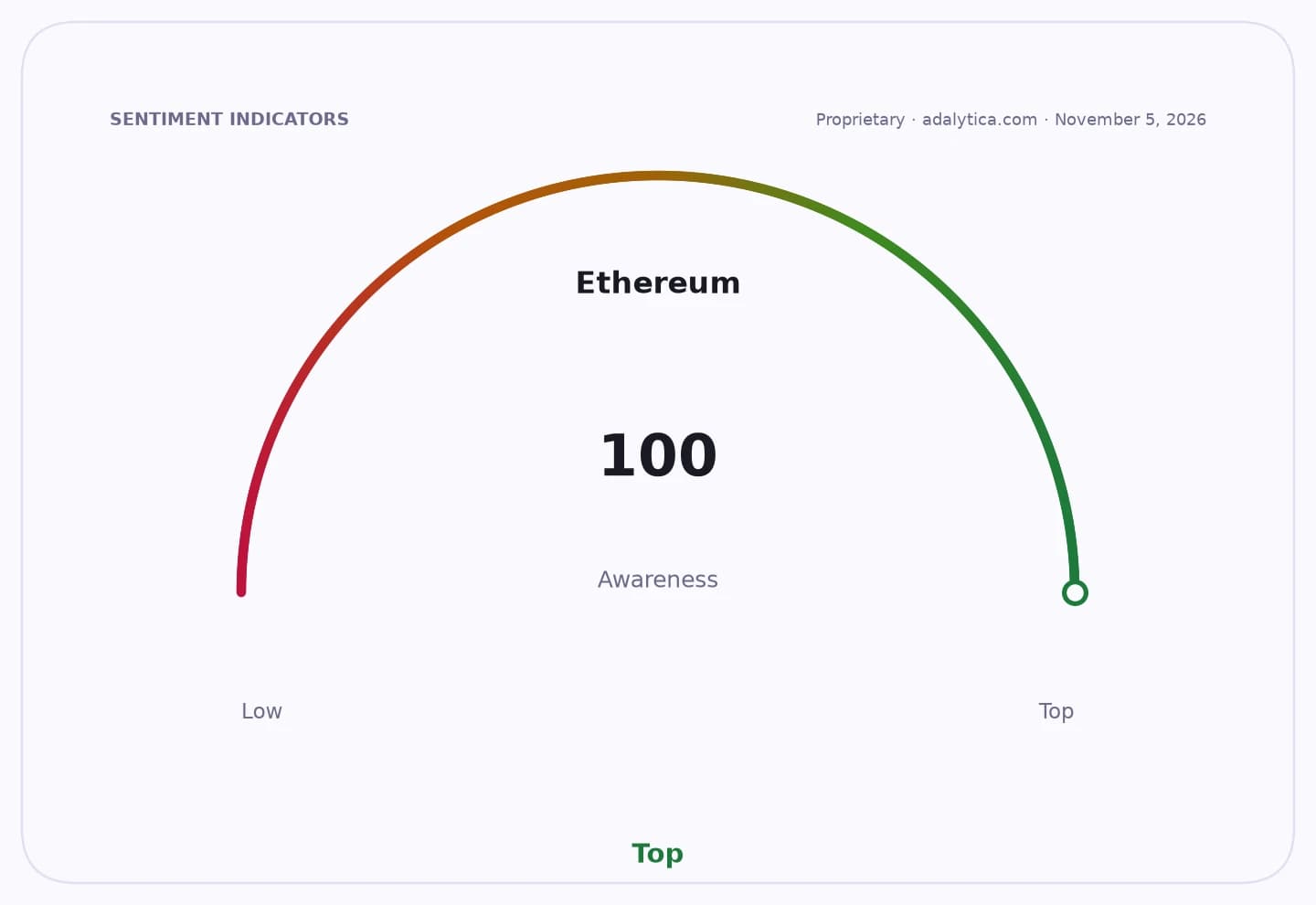
Ethereum — 30-day sentimentadalytica.com
Explore this data interactively — full history, time series and cross-market comparisons.
The launch follows Amundi’s first tokenized money market fund share class in November, also built with CACEIS on Ethereum. That suggests this is becoming a program, not a one-off marketing exercise. And Amundi is hardly alone in seeing the opportunity. Tokenized stocks are already a fast-growing niche, with their total value climbing to $4.24 billion, up nearly 27% in 30 days, according to RWA.xyz. But the market is still dominated by U.S.-linked assets, from Securitize to SpaceX, Circle and Alphabet — a reminder that Europe remains early in the race.
That helps explain why European firms have been pressing regulators for faster rule changes. A coalition of 39 companies and industry groups warned in April that the EU risks falling behind the U.S. unless it expands eligible assets, raises volume caps and removes time limits under its Distributed Ledger Technology Pilot Regime. Amundi’s move gives that lobbying push a concrete business case: institutions are ready to build, but they need clearer rules and enough room to scale.
Investors should view this as part of a broader modernization theme rather than a near-term earnings event. The first beneficiaries are likely to be infrastructure providers, custodians and established asset managers that can use tokenization to deepen distribution and lower back-office costs. The losers, at least over time, could be slower-moving fund firms and legacy transfer agents that depend on dated operating models. Even for Ethereum, the takeaway is more muted: institutional adoption is still incremental, but every real-world fund product adds legitimacy to the network’s role in financial infrastructure.
For now, the key question is not whether tokenized funds will replace traditional ones. It is whether they become a second, more efficient layer of distribution for the same portfolios. If they do, Amundi’s 12-month step onto Ethereum could prove to be an early marker of how Europe’s asset-management industry evolves over the next decade. Worth watching, and worth adding to the long-term investor’s watchlist.
| Entity | Gains | Losses |
|---|---|---|
| Amundi | ▲broader distribution | ▼legacy cost structure |
| CACEIS | ▲more servicing demand | ▼commoditized admin work |
| Ethereum | ▲institutional credibility | ▼none near term |
| Traditional fund rivals | ▲not much | ▼pressure to modernize |