China’s expanding reach in global commodities is becoming a bigger test for miners, and Anglo American’s latest deal shows why investors are treating any Beijing-linked agreement as a strategic, not just commercial, event.
Anglo American China Deal Faces Trade Pressure

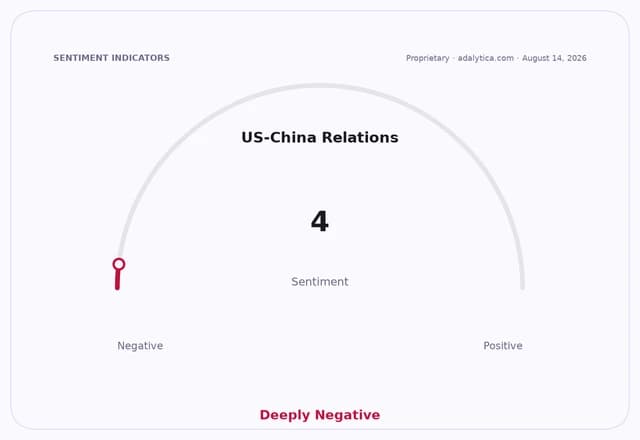
Anglo has finalized a China deal that ties into a broader contest over supply chains and market access, but the real question for shareholders is whether the arrangement can hold up if Washington keeps widening its trade pressure on countries doing more business with Beijing. The transaction lands at a time when US-China relations have deteriorated sharply, with Adalytica’s US–China relations gauge sitting at 4, or “Extreme Fear,” while awareness remains elevated, underscoring how closely markets are watching the next escalation.
Sentiment IndicatorsⓘProprietary · adalytica.com · August 14, 2026
This is a snapshot — live sentiment, awareness and momentum for 130+ markets update continuously in the dashboard.Open AlphaPulse

For miners such as Anglo, BHP and Rio Tinto, China remains both the largest demand center and the most important source of pricing power in bulk commodities, especially iron ore and copper. Any deal that deepens commercial ties with Chinese counterparties can support volumes, logistics and capital discipline in the near term. But it can also sharpen political risk, particularly if the US continues to pressure third countries such as Brazil over their China trade, or if tariffs and sanctions spill into commodity flows, financing and project approvals.
The market reaction in London-listed miners suggests investors are focused on that balance. Anglo’s shares have recovered to about 15.06 from a March low of 10.43, while technical readings show the stock still hovering around its 50-day moving average and far below the extremes seen earlier in the year. That points to a market that has warmed to the China theme again, but has not yet priced in a clean, durable rerating. BHP and Rio Tinto have also held near elevated levels, reflecting continued confidence in Chinese demand, though both remain exposed to any slowdown in Chinese industrial activity or renewed policy friction.
US-China Relations vs AALadalytica.com
Explore this data interactively — full history, time series and cross-market comparisons.Open AlphaPulse
The bullish case is straightforward: China demand remains indispensable, and miners with scale and high-quality assets can use closer commercial ties to secure offtake, protect market share and improve negotiating leverage. The bearish case is that the more explicit the linkage to China becomes, the more a miner risks getting caught between the world’s two largest economies, with trade policy, sanctions risk and political backlash limiting the benefits of any single deal.
That makes Anglo’s agreement less a finish line than a stress test. Investors will now look for evidence that the deal translates into stable volumes, better pricing or lower costs without drawing unwanted political attention. If US-China tensions worsen, the same arrangement that looks strategically smart today could become a source of volatility tomorrow.
| Entity | Gains | Losses |
|---|---|---|
| Anglo American | ▲China market access | ▼Geopolitical optionality |
| China buyers | ▲Secured commodity supply | ▼Less dependence on spot markets |
| BHP and Rio Tinto | ▲Rival demand remains strong | ▼Pressure to match China ties |
| US policymakers | ▲Trade leverage | ▼Influence over commodity flows |