Anthropic’s move to open a Singapore office and sign an AI safety pact with the government matters because it puts one of the world’s most closely watched AI companies at the center of a country that is turning regulation into a competitive advantage.
Anthropic opens Singapore office and signs AI safety pact

Singapore is not just another overseas market. It is becoming a regional test bed for how governments, banks and large enterprises adopt powerful AI while trying to keep model risk, security and compliance under control. That makes the deal economically important well beyond the small island state: it strengthens Anthropic’s distribution in Asia-Pacific, deepens its enterprise footprint, and gives Singapore a bigger role in shaping the rules that will govern AI deployment across the region.
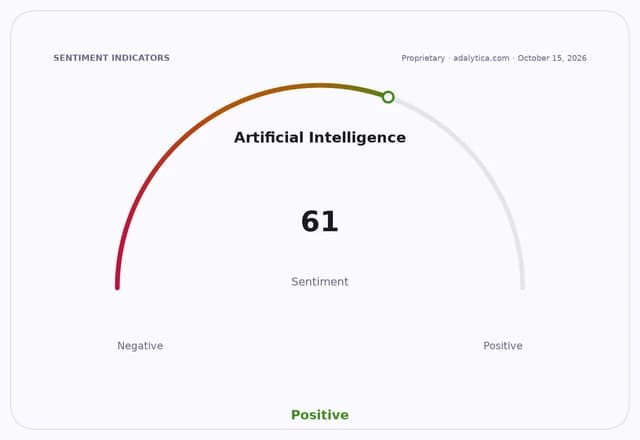
Sentiment IndicatorsⓘProprietary · adalytica.com · October 15, 2026
This is a snapshot — live sentiment, awareness and momentum for 130+ markets update continuously in the dashboard.Open AlphaPulse
The new office is Anthropic’s fifth in Asia-Pacific, underscoring how aggressively the company is following demand. Anthropic said Singapore is one of its most active markets globally, with Claude being used by businesses and government services serving millions of people every day. The company’s latest Economic Index shows Singapore ranked second among 121 countries in Claude.ai usage relative to population, with activity nearly six times higher than what demographics alone would imply.
That usage matters because AI monetization ultimately depends on where the software gets embedded in workflows, not just where it gets tested. In Singapore, the customer base already includes GovTech, DBS, GIC and Grab — the kind of anchor accounts that turn AI from a pilot program into a recurring enterprise infrastructure layer. More than 1,500 engineers and technical staff at GovTech have adopted Claude Code to modernize government systems and speed software delivery, while Grab says Claude-powered BriX saves sales teams about 40,000 hours a quarter. Those are not vanity metrics; they are productivity gains that can justify deeper enterprise spend.
For investors, the key takeaway is that Anthropic is building exactly the kind of trust-based distribution moat the market underestimates in AI. In a sector often framed around raw model performance and GPU supply, the real long-term winners will be the companies that win government approval, meet security standards and become embedded in regulated workflows. Singapore’s Ministry of Digital Development and Information is now formalizing technical exchanges on model evaluation, testing standards and incident response, along with research sharing and policy expertise as the country develops its AI rules.
That creates a second-order benefit for the broader AI stack. If Singapore becomes a regional benchmark for safe deployment, it could accelerate enterprise adoption across Asia-Pacific and pull forward spending on cloud, cybersecurity, model testing and AI governance tools. It also reinforces demand for the hardware and software backbone that makes these deployments possible. Nvidia remains a central beneficiary of rising AI inference and enterprise rollout, while Microsoft stands to gain as organizations standardize AI inside productivity and software-development workflows. The market, however, has been too focused on the headline winners and not focused enough on the ecosystem of toll roads around them.
The policy backdrop makes this even more important. Singapore is positioning itself as a practical AI rule-maker at a time when global regulators are moving from broad concern to hard requirements. By partnering with Anthropic rather than resisting it, the government is signaling that safety and adoption will advance together. That is an investable theme: countries that build credible frameworks fastest will attract more AI capital, more pilot programs and more enterprise spending.
The next catalyst is execution. If Anthropic can turn the Singapore office into a regional hub for enterprise sales, government projects and model assurance, it strengthens the case that frontier AI is shifting from experimental spend to durable infrastructure demand. For investors, the opportunity is to own the picks-and-shovels of that transition — the compute providers, cloud platforms, cybersecurity names and enterprise software vendors that benefit every time AI moves one step deeper into the real economy.
| Entity | Gains | Losses |
|---|---|---|
| Anthropic | ▲Asia-Pacific expansion | ▼Local rivals in enterprise AI |
| Singapore government | ▲Stronger AI safety framework | ▼Slower laissez-faire adoption |
| Nvidia | ▲More AI infrastructure demand | ▼Firms underinvested in compute |
| Microsoft | ▲Deeper enterprise AI usage | ▼AI laggards in productivity software |