Only two companies have ever touched the $5 trillion mark, and the choice between Apple and Nvidia now hinges on the same trade-off that built their fortunes: Nvidia offers far more growth at a much cheaper valuation, while Apple offers slower compounding with a steadier business and stronger downside protection.
Apple vs Nvidia: valuation and growth comparison
That contrast matters because the two megacaps sit at the center of the market’s most powerful themes. Nvidia remains the cleanest public-market way to own the AI infrastructure build-out, while Apple is the mature cash machine that still turns hardware loyalty into recurring services revenue and buybacks. For investors, the decision is less about which company is better run than which mix of duration, valuation and cyclicality they want in a portfolio.
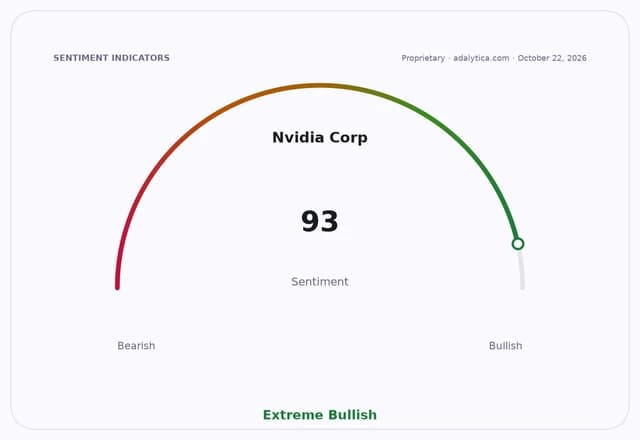
Sentiment IndicatorsⓘProprietary · adalytica.com · October 22, 2026
This is a snapshot — live sentiment, awareness and momentum for 130+ markets update continuously in the dashboard.Open AlphaPulse

Nvidia’s growth profile is still extraordinary even by megacap standards. The company generated nearly $27 billion of revenue in fiscal 2023, and analysts now expect almost $412 billion in fiscal 2027, a roughly 15-fold increase in five years off a large base. The stock has also kept its strategic edge as AI spending broadens from model training to inference and agentic workloads, with its chips, software and networking increasingly sold as an integrated “AI factory” stack.
That growth comes at a price investors have been willing to pay. Nvidia trades at about 13.5 times fiscal 2028 earnings estimates, according to the figures cited in the source material, a fraction of Apple’s roughly 36 times forward earnings. Even after its huge run, the market is still valuing Nvidia as if much of the growth is ahead, not behind.
But Nvidia’s appeal cuts both ways. Its business is more exposed to a pullback in AI infrastructure spending than Apple’s is to consumer device cycles, and that makes the stock vulnerable if hyperscalers or enterprise buyers slow capex. The recent price action reflects that tug of war: Nvidia’s shares have been volatile around the low- to mid-220s, with the 50-day moving average near 223 and the relative strength index hovering near 40, a sign of cooling momentum after a strong move earlier in the year.
Apple, by contrast, is the safer long-term compounder, not the faster one. Its revenue growth is far more modest, but earnings have continued to outpace sales as the company monetizes a loyal, affluent customer base through the App Store, iCloud, payments and search-revenue sharing. That ecosystem makes Apple more resilient than a typical hardware maker, even as the iPhone remains roughly half of total revenue and the company faces the normal replacement-cycle drag that comes with mature consumer electronics.
Apple’s valuation is the price of that stability. Investors are paying up for predictability, capital returns and the durability of the installed base, helped by an ongoing buyback program and a balance sheet that can absorb shocks. The stock has also held up technically better than Nvidia, with the shares recently around the mid-340s, above both the 50-day and 200-day moving averages, and momentum readings still relatively firm.
The near-term narrative, then, is not that one of these companies has become bad and the other good. It is that the market is forcing a choice between two different kinds of quality. Nvidia offers higher upside if AI spending keeps compounding and its platform remains the standard for training and inference. Apple offers a more durable earnings stream, but with much less room for multiple expansion unless growth improves.
For investors, that means Nvidia is the higher-beta bet on the next leg of the AI cycle, while Apple is the defensive megacap for those who want exposure to consumer technology with less dependence on one capital-spending boom. The better stock depends on whether the next few years look more like an infrastructure supercycle or a steady cash-compounding story.
| Entity | Gains | Losses |
|---|---|---|
| Nvidia shareholders | ▲Higher growth upside | ▼Greater AI-cycle risk |
| Apple shareholders | ▲Stability and buybacks | ▼Slower earnings growth |
| AI infrastructure buyers | ▲Turnkey compute stack | ▼Higher capital intensity |
| Value-oriented investors | ▲Cheaper multiple in NVDA | ▼Richer valuation in AAPL |