Nvidia’s unusually flat management model is becoming a strategic advantage, helping the chipmaker keep employees even as demand, pressure and pay expectations surge across the AI economy.
Nvidia Flat Management Supports Retention and Execution
That matters because in a market where the scarce resource is no longer just chips but the engineers, program managers and technical leaders needed to design and ship them, retention is a direct input to execution. Nvidia said in its fiscal 2026 sustainability report that global turnover was just 3.7%, far below the 21.9% average in technology, while 95% of its UK employees called it a great place to work, versus a 54% benchmark for other organizations there.
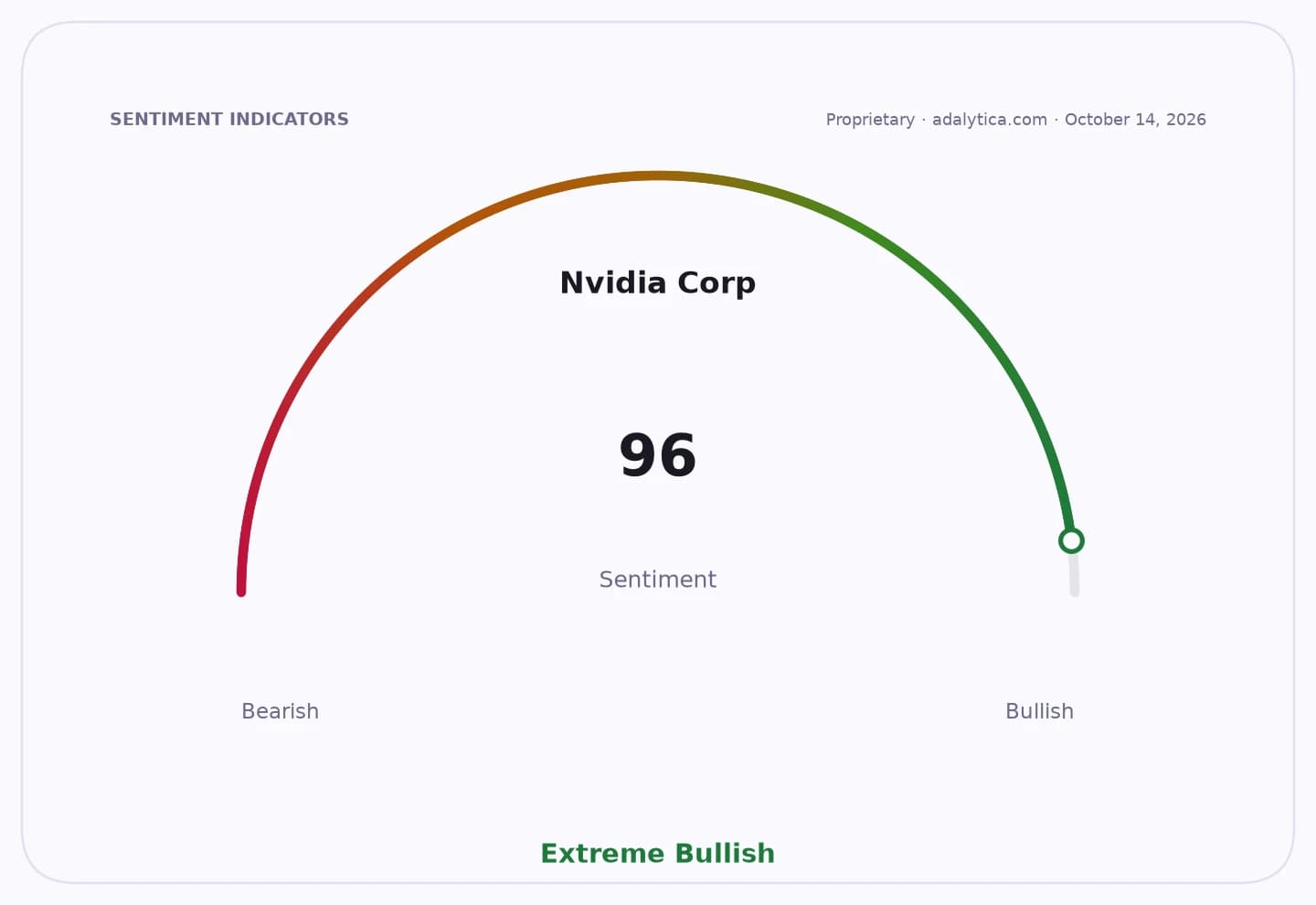
Sentiment IndicatorsⓘProprietary · adalytica.com · October 14, 2026
This is a snapshot — live sentiment, awareness and momentum for 130+ markets update continuously in the dashboard.Open AlphaPulse
The company’s pitch is simple: pay aggressively, grant autonomy and strip away layers that can smother speed. Human resources chief Febe Punsalan said Nvidia keeps its structure “very flat,” with strategic leaders reporting directly to Chief Executive Jensen Huang and every employee encouraged to speak up, regardless of seniority. Huang had 36 direct reports as of late 2025, underscoring a management style that prioritizes mission over bureaucracy.
For investors, that is more than a culture story. Nvidia sits at the center of the AI infrastructure buildout, and its advantage depends on shipping products, scaling systems and keeping top people from defecting to rivals chasing the same wave of capex. The company’s stock-based compensation program, which lets employees buy shares at a 15% discount, aligns staff with the equity story and helps turn compensation into a retention tool. Nvidia said the average employee pay was $301,233, while Huang’s compensation reached $49.9 million, evidence of how richly the company can reward talent when the market is rewarding growth.
The market underestimates how much organizational design matters in an era of hypergrowth. When a company is racing to capture demand from cloud operators, AI model builders and governments, every lost engineer is a tax on momentum. Nvidia’s structure appears built to minimize that tax, and that helps explain why it has remained one of the rare megacap names capable of scaling without the usual bureaucratic drag.
There are risks, of course. Nvidia is still asking a small number of people to do extreme work under intense pressure, and its valuation leaves little room for execution slips. But the combination of low turnover, direct access to leadership and rich equity participation suggests a company still operating with startup urgency even after becoming the first public firm to reach a $5 trillion market value.
My takeaway: Nvidia is not just winning the AI hardware race; it is building the organizational machine that can keep winning it. For long-term investors, that supports the bull case that the company’s moat is not only technical but cultural, and that moat may prove just as valuable as the chips themselves.
| Entity | Gains | Losses |
|---|---|---|
| Nvidia employees | ▲Higher pay, flexibility, equity upside | ▼Heavy workload |
| Nvidia | ▲Low turnover, faster execution | ▼Rising comp costs |
| Jensen Huang | ▲Direct control, tighter coordination | ▼More management burden |
| Rival AI chipmakers | ▲— | ▼Talent drain, slower scaling |