Karina Milei is tightening her grip on Javier Milei’s ruling coalition, and the power struggle with Patricia Bullrich is now spilling into the open just as the government needs discipline to push through politically costly reforms. For investors, that matters because the market’s Argentina trade rests less on ideology than on whether the president’s camp can hold together long enough to keep deregulation, fiscal tightening and electoral strategy on track.
Argentina Coalition Split Pressures Milei Reform Agenda
The latest signal was a show of force in Congress, where Karina Milei fronted a legislative training event and put her own loyalists on display, one day after Bullrich did the same with lawmakers aligned to her. In a movement that prizes loyalty above institutional structure, these staged photos are more than optics: they are a read on who controls the legislative machinery inside La Libertad Avanza and who may shape the next phase of the government’s agenda.
Sentiment Indicators
That internal contest matters economically because Milei’s reform program still depends on parliamentary arithmetic and provincial bargaining. The administration is negotiating votes for an electoral reform that would eliminate the PASO primary system, while also trying to manage governors who can make or break the passage of other bills. Any fracture between the Karina camp and the Bullrich wing raises the cost of coalition management and increases the risk that reforms stall, dilute or get traded away for regional concessions.
The gathering itself was designed to project breadth, bringing together senators and deputies from Neuquén and Salta alongside senior officials including deregulation minister Federico Sturzenegger, health minister Mario Lugones and presidential spokesman Javier Gravier. Karina Milei told supporters the goal was to build the network that will secure “the re-election of Javier” and the “transformation of Argentina,” a reminder that the government is already organizing for the next political cycle even as it still battles to consolidate the current one.
For investors, the key question is not whether the president’s sister is powerful — that is settled — but whether her rise improves cohesion or deepens factional risk. A more centralized operation can be efficient if it keeps the market-friendly reform agenda intact. But if the Bullrich group hardens into a parallel power center, the administration’s ability to negotiate with governors and deliver legislative wins could weaken, especially on measures that require broad provincial support.
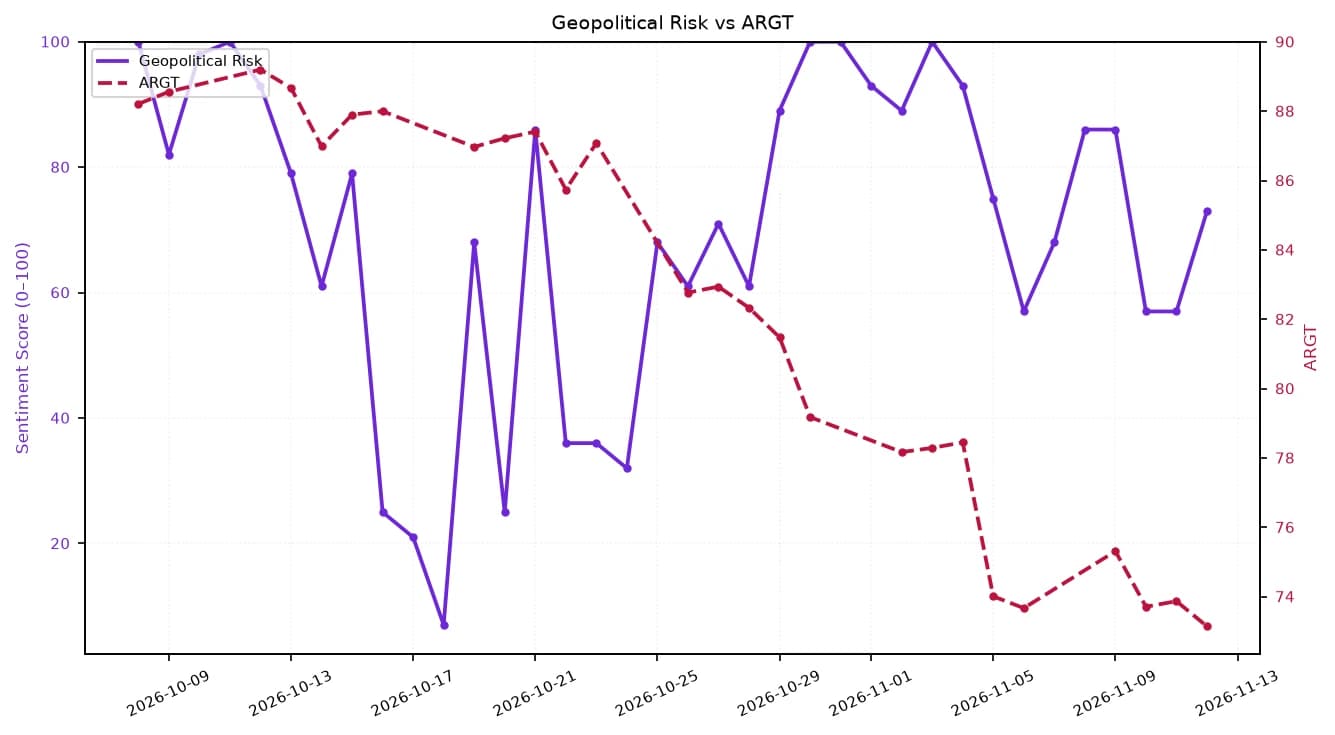
That is why the market should watch Argentina exposure through the lens of political execution, not just macro headlines. The Argentina ETF ARGT has been under pressure, closing at $73.14 on Nov. 12, down sharply from recent highs, with a 50-day moving average of $86.71 and an RSI of 12.2, a deeply oversold reading that suggests sentiment has already soured. The broader iShares MSCI Argentina ETF, EWW, has held up better, but the political story remains the same: upside in Argentine assets depends on the government’s ability to turn power concentration into legislative delivery.
The external backdrop makes the political test even more important. A global environment still defined by dollar strength and geopolitical caution leaves little room for policy slippage in emerging markets. If Milei’s camp can keep its internal rivals in line and preserve reform momentum, Argentina remains one of the more asymmetric turnaround stories in Latin America. If not, the market will quickly price in a slower, messier path — and that would hit equities, bonds and the peso story all at once.
The investable takeaway is straightforward: the real trade is not just on Milei’s ideology, but on whether Karina Milei can convert factional control into governability. For now, that makes the loyalists, the reform enforcers and the Argentina ETF the names to watch — while any sign of deeper fragmentation should be treated as a warning that the rally still lacks institutional support.
| Entity | Gains | Losses |
|---|---|---|
| Karina Milei loyalists | ▲More internal control | ▼Bullrich wing |
| Patricia Bullrich bloc | ▲Visibility in Congress | ▼Exclusive influence |
| Milei administration | ▲Short-term cohesion | ▼Reform negotiating leverage |
| Argentina assets (ARGT/EWW) | ▲Upside if unity holds | ▼Political fragmentation risk |