Argentina’s bid to turn Vaca Muerta into a reliable gas supplier for Brazil is moving from theory to infrastructure, and that is the economically important shift investors should watch.
Argentina Gas to Brazil via Vaca Muerta by 2029
At the region’s biggest energy summit in Rio de Janeiro, officials and industry executives framed a clear pathway for Argentine gas to reach Brazil by 2029, with a target of 10 million cubic meters a day of firm supply if the politics, contracts and pipelines line up. That would be roughly triple the 3 million cubic meters a day Argentina can now move on an interruptible basis through Bolivia, a gap that underscores both the scale of the opportunity and the bottleneck that has held Vaca Muerta back.
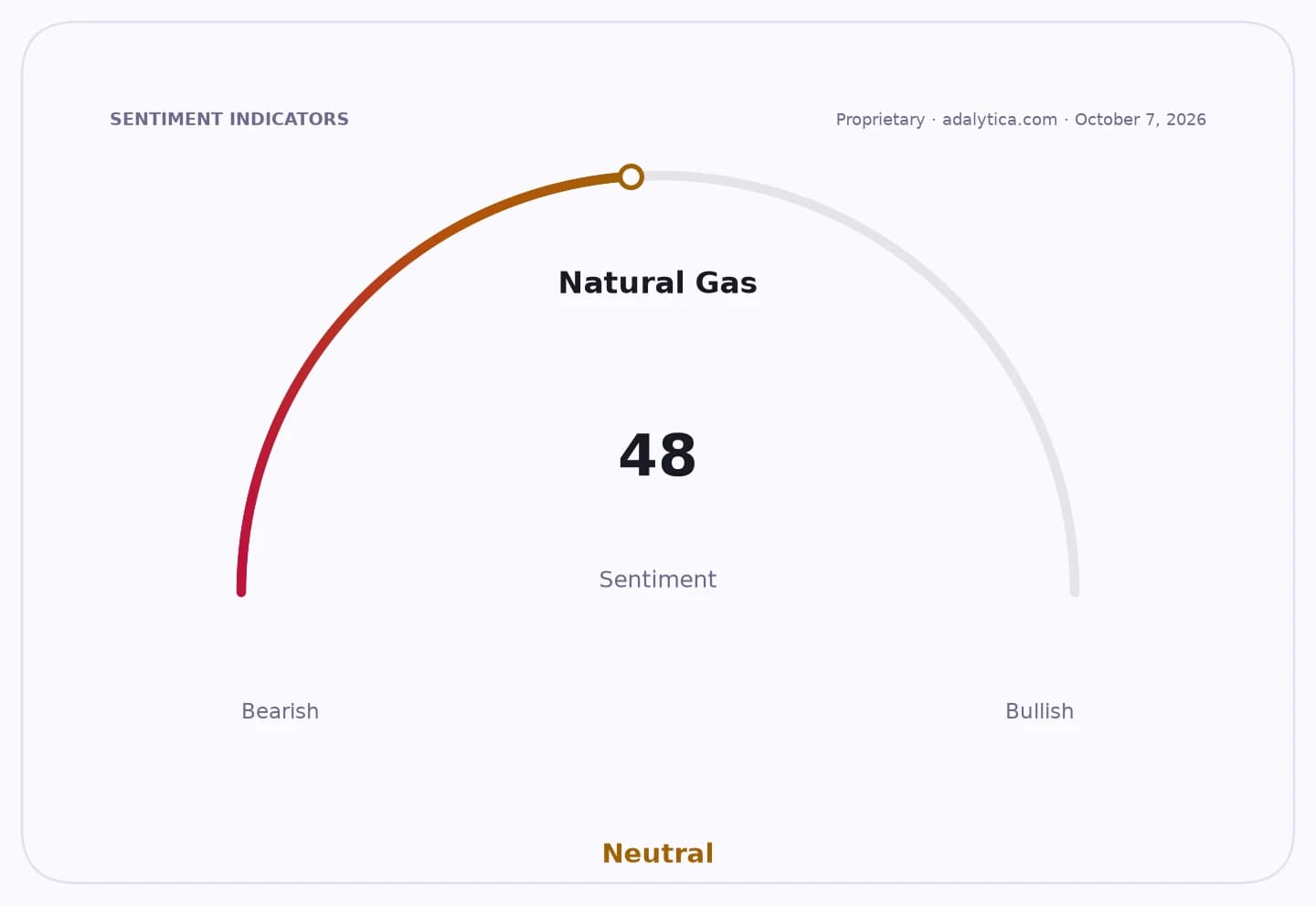
Sentiment IndicatorsⓘProprietary · adalytica.com · October 1, 2026
This is a snapshot — live sentiment, awareness and momentum for 130+ markets update continuously in the dashboard.Open AlphaPulse
The prize is not just more exports. It is a new regional gas trade route that could unlock stranded Argentine production, feed Brazilian industrial demand and create a multi-year capex cycle across pipelines, compression, transport and upstream services. In a world where energy security still drives capital allocation, the corridor from Neuquén to Brazil looks less like a one-off deal and more like an emerging toll road.
The commercial logic is straightforward. Guido Maiulini of the Latin American Energy Organization said Argentina could reach Brazil with competitive gas at around $6.3 per million British thermal units if export taxes are removed and transport costs through Bolivia fall. That compares with recent Argentine border sales of $7 to $8 per MMBtu and a landed price in Brazil near $9 per MMBtu. For Brazilian buyers, gas under $10 per MMBtu can support idle industrial capacity, while prices below $7 per MMBtu are needed to justify gas-intensive new investment, according to the bilateral working group cited in the report.
That is why this matters beyond Argentina’s own balance of payments. Brazil remains the region’s largest gas market, and even modestly cheaper and firmer supply can shift fuel choices in power generation and industry, while reducing reliance on more expensive LNG imports. For Argentina, a sustained export corridor would help monetize one of the world’s biggest shale reserves and strengthen the country’s external accounts at a time when hard currency remains scarce.
The bottleneck is still infrastructure. Argentina produced an average 145 million cubic meters a day of gas in the first half of the year, but winter demand rose to 158 million cubic meters a day, forcing imports of 640 million cubic meters between May and June, according to Paspartú. That imbalance explains why the country can talk about exports and imports in the same breath. It also explains why pipeline capacity, not geology, is the binding constraint.
The bilateral working group estimates the Bolivia route would require about $3.1 billion of investment, mainly to strengthen the Gasoducto Norte and expand the Tratayén-La Carlota system, with TGN saying that project could come online in April 2029. Direct alternatives through Uruguaiana or Paraguay would cost far more, between $3.9 billion and $5.4 billion. None of it pencils out, however, without long-term contracts. The report says at least 10-year supply and transport agreements are needed to finance the buildout, and roughly two years would be required between signing and startup.
That puts the next catalyst squarely on contract certainty, not geology. The pilot shipments already matter: TotalEnergies sent Vaca Muerta gas to Brazil in 2025 through Bolivia, and Petrobras later secured the right to buy up to 2 million cubic meters a day on an interruptible basis. Those flows proved the corridor works. The market now needs the durable version.
For investors, the implication is simple. The biggest beneficiaries are the companies and assets tied to gas transport, midstream expansion, compression and upstream production in Vaca Muerta, while the losers are higher-cost gas suppliers that compete for Brazilian demand. Petrobras and Brazilian industrial users could gain from more affordable supply, while Argentine producers such as YPF stand to gain if pipeline constraints ease and export optionality improves. But the real asymmetric trade is in the infrastructure buildout: once long-dated contracts arrive, the spending starts, and the equity market usually re-rates before the first molecule moves.
I believe the market is still underestimating how quickly Vaca Muerta can become a regional export engine once the financing framework is in place. The headline is not merely that Argentina may sell more gas to Brazil; it is that a new cross-border energy corridor is being priced into reality. If you want exposure to that inflection point, look first at the toll collectors, not just the producers.
| Entity | Gains | Losses |
|---|---|---|
| TGN / pipeline builders | ▲New multi-year capex | ▼Delay without contracts |
| YPF / Vaca Muerta producers | ▲Export optionality | ▼Transport bottlenecks |
| Petrobras / Brazilian industry | ▲Cheaper, firmer supply | ▼Higher-cost LNG imports |
| Bolivia transit route | ▲Transit revenue | ▼Bypassed by direct links |