Argentina’s provinces are emerging as the country’s most active pitch to U.S. investors, with Tucumán’s meeting with Washington’s envoy underscoring how local governments are now driving trade, capital and strategic alignment while Buenos Aires struggles to remain the sole point of contact.
Argentina provinces court U.S. investors
That matters because the new federalism is not just diplomatic theater. It is where export revenue, mining investment, energy projects and supply-chain decisions are increasingly being negotiated. Tucumán sends about 27% of its lemon, blueberry and strawberry output to the U.S., making phytosanitary rules, market access and investment flows directly relevant to provincial income and hard-currency earnings. In other words, this is about jobs, foreign exchange and the durability of Argentina’s recovery, not symbolism.

The visit by U.S. Ambassador Peter Lamelas to Tucumán, where Governor Osvaldo Jaldo discussed cooperation, investment and production, fits a broader pattern. Lamelas has already been touring the north, meeting authorities in Jujuy and Salta, while Argentina Week in Paris drew governors from Mendoza, Neuquén, Río Negro, Salta, San Juan and others to court investors with provincial mineral, energy and infrastructure projects. The message to global capital is that Argentina’s opportunity set is increasingly fragmented by region, but also more legible: each province wants to present its own assets, rules and pipeline.
For investors, that cuts two ways. The bull case is that provincial competition can speed permitting, sharpen policy discipline and create more investable entry points in sectors such as lithium, copper, energy and agriculture. Río Negro’s agreement with American Minerals to study geological potential, and the lithium provinces’ push to strengthen governance and local suppliers, suggest a more pragmatic effort to convert resources into bankable projects. The bear case is that provincial activism could deepen policy inconsistency if national and local priorities diverge, especially in a country where regulatory clarity has often been uneven.

The shift also reflects a larger geopolitical recalibration. Argentina’s debate is moving away from Cold War-era anti-U.S. reflexes and toward a more transactional question: with whom should the country build critical infrastructure, data, energy and technology capacity? That is why Washington’s outreach matters. It is not only about trade in citrus and berries, but about which outside powers gain influence over strategic sectors at a time when Argentina is seeking capital without surrendering control.
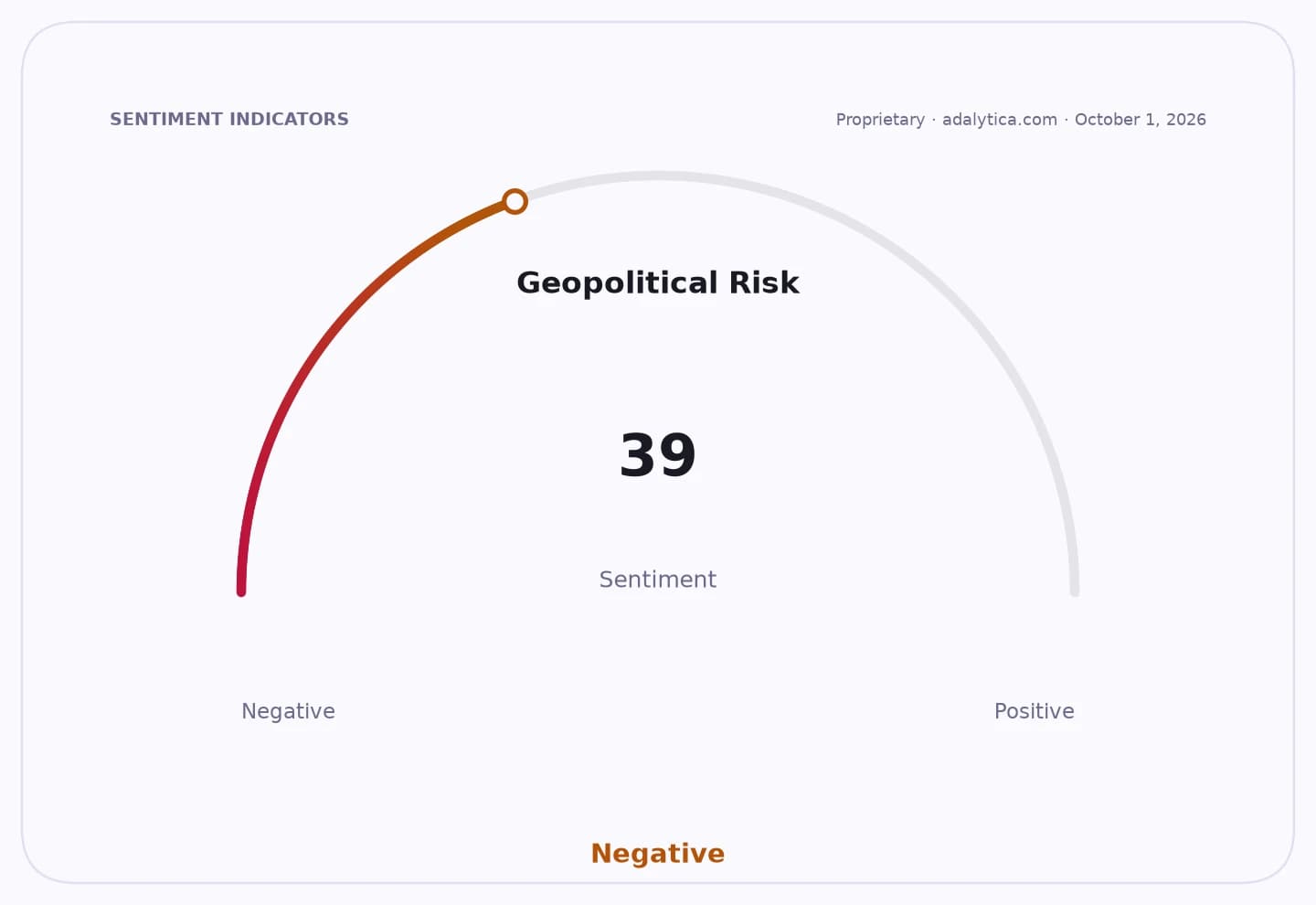
Market-wise, the message is supportive for assets tied to a cleaner external financing story and to export-oriented sectors, but it does not erase macro risk. Argentine equities remain volatile, reflecting policy uncertainty and weak confidence. The Global Stability Sentiment gauge from Adalytica points to extreme greed in geopolitics, but extreme fear in awareness, a combination that often leaves investors prone to abrupt reversals. Recent trading in the Argentina ETF, banks and energy names shows that optimism can lift prices quickly, but only when backed by evidence of investment, export growth and policy continuity.
The investment takeaway is that Argentina’s provinces are becoming the practical unit of reform and external engagement. If that trend holds, it could broaden the country’s appeal to U.S. and global capital beyond Buenos Aires and make export, mining and energy projects easier to finance. If it stalls, the current opening risks becoming another round of provincial marketing with little follow-through. For now, the more important story is that Washington is increasingly dealing with Argentina province by province — and investors will do the same.
| Entity | Gains | Losses |
|---|---|---|
| Argentine provinces | ▲More investor attention | ▼Dependence on Buenos Aires |
| U.S. investors | ▲Direct access to local projects | ▼Policy fragmentation risk |
| Exporters and miners | ▲New market and capital channels | ▼Higher compliance burden |
| Central government | ▲Broader external capital inflows | ▼Loss of gatekeeper role |