Argentina’s long-running Mackentor reparations case is moving toward a payout hearing after a federal appeals panel rejected attempts by the state to stall the process and lawyers for the dispossessed construction company asked President Javier Milei to testify under oath.
Argentina Mackentor reparations case moves to payout hearing
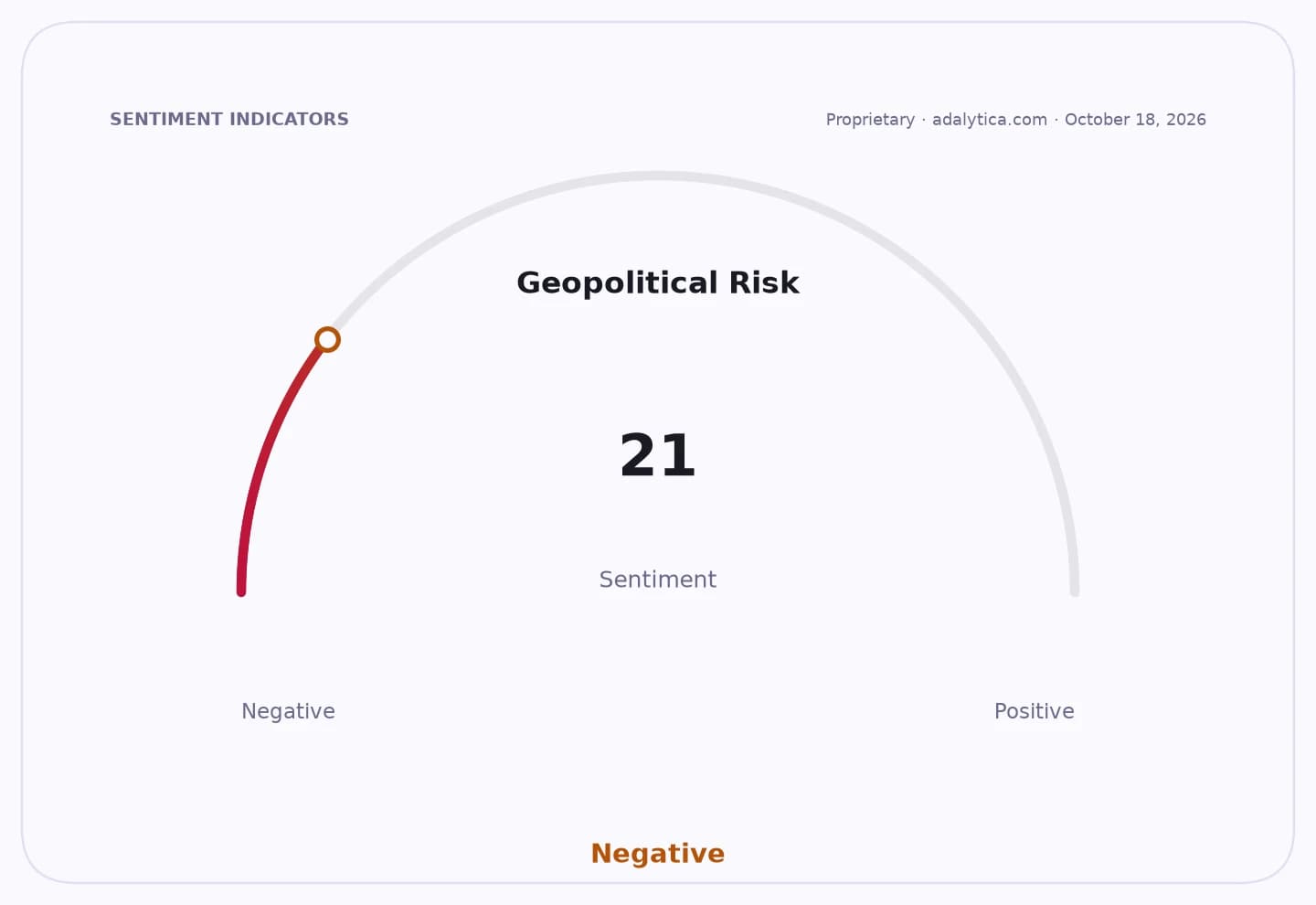
The fight matters because it could force the government to confront not just the financial cost of a potential compensation award, but also the legal and political fallout from a dictatorship-era seizure that Argentina’s human rights court system has now tied to crimes against humanity. For investors, the case adds another layer of sovereign legal risk in a market already sensitive to fiscal slippage, policy volatility and asset seizures linked to past state conduct.
Sentiment IndicatorsⓘProprietary · adalytica.com · October 18, 2026
This is a snapshot — live sentiment, awareness and momentum for 130+ markets update continuously in the dashboard.Open AlphaPulse
The Sala IV of the Federal Court of Cassation on Oct. 8 threw out two state complaints aimed at blocking the compensation procedure, saying they were not final rulings and repeated arguments already decided in the file. The panel also upheld the Córdoba federal oral court’s role in handling the reparations claim, preserving the venue where damages will now be determined.
Lawyers for Mackentor’s heirs and former owner Natalio Kejner’s family then asked the court to take Milei’s “confesional” testimony, a civil-procedure device that would require the president, as head of the defendant state, to answer 18 questions under oath. The filing says the government was notified of the Inter-American Commission on Human Rights’ 2021 report finding Argentina internationally responsible, and of a follow-up ruling ordering full reparation.
Geopolitical Risk vs ARGTadalytica.com
Explore this data interactively — full history, time series and cross-market comparisons.Open AlphaPulse
The request seeks to pin down whether the state has systematically resisted compliance, including through five cassation and complaint filings the lawyers say were brought under Milei’s administration. It also points to the government’s payment of roughly $142 million to Supercemento for work taken from Mackentor during the dictatorship, without an investigation into corruption surrounding the public works contract.
The case dates to 1977, when Army troops occupied Mackentor’s offices in Córdoba and Buenos Aires, paralyzing the company after accusing it of financing guerrillas, an allegation never proven. The seizure led to arrests and disappearances of employees and executives, the cancellation of a major aqueduct contract and the later handover of the project and related assets to Supercemento.
Mackentor was once one of Argentina’s top builders, with about 400 employees and major infrastructure assets across several provinces. Its principal shareholder, Natalio Kejner, spent decades pursuing restitution and died in 2014 before seeing a remedy.
The courts have already moved far toward acknowledging the claim. In July 2025, the Córdoba oral court annulled the 1977 intervention as part of a crime against humanity, and later decisions voided the contract rescission, the re-award to Supercemento and subsequent bankruptcy-related acts. Cassation confirmed that nullity in November 2025 and sent the file back to Córdoba to set compensation.
The lawyers are now also asking for precautionary measures to secure any award, including attachments on state accounts, Ministry of Economy and Treasury funds, and deposits held by Supercemento, as well as on assets tied to Mackentor’s former properties. That raises the prospect of a costly enforcement fight if the court orders a large payout.
For Milei, the case is politically awkward because it places his government in the dock over a dictatorship-era asset grab just as his administration is trying to present itself as a champion of fiscal discipline and institutional order. For the market, the key issue is whether the state’s resistance hardens into a broader legal and fiscal burden.
The next catalyst is the Córdoba court’s response to the testimony request and the compensation phase itself, which could turn a decades-old human-rights case into a fresh sovereign liability.
| Entity | Gains | Losses |
|---|---|---|
| Mackentor heirs | ▲Reparations momentum | ▼Delay tactics fade |
| Argentine state | ▲None | ▼Legal exposure |
| Supercemento | ▲Status quo challenged | ▼Asset clawback risk |
| Investors in Argentina | ▲Rule-of-law clarity | ▼Fiscal/legal uncertainty |