Argentina’s formal private payrolls fell for a 14th straight month in July, underscoring how a weak labor market is still restraining consumption, tax receipts and business confidence even as wages recover unevenly.
Argentina private payrolls fall for 14th straight month

Registered private-sector employment dropped by 12,716 jobs from June, according to the SIPA labor registry, leaving the economy 134,034 jobs short on the year. The decline was broad-based, with industry, construction and retail among the biggest losers, and with 21 of 24 provinces posting annual declines.
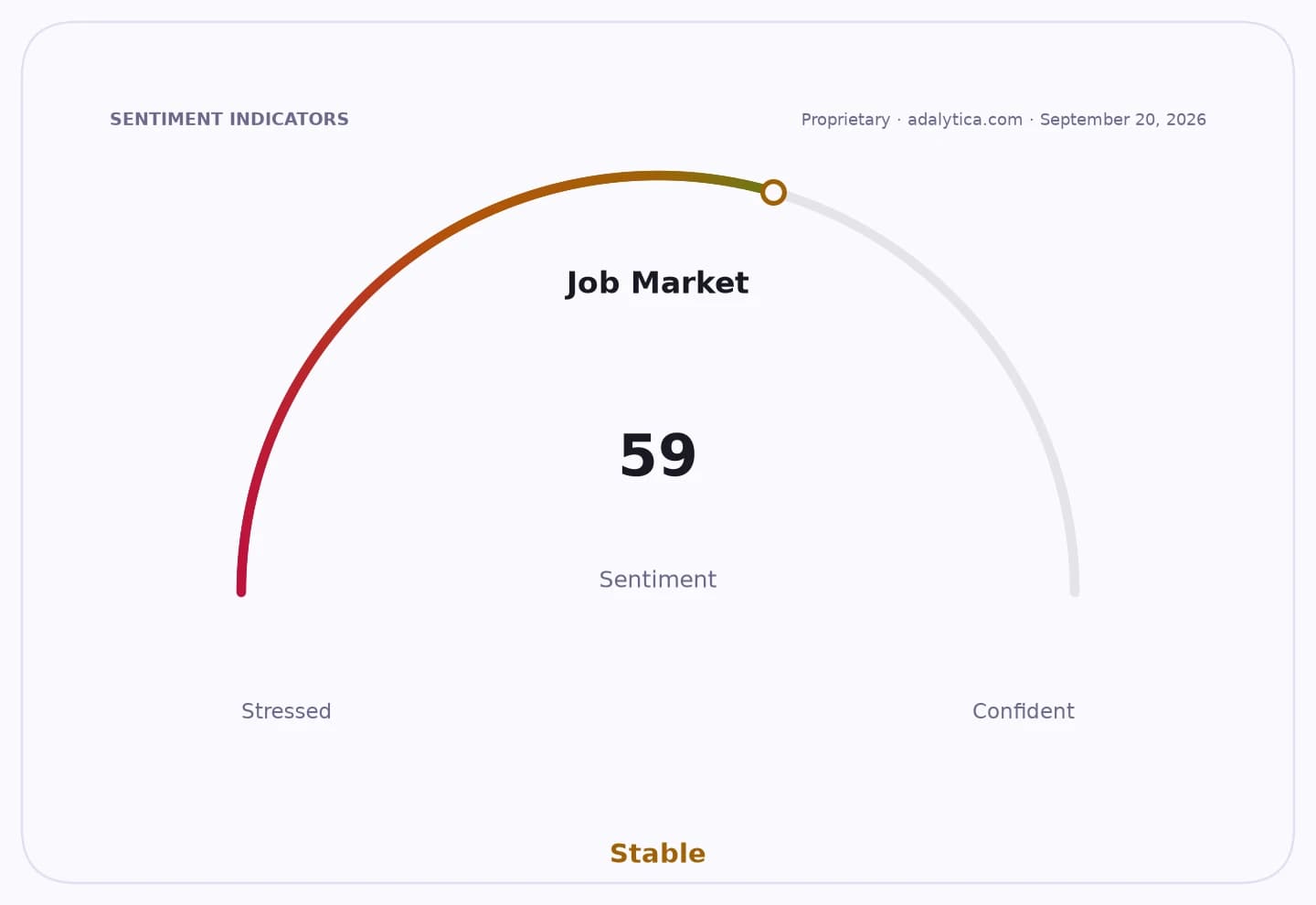
Sentiment IndicatorsⓘProprietary · adalytica.com · October 14, 2026
This is a snapshot — live sentiment, awareness and momentum for 130+ markets update continuously in the dashboard.Open AlphaPulse
The persistence of job cuts matters because formal payrolls are the backbone of household income, social-security contributions and creditworthiness in Argentina. A labor market that keeps shedding salaried workers tends to slow demand for durable goods, services and construction inputs, while adding pressure on companies that already face tighter margins, slower sales and fragile financing conditions.
The report suggests the contraction is not just a cyclical dip but a deeper adjustment in hiring plans. The labor ministry said private formal employment in major urban areas was flat in August for a second month, with the lack of new jobs tied mainly to weak hiring. That points to firms choosing to freeze headcount rather than expand, a sign that confidence remains shaky despite falling inflation.
The losses were concentrated in sectors that are highly sensitive to domestic activity. Construction led monthly declines, followed by financial intermediation, while manufacturing, trade, transport and hotels and restaurants all registered contractions. On a yearly basis, manufacturing employment was down 4.4%, financial services 4.8% and commerce 3.4%, a combination that reflects soft demand, tighter credit and still-high operating uncertainty.
Geography is also telling. Neuquén and Río Negro were among the few provinces to add private jobs, helped by energy and resource activity, while Tierra del Fuego, Misiones, Corrientes, Formosa and Santa Cruz saw some of the sharpest annual drops. That split shows the labor recovery is being driven by a narrow group of industries and regions rather than by a broad-based improvement.
Wages are offering some relief, but not enough to offset the employment slump. Real average pay in the formal private sector rose 1.3% in August from the prior month, and the main collective agreements gained 0.9%. Yet measured against November 2023, the average registered private salary was only 1.2% higher, while pay under key labor contracts remained 6.9% below that benchmark.
For investors, that combination is crucial. Higher real wages can support consumption, but if the recovery is coming with fewer formal jobs, the net effect on spending is limited. It also complicates the outlook for companies in retail, consumer goods, transportation and construction, where volumes depend on payroll growth more than on headline wage gains.
There is also an implication for the policy mix. The government can point to firmer salaries and a smaller inflation burden, but a prolonged drop in private formal employment risks slowing the rebound in tax revenue and widening political pressure around growth and living standards. For markets, the key question is whether easier price dynamics eventually translate into hiring or whether businesses keep using labor costs as the adjustment variable.
The balance of evidence still favors caution. The formal labor market is stabilizing in places, but it is not yet creating enough jobs to reverse the damage of the past 14 months. Unless domestic demand strengthens and credit conditions improve, the employment picture is likely to remain a drag on growth into the next quarter.
| Entity | Gains | Losses |
|---|---|---|
| Argentina government | ▲Lower inflation optics | ▼Payroll-tax revenue |
| Workers with jobs | ▲Real wage rebound | ▼Employment security |
| Employers | ▲Lower labor costs | ▼Domestic demand |
| Provinces tied to energy | ▲Job gains | ▼Labor-rich regions |