Former Argentine economy minister Hernán Lacunza is warning that Javier Milei’s push to alter the voting system is not just institutional tinkering — it is a sign the government is bracing for a weaker economy, softer public support and a harder road to 2027.
Argentina Reform Trade Faces Political Risk
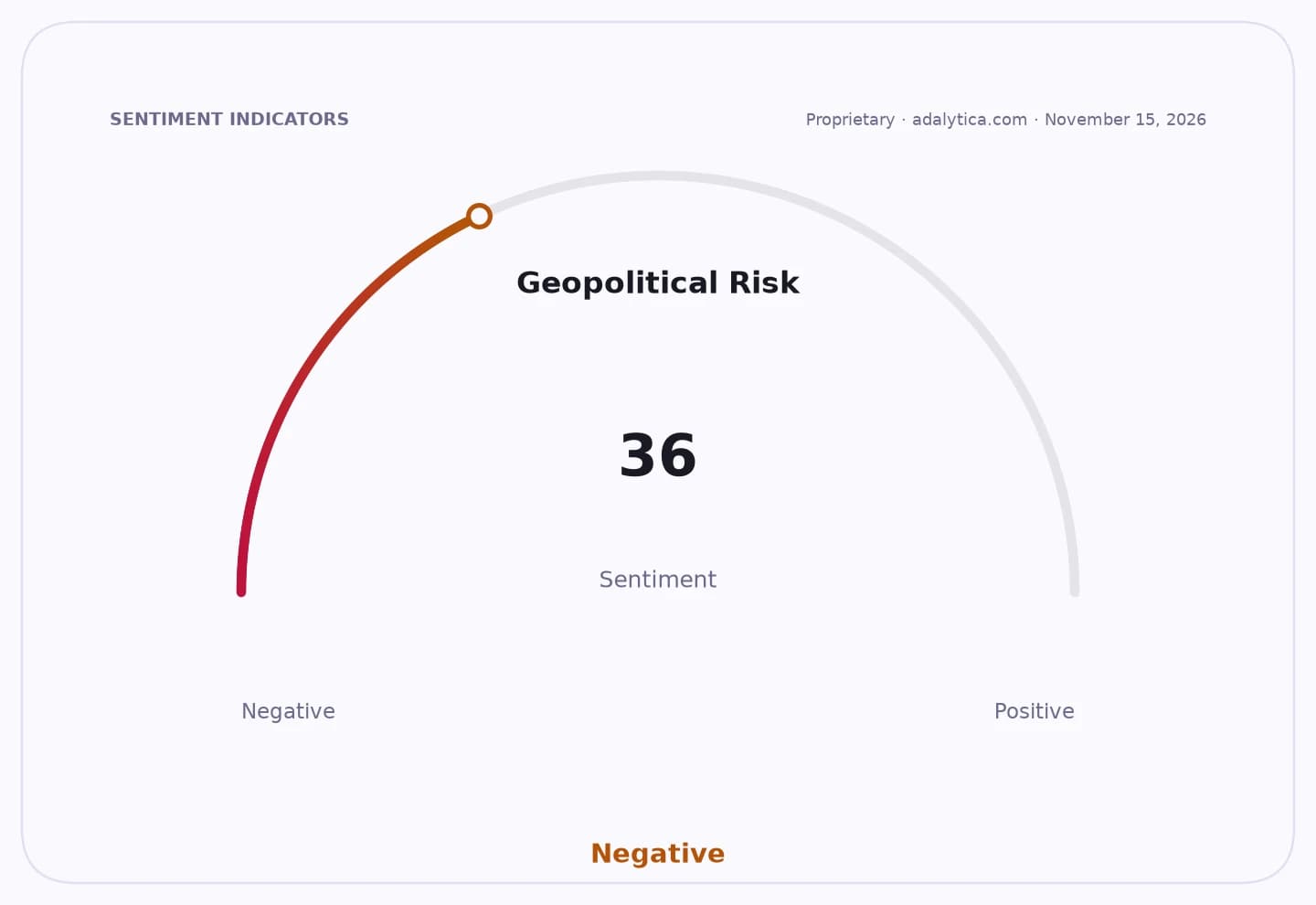
Geopolitical Risk
That matters because Argentina’s investment case still rests on a narrow balance: fiscal discipline and monetary restraint have helped avoid the kind of collapse Lacunza says he is not expecting, but they have not yet delivered the growth, wages or consumption rebound that would make the adjustment politically durable. In other words, the market can tolerate austerity only if it eventually produces credibility and recovery. If it does not, the reform story gets much harder to sustain.
Sentiment Indicators
Lacunza’s critique lands at a sensitive moment for investors tracking Argentina’s turnaround trade. He said the government is considering changes to the electoral system because “social patience is not going to be enough,” a remark that ties political engineering directly to economic stagnation. He also said the administration’s approval rating has slipped from around 50% after the midterm election to “thirty-something,” underscoring the risk that policy fatigue could deepen before the economy improves.
The macro backdrop explains why markets should care. Lacunza said he does not see a hyperinflation, bank run or sovereign default next year, acknowledging that Milei has preserved fiscal and monetary order. But he still sees inflation running around 30%, with a range of 25% to 40%, and says there will be no meaningful improvement in employment, real wages, consumption or investment if the government keeps doing “more of the same.” That is the key investment problem: stabilization alone is not the same as recovery.
Geopolitical Risk
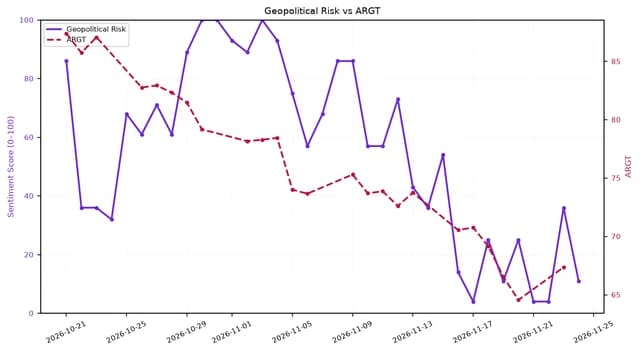
For asset prices, the signal is more immediate. Lacunza pointed to Argentina’s country risk premium rising from about 400 basis points to 850, a sharp reminder that bond investors are demanding a bigger cushion for political and policy uncertainty. The ARGT Argentina ETF reflects that stress: it closed at 67.36 on Nov. 23 after falling to 64.56 the prior session, and remains well below its 50-day moving average of 82.9 and 200-day average of 89.93. Its RSI reading of 26.4 shows the fund is still in deeply oversold territory, but oversold can stay that way when the macro narrative is deteriorating.
That creates a split-screen for investors. If Milei’s program preserves fiscal balance and keeps inflation from reigniting, Argentina remains a high-beta turnaround trade with substantial upside. But if political support keeps eroding while growth stays flat, the market will keep discounting reform durability, keeping pressure on local assets and any external financing story. The country is still priced for a recovery that has not yet arrived.
Lacunza’s rejection of a 2027 alliance between the PRO and La Libertad Avanza only sharpens the political risk. He argued that such a pact would be bad for both his party and the country, saying the PRO would “disappear” if it joined Milei. That matters because investors are not just betting on policies; they are betting on the coalition that can actually carry those policies through the next election cycle. Without a broader, durable governing bloc, Argentina’s reform premium remains fragile.
| Entity | Gains | Losses |
|---|---|---|
| Milei government | ▲More room to control agenda | ▼Approval and reform credibility |
| ARGT / Argentina bulls | ▲Tactical rebound if stabilization holds | ▼If growth and politics worsen |
| Bondholders | ▲Higher yields for risk taking | ▼Mark-to-market volatility |
| PRO opposition | ▲Distance from Milei's erosion | ▼Coalition relevance if it merges with LLA |