Armenia is pushing the European Union to redesign its Eastern Partnership around a South Caucasus that is no longer defined by the old assumptions of 2009, a change that could reshape how Europe engages the region for years to come.
Armenia pushes EU to reshape Eastern Partnership
That is the real economic and political message in Foreign Minister Ararat Mirzoyan’s remarks in Warsaw: the bloc’s flagship neighborhood policy must become more flexible if it is to stay relevant. For investors, that matters because the South Caucasus sits at the crossroads of trade, energy and transport routes linking Europe and Asia, and any durable easing of regional risk can improve the investment case for infrastructure, logistics, energy and cross-border business.
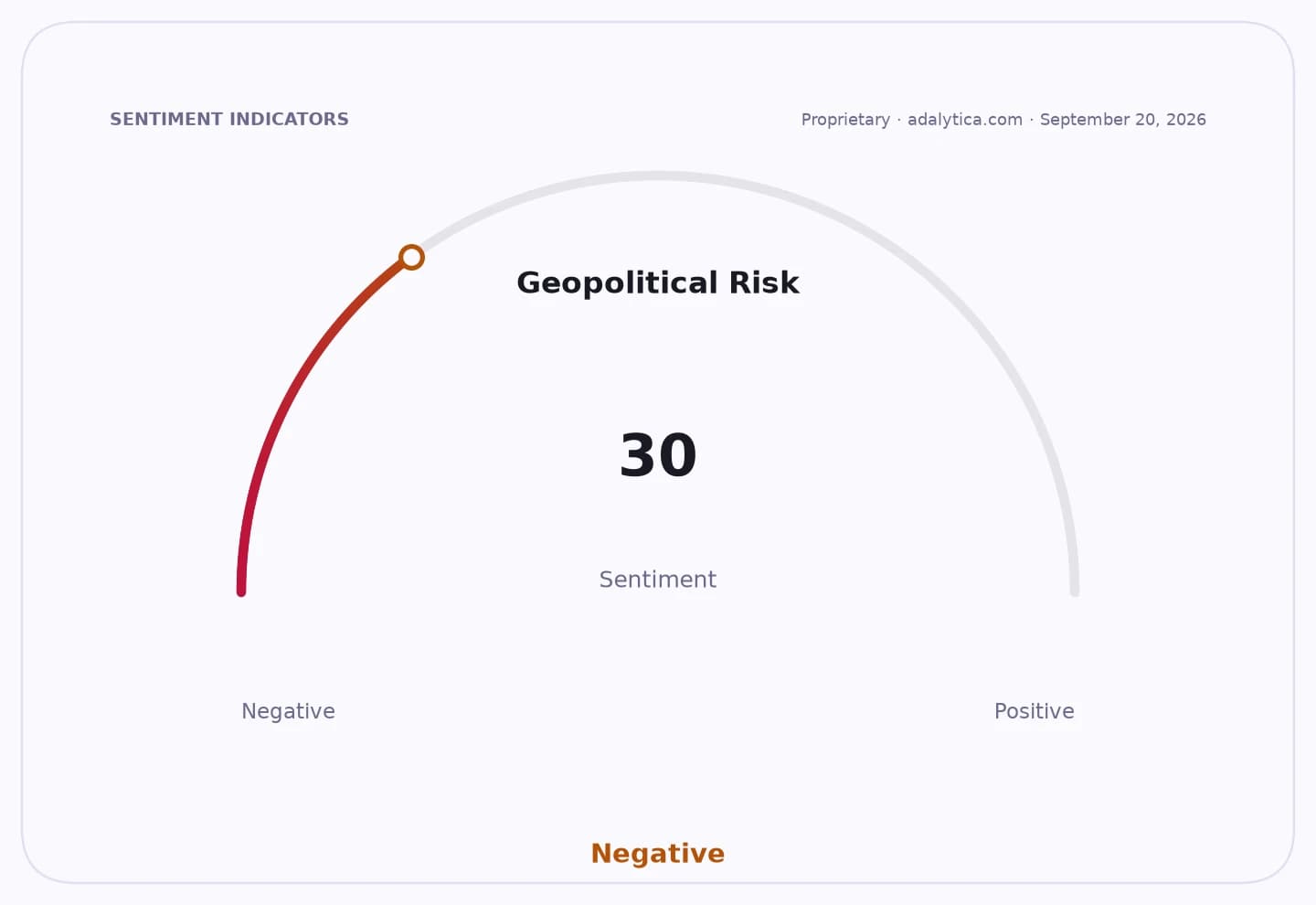
Sentiment IndicatorsⓘProprietary · adalytica.com · October 14, 2026
This is a snapshot — live sentiment, awareness and momentum for 130+ markets update continuously in the dashboard.Open AlphaPulse
Mirzoyan argued that the six Eastern Partnership countries have moved onto very different political paths, making a one-size-fits-all framework less useful. Armenia, in particular, is trying to lock in a more tailored relationship with Brussels. He pointed to a new Armenia-EU strategic agenda adopted in December 2025, an EU membership-start law passed in March 2025 and the first Armenia-EU summit in May 2026 as evidence that Yerevan is moving closer to Europe on its own terms.
That individualized approach has real economic consequences. Armenia is already benefiting from the EU monitoring mission on its border with Azerbaijan, which has helped stabilize a front line that has long discouraged capital and complicated trade. A new EU partnership mission is also meant to strengthen defenses against disinformation, hybrid threats and cyber risks. In practical terms, that lowers some of the nonfinancial friction that can deter foreign direct investment, raise insurance costs and slow supply-chain decisions.
The bigger shift, though, is regional. Mirzoyan linked the future of the Eastern Partnership to the August 2025 Washington peace summit and to the TRIPP initiative, which is meant to unlock the South Caucasus’ transit, energy and economic potential. In plain English, that is about turning a historically volatile corridor into a more reliable bridge between Europe and Asia. If that happens, exporters, shippers, energy companies and investors in transport infrastructure stand to gain from shorter, safer and more predictable routes.
For Europe, the prize is diversification. For Armenia, it is strategic relevance. For investors, the attraction is that a more connected South Caucasus could become a long-cycle play on logistics, energy interdependence and regional normalization rather than a purely geopolitical trade. The risk, of course, is that this remains aspirational unless political commitments are matched by hard security guarantees and sustained implementation.
Still, the direction is clear: the Eastern Partnership is being recast less as a uniform neighborhood policy and more as a flexible platform for countries with different ambitions. That is the kind of policy evolution that can take years to matter, but when it does, it can change the investment map of an entire region. Worth watching for long-term exposure to the South Caucasus and Europe’s wider connectivity theme.
| Entity | Gains | Losses |
|---|---|---|
| Armenia | ▲Tailored EU ties, connectivity gains | ▼Old one-size-fits-all model |
| EU | ▲More flexible neighborhood policy | ▼Rigid Eastern Partnership framework |
| South Caucasus transit projects | ▲Lower geopolitical risk | ▼Fragmented regional routes |
| Existing regional spoilers | ▲Harder to block integration | ▼Influence over corridor politics |