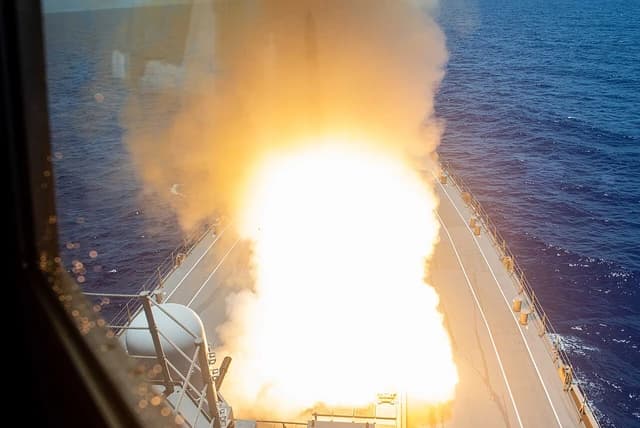
China’s latest missile test is a reminder that Asia is moving into a more heavily militarised era, and investors are beginning to price in what that means for defence spending, procurement cycles and regional security planning.
Asia militarization supports long-term defense demand
That matters because military deterrence is no longer a background assumption in the Indo-Pacific. It is becoming a budget line. Governments from Australia to Japan and South Korea are being pushed to spend more on missiles, air defence, surveillance, munitions and shipbuilding as the regional balance of power shifts. For long-term investors, that kind of strategic change tends to outlast headlines — and it can support years of demand for the contractors that build the hardware.
Sentiment Indicators
The market is already reflecting that shift. Lockheed Martin, Northrop Grumman and RTX have all been trading near elevated levels, helped by the idea that defence outlays will remain structurally higher even if one conflict cools. RTX closed most recently at $195.93, up from $150.03 less than a year earlier, while Northrop Grumman ended at $539.63 after climbing above $760 earlier in the year. Lockheed Martin, meanwhile, has swung lower recently but still sits far above where it traded in October, underscoring how investors have rewarded the sector for its central role in rearmament cycles.
This is where the economics become important. A more militarised Asia means allied governments are likely to keep replenishing inventories, hardening bases and expanding missile-defence networks. That supports a multi-year pipeline for prime contractors and their suppliers, especially in areas where production capacity is already tight. It also raises the odds of sustained public spending even if growth slows elsewhere, since defence is increasingly being treated as national insurance rather than discretionary expenditure.
Global Stability Sentiment vs LMTadalytica.com
Explore this data interactively — full history, time series and cross-market comparisons.

Lockheed Martin is especially exposed to that theme. Its own filing points to a large U.S. weapons-modernisation push, including missile defence, shipbuilding and additional F-35 purchases. Northrop Grumman and RTX also stand to benefit from the same strategic backdrop, whether through air and missile defence, space systems or advanced sensing. In technical terms, RTX has pushed back above both its 50-day and 200-day moving averages, while Northrop’s recovery from a spring selloff suggests investors are again leaning into the defence trade after a sharp reset.
For investors, the key question is not whether the next missile test moves the market for a day. It is whether Asia’s security environment is forcing a permanent re-rating of defence demand. The answer increasingly looks like yes. Australia, in particular, will have to live with higher defence budgets, greater reliance on long-range strike and more pressure to integrate with U.S. and allied supply chains. That does not just matter for policymakers. It shapes revenue visibility for the contractors that will fill those orders.
There are risks, of course. Defence shares can become extended, and governments can always delay procurement. But the larger story is durable: a region once defined by trade is becoming one defined by deterrence as well. For patient investors, that makes the sector worth watching, and in many cases worth holding for the long term.
| Entity | Gains | Losses |
|---|---|---|
| Defence contractors | ▲Bigger order books | ▼Procurement delays |
| Australia and allies | ▲Stronger deterrence | ▼Higher defence budgets |
| China | ▲Strategic leverage | ▼Greater regional mistrust |
| Long-term investors | ▲Multi-year revenue tailwinds | ▼Short-term valuation risk |