Asian stock markets fell broadly on Thursday, with Japan, China, Hong Kong and South Korea all opening weaker as investors took a more cautious stance after a recent run of gains.
Asia stocks fall as investors turn cautious
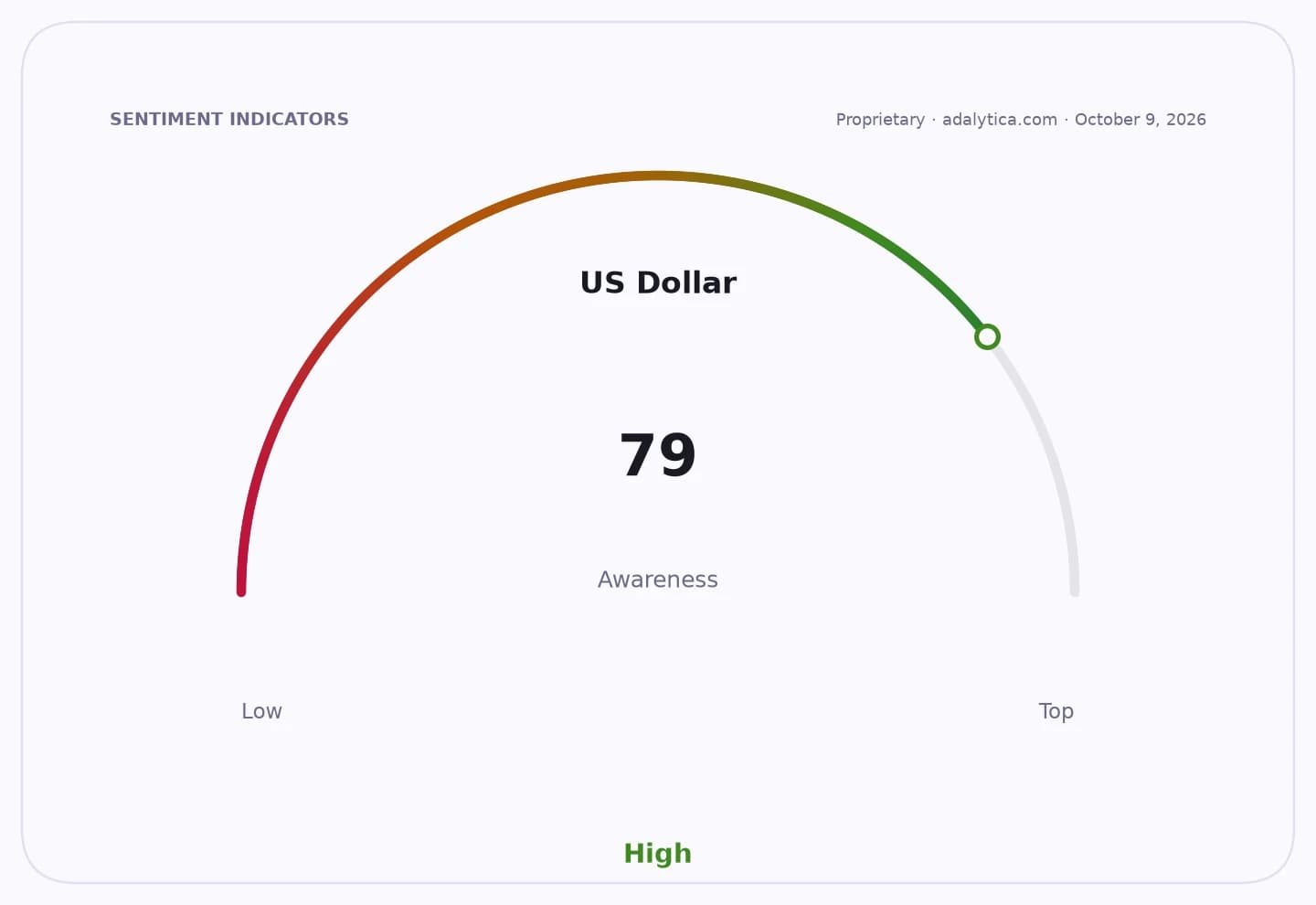
That matters because Asia is often the first major region to show whether global risk appetite is holding up. When the region turns lower together, it usually reflects a mix of worries about growth, rates and positioning rather than a single local catalyst.
Sentiment IndicatorsⓘProprietary · adalytica.com · October 9, 2026
This is a snapshot — live sentiment, awareness and momentum for 130+ markets update continuously in the dashboard.Open AlphaPulse
In China, Shanghai and Shenzhen slipped after returning from a holiday shutdown, with the Shanghai Composite down 0.2% and Shenzhen off 1.0%. Hong Kong’s Hang Seng fell 0.3%. Japan was weaker too, with the Nikkei 225 down 1.0% and the broader Topix losing 1.5%. South Korea’s Kospi dropped 0.7% even after Samsung Electronics reported preliminary operating profit at a record level, a reminder that strong company earnings are not enough to offset a softer market backdrop.
For investors, the move is less about one bad session and more about what it says about breadth. When even a heavyweight like Samsung cannot lift sentiment, it suggests the market is still trading macro first and fundamentals second. That tends to favor patient investors with a long horizon, because broad weakness can create better entry points in high-quality franchises, especially in technology, exporters and Asia-focused ETFs.
The U.S. backdrop is also relevant. The 10-year Treasury yield has been hovering a little above 5%, keeping pressure on equity valuations worldwide, while technical readings on U.S.-listed Asia funds such as EWJ, FXI and EWH show the recent pullback has not broken the longer-term uptrend. EWJ remains above its 200-day moving average, while FXI and EWH are still trying to stabilize after weaker stretches.
From a long-term perspective, this looks more like a pause in a still-constructive regional cycle than the start of something deeper. If inflation cools and global rates ease, Asian equities could regain support quickly, especially in markets tied to electronics, trade and China demand. For now, the message for investors is simple: don’t confuse short-term weakness with long-term deterioration. This kind of broad decline is worth watching, but for disciplined investors it may also be worth using to build positions gradually.
| Entity | Gains | Losses |
|---|---|---|
| Long-term buyers | ▲Better entry points | ▼Near-term volatility |
| Exporters | ▲Potentially cheaper valuations | ▼Softer risk appetite |
| Defensive holders | ▲Relative safety | ▼Missed rebound upside |
| Short-term traders | ▲Trading opportunities | ▼Momentum longs |