ASML’s latest results and guidance suggest the AI chip buildout is still far from over, and that’s why long-term investors may want to keep this Dutch monopoly firmly on the watchlist.
ASML reports Q3 results and keeps 2026 outlook
The company reported €11.7 billion in third-quarter sales and €5.0 billion in net income, while reiterating a 2026 revenue outlook of €44 billion to €45 billion and gross margins around 56%. For investors, that is the key story: the AI infrastructure cycle is still translating into real demand for the most critical tools in advanced chipmaking, and ASML remains the gatekeeper.
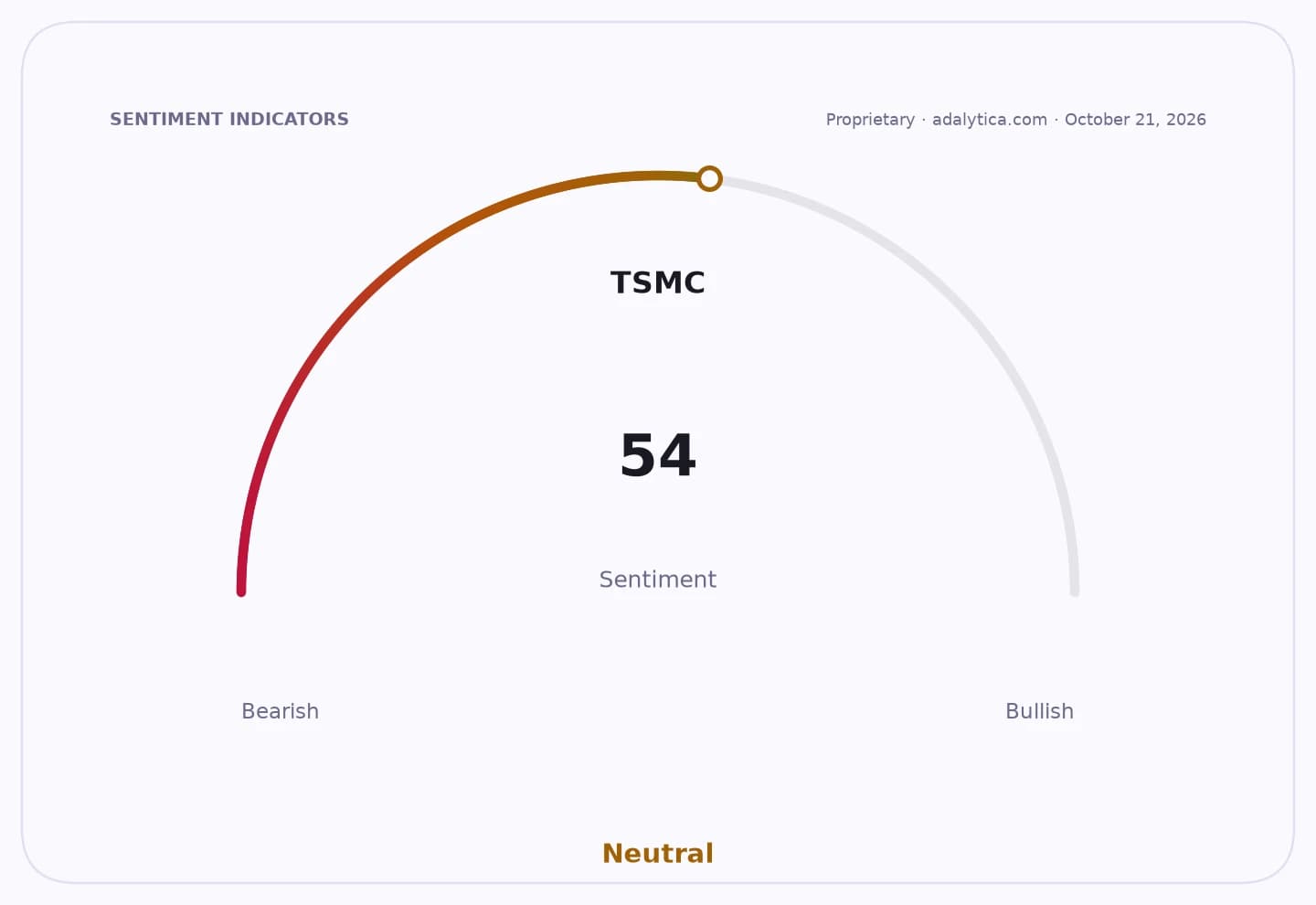
Sentiment IndicatorsⓘProprietary · adalytica.com · October 21, 2026
This is a snapshot — live sentiment, awareness and momentum for 130+ markets update continuously in the dashboard.Open AlphaPulse
This matters because ASML does not just sell equipment; it sells the lithography systems that make modern leading-edge semiconductors possible. As AI spending keeps flowing into data centers, accelerators, memory, and advanced packaging, chipmakers need more capacity, more precision and more process technology. That puts ASML at the center of one of the most durable capital-spending waves in technology.
The stock has been volatile, but the business backdrop is still constructive. ASML’s shares closed at 1,676.69 on Oct. 21, well below the recent highs near 1,986.87 in late June, and below the 50-day moving average of 1,733.25. Technical readings also show the shares have cooled sharply from overbought levels, with an RSI of 33.0 and a negative MACD. For long-term investors, that kind of pullback can matter more than the daily tape if the earnings engine keeps widening.
The broader semiconductor chain tells the same story. Nvidia remains a central beneficiary of AI demand, while Taiwan Semiconductor continues to anchor foundry spending. South Korea is also leaning harder into chip equipment investment, underscoring how global the race has become. In other words, the AI capex party is not a single-company narrative; it is an ecosystem spending cycle, and ASML sits near the top of the value chain.
Of course, investors should still respect the risks. Semiconductor demand can swing, export controls can complicate supply chains, and a slowdown in hyperscaler spending would hit the whole group. But ASML’s moat is unusually hard to challenge. Few companies in the world can match its technological lead, pricing power and installed base, which is why earnings tend to compound through cycles rather than depend on them.
For patient investors, that combination is powerful. If the AI buildout keeps running for years, not quarters, ASML is the kind of infrastructure stock that can reward buying during weakness and holding through volatility. It is still worth watching closely, and for long-term portfolios, it remains one of the most compelling ways to play the semiconductor supercycle.
| Entity | Gains | Losses |
|---|---|---|
| ASML | ▲Higher EUV/AI demand | ▼Short-term stock volatility |
| AI chipmakers | ▲Access to advanced tools | ▼Higher capex burden |
| Foundries like TSMC | ▲More leading-edge capacity | ▼Margin pressure from spending |
| Short-term traders | ▲Opportunity from swings | ▼Risk of missing long-term compounding |