Australia and its Pacific partners are turning China’s latest missile test into another reminder that geopolitics is now a market variable, with the immediate investment question less about headlines than about where defense, infrastructure and resource capital gets redirected next.
Australia ETFs Rise as China Tensions Grow

The sharp public criticism from Australian Prime Minister Anthony Albanese and Palau President Surangel Whipps Jr. underscores how Beijing’s military signalling is hardening regional risk perceptions just as investors are already pricing a more fragmented Asia-Pacific. That matters economically because higher security tension tends to support defense spending, harden supply-chain redundancy plans and reinforce the case for countries to spend more on ports, undersea cables, surveillance and energy resilience.
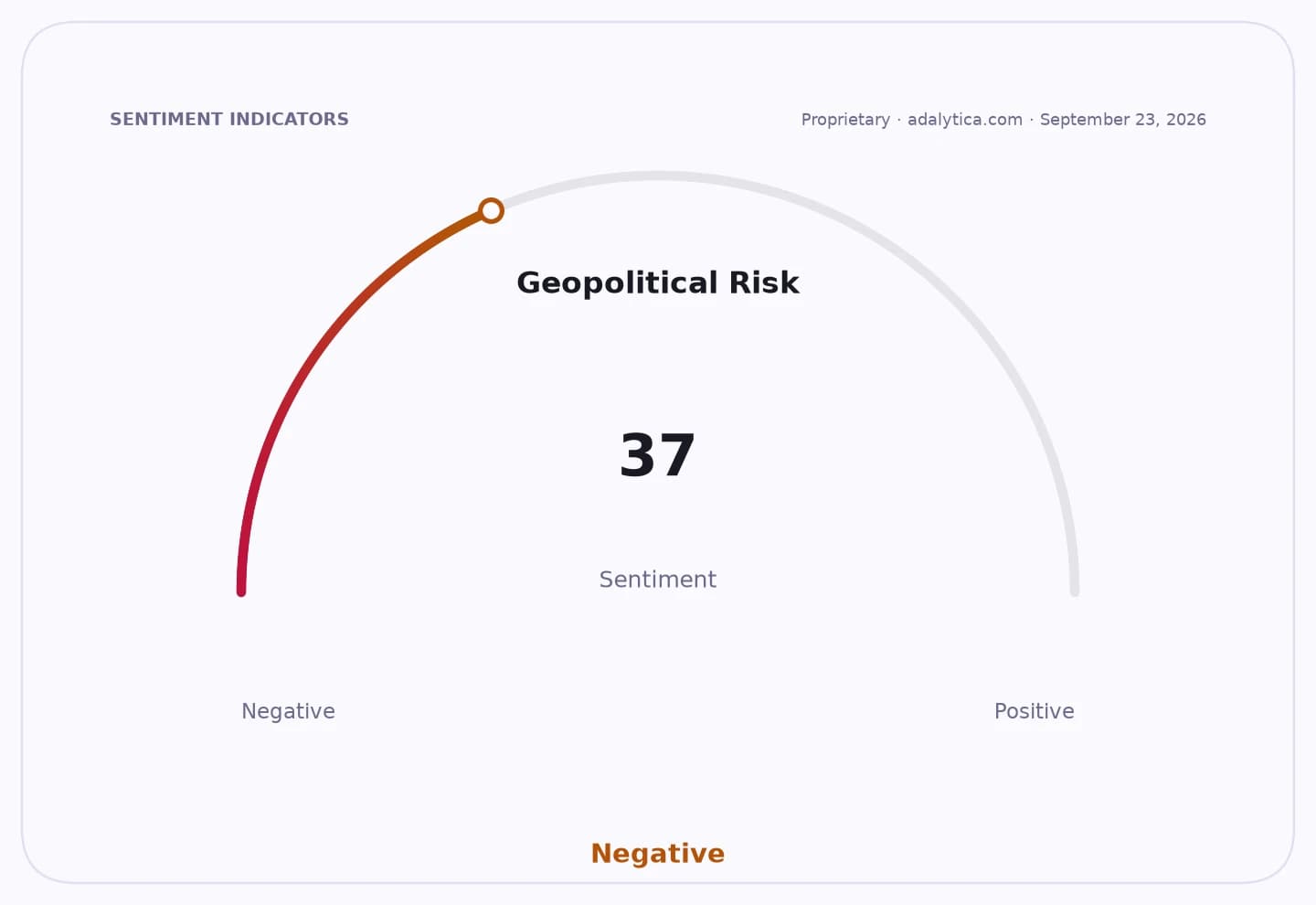
Sentiment IndicatorsⓘProprietary · adalytica.com · September 3, 2026
This is a snapshot — live sentiment, awareness and momentum for 130+ markets update continuously in the dashboard.Open AlphaPulse
The market backdrop reflects that tension. Australia-focused ETF EWA has climbed to 30.37, above its 50-day and 200-day moving averages, while RSI readings have recovered to 61.8, suggesting momentum has improved even after a volatile stretch. That is not a direct trade on the missile test, but it fits the broader pattern: investors are gradually rewarding exposure to resource-rich, strategically aligned economies that can benefit from reindustrialization, allied capex and commodity demand tied to security-driven spending.
The bigger winner, in our view, is not the headline itself but the second-order trade. Australia sits at the intersection of defense, critical minerals and Indo-Pacific logistics. Any escalation in regional pressure strengthens the investment case for companies tied to uranium, copper, iron ore, rare earths and infrastructure that supports military and commercial supply chains. BHP, for example, remains near 92.71 after a huge run this year, keeping it in view as a levered play on strategic materials even as its momentum cools from earlier highs.
FXI, by contrast, has lagged at 35.34 and remains below its 200-day moving average, a sign that capital is still demanding a discount for China exposure as geopolitical risk persists. That divergence is exactly where the opportunity lies: the market is paying for resilience and penalizing strategic overhangs, and that gap can widen quickly if tensions intensify or if allied governments respond with more defense and industrial policy spending.
Adalytica’s Global Stability Sentiment remains neutral at 44, but the 7-day and 30-day declines show how quickly risk appetite can deteriorate when military friction reappears. For investors, the message is clear: don’t trade only the news cycle. Position for the capex cycle that follows it. That means favoring Australia-linked beneficiaries, critical materials, and defense-adjacent infrastructure while staying selective on China-facing assets until geopolitical premium compresses.
| Entity | Gains | Losses |
|---|---|---|
| Australia defense and infrastructure names | ▲Higher spending tailwind | ▼None |
| Critical minerals producers | ▲Strategic demand premium | ▼China-sensitive discount eases |
| China-linked equities | ▲Short-term volatility traders | ▼Geopolitical risk premium |
| Regional importers | ▲Supply-chain diversification | ▼Higher security costs |